

 This week I and the Bird is having its belated four anniversary celebration. Go visit I and the Bird #106 to read Corey's presentation.

 Posts
All Comments
Posts
All Comments
This week I and the Bird is having its belated four anniversary celebration. Go visit I and the Bird #106 to read Corey's presentation.
This katydid was on a parked car in Wildwood Crest, New Jersey. After keying it out as best I could with this guide (and photos on BugGuide), I think it is an anglewing katydid, in the genus Microcentrum. In New Jersey, it could be either a Great Anglewing Katydid or a Lesser Anglewing Katydid. This one appears to be a nymph because the wings are not fully grown. Despite being a nymph, this individual was not small, with its body (not including legs or antennae) being a little under two inches long.
 From what I have read, one can distinguish the two species by the color of an individual's stridulatory field, but I am not sure if that is reliable for a nymph.
A study of Eastern Bluebirds has found that in addition to the normal wear and tear on their feathers, they have to cope with feather-eating bacteria.
Feather-degrading bacteria work by hydrolysing the protein beta-keratin, which constitutes over 90% of a feather's mass.Birds are not entirely defenseless against these parasites:
But these bugs are usually found in a minority of birds sampled, and it has not been clear what impact they have on their hosts.
So Gunderson and colleagues Mark Forsyth and John Swaddle of the College of William and Mary in Williamsburg, Virginia, US surveyed a population of Eastern bluebirds (Sialia sialis) living in Virginia.
They found that 99% of all the birds surveyed carried feather-eating bugs, they report in the Journal of Avian Biology.
What's more, they found a correlation between the bacteria and the brightness of female birds' feathers, with more bacteria causing duller feathers.
"If bacteria detrimentally influence feather colouration, they may place selective pressure on birds to evolve defences against them," says Gunderson.I find this result very intriguing. The article focuses on sex differences: females suffer worse effects from the bacteria than males. I am also interested in the contrast between the infection rates found in this study compared to those in previous studies. Are bluebirds in general more susceptible to the bacteria than other bird species? Or does the bacteria spread more easily in Williamsburg than in other places?
"There is evidence that certain avian traits are defences against feather-degrading bacteria. For instance, we know that feathers coloured by melanin pigments are resistant to bacterial degradation, and that the preen oil that birds apply to their plumage inhibits the growth of some feather-degrading bacteria."
"In general, an understanding of the influence of feather-degrading bacteria on birds could, to some degree, help explain the evolution of these and other avian traits," he says.
These are a few insects that I saw in Beaver Swamp WMA in Cape May County this weekend. First off is a dragonfly, a Slaty Skimmer. It was very cooperative as I maneuvered my camera into position to take the photo. I think this is one of the better dragonfly photos I have taken since I got this camera.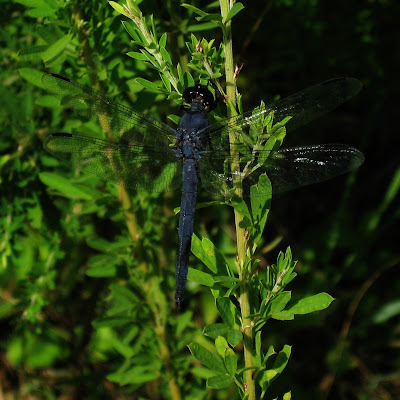 Next, I have some butterfly photos. With some exceptions, skippers are almost always difficult to identify as they are tiny and their field marks may not be visible at all angles. I believe that the following two photos are of Broad-winged Skippers, but I am happy to hear other opinions. There were a lot of these flying among the plants at the edge of the swamp. These two were the most cooperative.
 Finally, I have one more butterfly, which I think is a Horace's Duskywing. Like the grass skippers, duskywings can also be difficult as their identification requires careful study of subtle patterns. This one seems to have had a close encounter with a kingbird.
 There were many other insects patrolling the dam trail at Beaver Swamp. Other butterflies included a Monarch and a Silver-spotted Skipper, the latter of which I made several unsuccessful attempts to photograph. In the end, though, I was satisfied with the photos I got.


