Sunday, July 29, 2012

Book Note: The Young Birder's Guide to Birds of North America

Birder and writer Bill Thompson III has produced a new paperback edition of The Young Birder's Guide to Birds of North America. This book builds on his 2008 book, The Young Birder's Guide to Birds of Eastern North America, which I reviewed at the time. These guides are aimed to engage young birders and help them learn the most common bird species before using a standard guide that might overwhelm them with information. The species accounts are less condensed than a standard field guide and focus on how to find and identify each species, along with unusual facts about their natural history. The new edition follows the same format as the 2008 edition, but it adds 100 western species to broaden the book's appeal.

Saturday, July 28, 2012

Mothing for National Moth Week

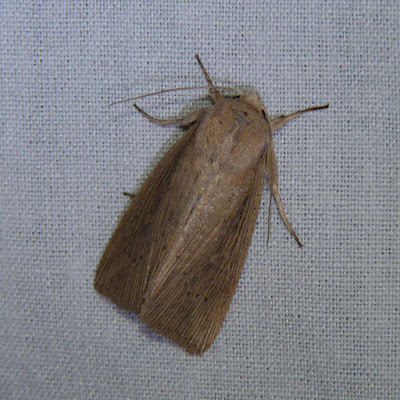
On Wednesday I put out my black light in the backyard for a few hours to attract moths for National Moth Week. I am still in the process of identifying them, which is still a slow process even with the new Peterson guide. In the meantime, here are a few of the macromoths. The one above is one of two Yellow-striped Armyworms (Spodoptera ornithogalli) that came to the light. Instead of landing on the sheet, this one perched on a lattice fence nearby.

This is a Large Wainscot (Rhizedra lutosa), a member of the family Noctuidae. Large Wainscots were introduced to North America (first recorded in 1988) and feed on Phragmites australis.

This is another noctuid called The White-Speck or Armyworm (Mythimna unipuncta).

I believe this is a Linda Wainscot (Leucania linda), which is closely related to the previous species.

This is a Green Cloverworm Moth (Hypena scabra), an extremely common moth here.

This is a Black Fungus Moth (Metalectra tantillus).

This Celery Looper (Anagrapha falcifera) was reluctant to settle down on the sheet and kept fluttering and disturbing the other moths.

Finally, here is a Common Pug (Eupithecia miserulata). The Eupithecia moths all look very similar so that it can be hard to tell one from another, but the genus's shape is very distinctive.

Friday, July 27, 2012

Loose Feathers #353

White-crowned Sparrow / Photo by Roy Lowe (USFWS)
Birds and birding news
Nature blogging
Environment and biodiversity

Monday, July 23, 2012

National Moth Week Starting Today

This week, July 23-29, is the first ever National Moth Week in North America. Moths are widespread and diverse insects, capable of adapting to many niches and with significant ecological and economic effects. They range in size from micromoths barely bigger than a pin head to giant silkworm moths whose wingspans may measure several inches across. Most are patterned with shades of brown and gray, but some are brightly colored, and even moths with camouflaged forewings may conceal dazzling hindwings underneath. Since moths can be found anywhere and studied without a lot of special equipment, it makes them a natural subject for a citizen science project. Indeed, a National Moth Night has taken place in the United Kingdom for several years.

Anyone can participate in National Moth Week by attending a scheduled public event or by looking for moths themselves. There are currently events scheduled in 20 countries and 49 U.S. states; check the map at the link to find events near you. To study moths on your own, register your location and then leave a light on outdoors at night. Ideally, this would be a bulb that shines into the UV spectrum, like a mercury vapor lamp or blacklight, but even regular bulbs will attract some moths. The light should be near a landing zone, like a wall or a light-colored sheet. Check periodically to record what moths have come to the light and photograph any interesting ones for identification. Here are some suggestions for submitting data. Three websites have set up data collection projects for National Moth Week.

Friday, July 20, 2012

Loose Feathers #352

Common Yellowthroat feeding Brown-headed Cowbirds / Photo by Bill Thompson (USFWS)
News about birds and birding
Nature blogging
Environment and biodiversity