Monday, September 04, 2006

10 Things You Did to Further Your Interest in Birding

Someone on BirdForum started a thread asking people to name 10 things they did to further their interest in birding. It looks like a fun question to answer, so I decided to post it on my blog as well as over there. If anyone else wants to pick this up, go right ahead.

  1. Bought good pairs of binoculars.
  2. Bought the Sibley Guide and Sibley's Birding Basics.
  3. Read Kingbird Highway by Kenn Kaufman.
  4. Read some books by Pete Dunne.
  5. Read Spring in Washington by Louis Halle.
  6. Learned how to get to DC's parks by public transportation.
  7. Found a local patch: the National Arboretum.
  8. Attended field trips with the DC Audubon Society.
  9. Joined MDOsprey and other email lists.
  10. Started a birding blog.
Tags:

Sparrows of September, and Trees in Sacramento

Washington is full of small parks and squares thanks to the L'Enfant Plan's inclusion of diagonal streets inside of the regular urban grid. Where diagonal streets meet with a grid intersection, traffic flow is regulated with a square or circle, which then has room for a park. These parks have become the focus for neighborhoods within the District and relieve long stretches of concrete and asphalt with a bit of green

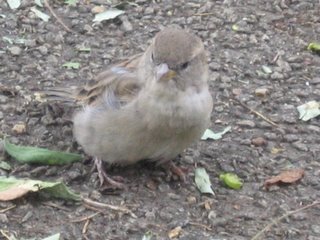
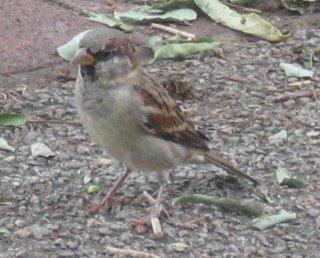
This afternoon I was in a small park near my apartment. A house sparrow landed nearby to scrounge for food. Soon a starling appeared. Then a few more house sparrows flew in, then a few more, and soon on, until about twenty birds were on the ground. I got pictures of a few. Below are two birds that came close.
Today's Washington Post has an article about tree-planting in Sacramento. The city is trying to encourage home owners to plant trees in order to reduce their own and the city's energy bills. A few well-placed trees around a house will cool the structure by a few degrees, meaning that air conditioning units will have less work and use less energy over the course of a summer. The program seems to be doing well so far.

About 375,000 shade trees have been given away to city residents in the past 16 years, and there are plans to plant at least 4 million more. To receive up to 10 free trees, residents simply call the Sacramento Municipal Utility District, a publicly owned power company.

"A week later, they are here to tell you where the trees should be planted and how to take care of them," said Arlene Willard, a retired welfare case worker who with her husband, John, has planted four SMUD trees in the back yard of their east Sacramento house.
Several other western cities are adopting a similar approach. Eastern cities, where more humid air reduces the impact of individual trees, have been slower to respond with tree planting programs. Such programs are needed because the tree canopy in most cities is shrinking dramatically. Nationwide, the decline has been about 25 percent over the past 30 years; in Washington, DC, the canopy has shrunk by about 64 percent. The declines are unfortunate, not only because trees reduce the urban heat island effect, but also because they absorb much of the carbon dioxide produced from traffic and other urban sources.

For information about planting trees in Washington, see the Casey Trees Endowment Fund and the District's Urban Forestry Administration.

Sunday, September 03, 2006

Weird Searches

People look for strange things on internet, and some of those strange searches bring visitors to my blog. Here are some phrases that led people here. (Some are not weird in themselves, but weird for finding my website.)

Tags:

Saturday, September 02, 2006

Ten Places to Visit for Birding

Birding is NOT a crime!!!! is running a survey on Ten Places Every Birder Should Go Before They Die, with the provision that the sites are limited to the lower 48 United States and Canada (excluding Alaska, Hawaii, and everywhere south, east, or west of there). I am not sure how long he intends to keep this survey running, but if you would like to suggest some sites, you can do so at that link. Eventually the survey will become a poll with about 25-30 contenders.

Now I cannot contribute much to this question, since I am not well-travelled and know only a handful of sites in my region. However, I am going to change the question a little bit, and list the top ten sites I would like to visit for birding. As with the poll, I am limiting this in scope to the lower 48 and Canada.

  1. Machias Seal Island (Maine) - I have always wanted to see Atlantic Puffins, and this is one place to do it. Plus, there is the likelihood of seeing many other alcids, most of which would be lifers for me.
  2. High Island (Texas) - As I understand it, this is the place for major migration fallouts in the spring.
  3. Santa Ana NWR (Texas) - The Rio Grande Valley is full of bird life, including many birds from Mexico that cross the border into Texas and many other specialties like Green Jay, Great Kiskadee, and Plain Chacalaca.
  4. Everglades National Park (Florida) - Lots of tropical or subtropical species at the northernmost limit of their breeding range.
  5. Crane Meadows Nature Center (Nebraska) - Sandhill Crane and Greater Prairie-Chicken
  6. Churchill (Manitoba) - premier site for gulls and shorebirds
  7. Point Reyes National Seashore (California) - Great for west coast shorebirds and landbirds, like Tricolored Blackbird.
  8. Madera Canyon (Arizona) - Great for many species of hummingbirds, sparrows, and warblers, plus some Mexican vagrants.
  9. Yellowstone National Park (Wyoming) - Known for geysers but good for birds, too. Great Gray Owl, Trumpeter Swan, Barrow's Goldeneye, plus woodpecker specialties.
  10. Sequoia National Forest (California) - Spotted Owls, plus other specialties in fabulous surroundings.
So there are 10 places I would like to visit eventually. Any better spots out there?

Tags:

Friday, September 01, 2006

Loose Feathers #65

News and links about birds, birding, and the environment.

  • California has passed a law that aims to reduce its carbon dioxide emissions by 25 percent by the year 2020. The article is a little short on details; it seems that the details of the plan still need to be worked out by the California Air Resources Board.
  • Early hominids may have been preyed upon by eagles. The modern African Crowned Hawk Eagle will take small monkeys such as Mangabeys. The skulls of primates found under these eagles' nests bear similar scratches and holes to the skull of the Taung child, a young representative of the species Australopithecus africanus. The article explains more.
  • Lambert's Bay in South Africa had grown dependent on business from birdwatchers who came to watch the nesting flocks of Cape Gannets. When fur seals killed some and drove off the rest, the town lured the gannets back with decoys. It is good for birdwatchers, and good for the town, but is it good for the birds? I guess it depends on whether another incident can be prevented.
  • The oceanside beach at Cape Henlopen State Park in Delaware is reopening as of today because piping plover chicks have left their nests.
  • A student writes about the trials of being a park ranger on the C&O Canal. Hmm... sounds like good material for a blog.
  • New Jersey is looking to ban the use of pipes and funnels to force feed ducks and geese in the production of foie gras. Here's more on Chicago's ban and the process of making foie gras.
  • The National Park Service is issuing new rules that reject most proposals for allowing jet skis, off-road vehicles, and commercial activities like mining. However, so-called "gateway communities" will have a say in the rules for individual parks.
  • Meanwhile, the Bureau of Land Management has not been monitoring emissions and the effects on wildlife of drilling on BLM lands. Sage Grouse have been declining thanks to human interference.
  • Dick Kempthorne, the Interior Secretary, is touring the Arctic NWR. He supports drilling: "There's a [wildlife] reserve there," he said before the aborted flight. "But we've seen so many different areas where we can responsibly recover resources and do it while meeting the highest environmental standards. I think it's also important to see it." (The link above suggests otherwise.)
  • A study confirms that California Condors are suffering from lead poisoning due to injested shotgun pellets.
Podcasts
Carnival