Friday, November 03, 2006

Loose Feathers #73

News and links about birds, birding, and the environment.

  • Dover Air Force Base is testing a new radar system to reduce collisions between birds and aircraft. A similar system in North Carolina has eliminated most strikes.
  • Tool use by crows may be learned from other crows. A study showed that all crows have some ability to use tools, but crows that had been taught tool-using skills were faster to make use of them.
  • Large, flightless birds are being studied to understand how bipedal dinosaurs walked.
  • Global fisheries are in the midst of a steep decline, which could wipe out most populations of seafood species by 2048. Needless to say, this would be a disaster for both humans and seabirds.
  • Farmers producing ethanol have been slow to sell their plants to major investors despite the high prices; in many places ownership remains local for now.
  • John at Birds Etcetera has a follow-up to my post on crows and ravens. It turns out that, in contrast to the decline among the DC-MD-VA corvids that I charted, American Crows in West Virginia have actually increased in recent years. It would be interesting to know the cause for this.
  • A California woman was caught with two spotted owls in her freezer, as well as a red-tailed hawk hanging from the ceiling.
  • Maryland has approved a wind-power project along Backbone Mountain in Garrett County, after barring construction in sections of the site that would affect mourning warblers, among other species.
  • This Week at Hilton Pond notes that rufous hummingbirds have already been spotted in South Carolina this fall. It is time to start looking out for these migrants from the northwest along the eastern seaboard.
Carnivals
Tags:

Thursday, November 02, 2006

The New Mall

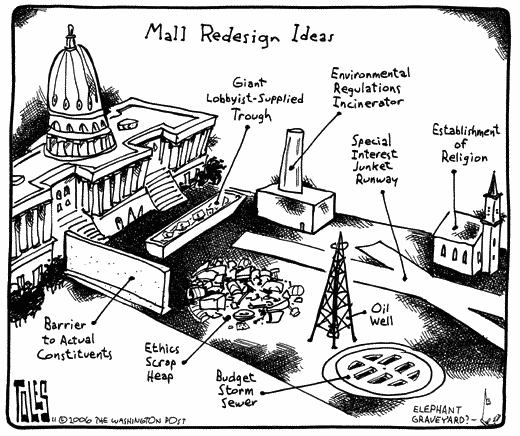
Following up on yesterday's story, here is a cynical view of what a redesigned National Mall may look like.

Cartoon by Tom Toles of the Washington Post.

Pigeons As Bloggers

Ordinary Rock Pigeons in California are being used to monitor that state's notoriously smoggy skies. Pigeons are equipped with special lightweight backpacks that monitor the levels of certain smog gases such as carbon monoxide. As the pigeons fly, their backpacks relay the gas levels to central computers, which post the results on a blog.

Each bundle contains gas sensors along with a global positioning system (GPS) for tracking the birds and a stripped-down cell phone that automatically transmits the data they collect.

The parts for each pack cost about $250 (U.S.) and weigh just 1.3 ounces (37 grams), about a tenth of a pigeon's weight.

Then da Costa had to enlist some birds. Rather than plucking random pigeons off the street, she got in touch with pigeon fanciers who owned homing pigeons....

The volunteers strapped the packs onto their pigeons, then took the birds up to 20 miles (32 kilometers) away from their homes and released them.

As the birds flew home, the backpacks sampled the air. The data, combined with GPS coordinates for each reading, were sent to PigeonBlog, which then automatically generated a pollution map (click here and then on the "map" tab to see an example).
The researchers working with these pigeons hope to create cheaper versions of the sensors that can be used more widely, including in homes and in Third World countries. Cheaper sensors could conceivably be carried by people as well as pigeons. More information about the project is available at PigeonBlog.

Wednesday, November 01, 2006

Rethinking the Mall

The National Park Service is undertaking a major planning process to improve the National Mall. The goal is to create a new plan for the Mall on the scale of the century-old McMillan Plan. It will guide future building projects for museums and monuments, addition of amenities for tourists, and general improvement of the grounds. The Park Service is seeking comments from individuals around the country - both experts and visitors - to inform the process.

In addition to attracting millions of tourists and demonstrators, the Mall is also the preferred address for dozens of monuments, memorials and museums. Federal officials have tried to encourage pocket parks and intersections throughout the city as future sites for dozens of projects waiting in the wings, but the quandary is that everyone wants to be on the Mall.

Architects, planners, historians and tourists will be among those asked to suggest a future look and feel for the Mall: Should it be about formal gardens and fountains, or baseball games, gift shops and hot dog stands?

The Mall serves many purposes: It is the equivalent of Paris's fabled gardens of the Tuileries, the political gathering space of Beijing's Tiananmen Square, the open space of London's Hyde Park, the sports haven of New York's Central Park and the museum row of any international city.

Trying to meet all these demands in one space can create a park that is frayed, unable to handle the crowds and not true to its iconic nature.

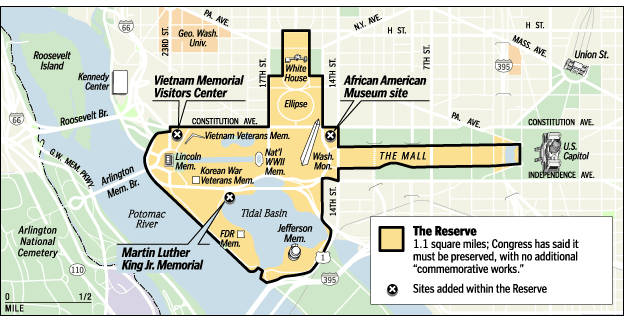
Some movement has already been made in this direction. Parts of the Mall are fenced during the winter to allow grass to recover. Congress has passed a Reserve Act to prevent further building in certain sections of the Mall to prevent them from being overcrowded. (Of course, it has not stopped several building projects since the law was passed.) The image below, from the Post article, shows the reserve area in yellow.

To comment on the Mall's future, you can visit the NPS website devoted to the project. Not all pages on that site are ready yet, so be patient with it.

The Birder Survey

Patrick of Hawk Owl's Nest has started this survey on his blog. Here are my answers.

What state (or country) do you live in? DC, USA
How long have you been birding? 3 years
Are you a "lister"? Yes
ABA Life List: 284
Overall Life List: 284
3 Favorite Birding Spots: National Arboretum, DC; Blackwater, MD; Bombay Hook, DE
Favorite birding spot outside your home country: n/a
Farthest you've traveled to chase a rare bird: 1.5 hours for a Snowy Owl
Nemesis bird: Horned Lark
"Best" bird sighting: Cape May Warbler in Constitution Gardens, DC
Most wanted trip: Colombia
Most wanted bird: Horned Lark
What model and brand of bins do you use?: Swift Audubon 8.5 x 44
What model and brand of scope do you use?: n/a
What was the last lifer you added to your list?: Pacific-slope Flycatcher
Where did you see your last lifer?: Cascades, WA
What's the last bird you saw today?: European Starling
Best bird song you've heard ever: Winter Wren (and others)
Favorite birding moment: Seeing a Cerulean Warbler for the first time
Least favorite thing about birding: Finding transportation to good spots
Favorite thing about birding: Listening to birds
Favorite field guide for the US: Sibley
Favorite non-field guide bird book: Kingbird Highway
Who is your birder icon?: Pete Dunne
Do you have a bird feeder(s)? No
Favorite feeder bird? n/a

I am following Patrick's lead in not tagging anyone, but feel free to pass it along.