Thursday, February 04, 2010

I and the Bird and SkyWatch

I and the Bird #118 is now online in some weird dialect at Ben Cruachan Blog, a long-time member of the blogosphere.

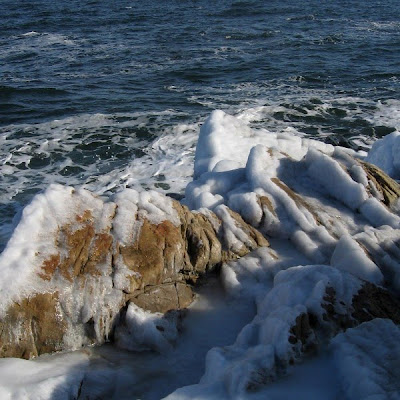
The photo above, presented here for SkyWatch Friday, is from the early morning last Sunday on Cape Ann.


Scoping for Seabirds


 At several stops during the Superbowl of Birding, other birders would ask us what we were seeing. According to the contest rules, teams may not receive assistance from people who are not on the team during the competition, except for a few sanctioned sources. This means, in part, that teams cannot give each other assistance. Even without such a rule, it would be unwise to tell other teams where good birds are located because that could make the difference between winning and losing. So we had to coldly rebuff such requests. After several such encounters, Christopher expressed his frustration that he wanted to get back to talking about birds instead of keeping quiet.

On Sunday morning, we had a chance to do some normal birding (without a veil of secrecy) before all of the team members had to go their separate ways. We chose to return to Cape Ann, to look for the King Eider we all missed and the Dovekie that Mike and I missed. We also hoped that some of the unusual gulls might have returned to Gloucester Harbor or Niles Pond. Unfortunately we missed all of the desired birds, but the coves at Cape Ann provide ample opportunities to view and photograph some gorgeous seabirds such as Harlequin Ducks and Purple Sandpipers. I was also glad to spend more time at Andrews Point, which became my favorite birding location from the trip.

Mike had brought an extra spotting scope when he drove from New York to Massachusetts, so I had use of a scope throughout the competition and during the next day. On the competition day it was very helpful to be able to scan the ocean and marshes because I was able to find birds faster than I would have otherwise. On Sunday I took advantage of the scope to take a closer look at some species (such as a Black Guillemot) and try my hand at digiscoping.

The bird above is an immature male Common Eider that was swimming in the bay near East Point. Unfortunately the focus is a little soft; I am not sure if that was a result of how I focused the scope or what the camera picked as a focal point. The birds below are Harlequin Ducks from Andrews Point.


I tried digiscoping a few other birds as well, but the results are not presentable. I will need a lot more practice before I can produce images on par with someone like Mike McDowell or Kevin Bolton.

As I mentioned in my second post on the competition, our team won the Essex County Excels award for accumulating the most points in Essex County, Massachusetts. We received gift certificates for a nature store in Newburyport, and since we were all (except Christopher) leaving the area that day, we needed to cut short our birding time if we wanted the opportunity to use them. I used mine on a lens pen and two insect guides: Stokes Beginner's Guide to Dragonflies and Caterpillars of Eastern North America. Those books should help me to identify insects faster and more accurately – and post photos of them on the blog more quickly.

Having said our goodbyes, we went our separate ways. I was very happy to meet and bird with Corey, Andrew, Nate, Mike, and Christopher, and I hope to bird with them again, hopefully sooner rather than later. You can read their own versions of the weekend's events on their blogs; I'll post links here to the individual posts once everyone is done posting.

Wednesday, February 03, 2010

Cold Competition, Continued

When we left Nahant, we had already missed some good birds and needed to catch up. As we drove into Gloucester, we made a quick stop to find the Peregrines that perch atop the city hall's clock tower. I missed them since my binoculars got tangled in my seatbelt, but four team members saw them, enough for the species to count. (I saw one of the Peregrines on the following day.) From there we headed to Gloucester's fish pier, normally a reliable spot for white-winged and other unusual gulls. On that day the only gulls were Herring and Great Black-backed, with the exception of a possible Iceland that Christopher picked out in flight. We had a similar result at the nearby Niles Pond, another reliable gull location that was bereft of gulls on the day of the Superbowl.

On the way to Eastern Point, the first of our coastal stops along Cape Ann, we spotted a small group of Wild Turkeys in someone's backyard and a Black Scoter on the bay. One thing I noticed during the event was that White-winged Scoters, a species I consider a relative rarity, seems very common in Massachusetts, but Black and Surf Scoters seem much less common. Most scoters I saw were White-winged. Eastern Point itself was a blast – in the sense of a blast of Arctic air. Even my hand and toe warmers and multiple layers proved inadequate against the penetrating cold. Needless to say, we did not spend much time there.

Elsewhere along Cape Ann's coast, cold and wind proved less of a problem.* Nate picked out a Black Guillemot, a life bird for me. Andrew spotted an airborne flock of Sanderling with a Ruddy Turnstone at its head. At one point, the lure of watching several dozen Harlequin Ducks proved too much for me to resist until Mike announced another alcid, this time a Thick-billed Murre. Nate found a Northern Flicker flying in off the ocean; where it originated is unclear. Our last stop in Cape Ann was Andrews Point, a rocky outcropping with a commanding view of the ocean. There the team picked up a Dovekie, our first five-point bird of the day. Enough team members saw it for it count. Unfortunately both Mike and I missed it; the Dovekie would have been a life bird for both of us. My consolation prize was a satisfying look at my life Black-legged Kittiwake.


Pressed for time and needing to find more birds, we headed north to Salisbury and Newburyport. Along the way we scanned every distant raptor-like bird for the elusive Turkey Vulture, a five-point bird for this winter competition. Finally, I spotted two out the front window of the van just outside Ipswich. At Salisbury State Park, we found Bald Eagle and Horned Larks, but missed Merlin, Snow Buntings, and Lapland Longspurs. In downtown Newburyport, we missed the Common Mergansers that we had expected and that Nate and Christopher had seen the day before. At Parker River NWR, commonly known as Plum Island, our luck changed for the better as we quickly found an American Kestrel, a Rough-legged Hawk, and two Snowy Owls. We missed Northern Shrike, despite our best attempts to make one out of every robin and mockingbird that we passed. We ended the competition scanning the ocean from the top of a dune. Nate picked out an Iceland Gull floating on a block of ice while the sun set over the marshes behind us.

As the clock ticked over to 5 pm, we left the refuge for the compilation dinner, and I posted "Game over" on Twitter. We ended the day with 70 species and 127 points, which was good for 6th in species and 7th in points among all teams. The winning team, The Granite State Bird Watch, observed 83 species for 164 while competing only in Rockingham County, New Hampshire. You can read about their day at The Worn Field Guide. While our effort was unable to beat The Granite State Bird Watch – or several other teams, for that matter – it did win us the Essex County Excels award for the most points in Essex County, Massachusetts. Truth to be told, we probably won only because another team neglected to compete in that category, but a win on a technicality is still a win. As a prize, we each received a $50 gift certificate for Massachusetts Audubon's nature store. With the competition over, we headed back to our hotel suite for dinner and some much-needed sleep.

* Some details in this paragraph may not be completely accurate since many of the stops blur together.

Tuesday, February 02, 2010

Cold Competition

On the morning of the Superbowl of Birding, we rose early in order to be at our first stop by the 5 am starting time. As we were driving to our starting point in the rental van, we passed by a sign giving the time and temperature. The sign showed the temperature as 3°F. Combined with a modest wind, this made for a frigid start to our birding.

We arrived at our first stop just a few minutes before 5 am. Once the clock read 5:00, we jumped out of the van and started looking for birds. Scanning the waterfowl sleeping on a small pond, we quickly located our target species, American Coot, and recorded a few other species like Hooded Merganser as well. Over the next two hours, we listened for owls at several locations while Nate and Corey did their best owl vocalizations to try to draw responses. We heard an Eastern Screech Owl respond at one location but missed Barred, Great Horned, and any other owl species. During this time the moon shone brightly and appeared especially large as it sank towards the horizon.

As the sky lightened, we headed towards Nahant to start the diurnal portion of the competition. Along its coastline, we tallied many waterbird species such as Common Loon and Red-necked Grebe. Unfortunately we missed a five-point bird, a Northern Shoveler, in one of the coves. We searched two spots for songbirds. The first, known as the "stump dump" was bereft of birds. At the second, the Audubon "thicket," we heard a Carolina Wren singing as soon as we exited the van but somehow missed a Yellow-bellied Sapsucker (another five-point bird) tallied by a different team five minutes later.

With the early portion of our route completed, we headed towards Gloucester.

(to be continued)

Monday, February 01, 2010

Finally, a Northern Saw-whet

This weekend I traveled to Massachusetts to participate in the Superbowl of Birding, an annual big day competition sponsored by Massachusetts Audubon. Christopher of Picusblog invited my to join the Bloggerhead Kingbirds this year along with Nate of The Drinking Bird; Corey of 10,000 Birds; Mike of The Feather and the Flower; and Andrew the Birding Dude. I will have a report on the competition in a subsequent post.

On Friday morning, I met Corey and Andrew in Queens to ride up with them to Massachusetts in our rental van. Along the way, we made a stop at the Pruyn Sanctuary in Westchester County to follow up on a report of a Yellow-headed Blackbird being seen at the sanctuary's feeders. We stood and waited in the cold for about an hour and a half. During that time we saw many sparrows, including a Fox Sparrow; a Sharp-shinned Hawk, and a couple hundred blackbirds, including a Rusty Blackbird. Sadly, we saw no Yellow-headed Blackbird. Eventually time constraints forced us to leave, and we continued on our way to Massachusetts.

Once we had arrived at our hotel, met the other bloggers, and checked in, we set out to do a little bit of birding. Christopher knew the roost location for a Northern Saw-whet Owl, a bird that was a lifer for me and (I think) one or two others. (This species was also a source of frustration for me when I lived in Cape May, since I missed seeing one on multiple occasions.) Christopher guided us to the roost, and we saw this:


We stayed just long enough for everyone to get a good look and take a few photos. I shot this photo through Corey's spotting scope. When I reviewed the photo later, I noticed just how good its camouflage is. If you look closely at this photo, you can see that the feather pattern on the top of its head fades into the tree. You may see the crown of its head, and you can see the eyebrow, but the feathers between those two curves look almost like bark. Owls as a group are especially adept at cryptic camouflage, which helps these birds stay hidden in their daytime roosts. It takes very careful searching and a lot of luck to locate one of these tiny birds.

Northern Saw-whet Owls are fairly common migrants, from what I understand. However, their cryptic feather pattern and tiny size make them extremely difficult to find for the average birder. Saw-whets breed in the coniferous forests of northern North America and migrate south for the winter months.