Monday, June 14, 2010

More June Moths

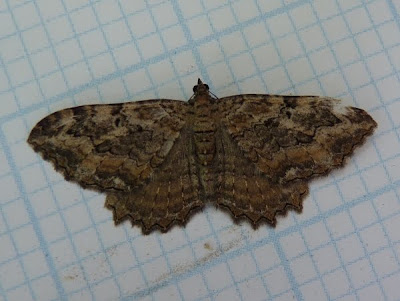
Here are a few moths I found over the weekend. My usual procedure with moths I find at night is to capture them, refrigerate them overnight, and then photograph them during the day and release them. Photographing them during the day makes the colors look more natural without the harsh glare of a point-and-shoot camera's flash. It also makes it easier to add a ruler for scale. Some moths are more cooperative than others; sometimes one will escape before I can get any good photos of it. Others, like the one above, will cling to the side of their containers.

That one eventually did sit on the paper so that I could photograph its upperside. I think this is a Barberry Geometer Moth. As the name suggests, its larvae feed on barberry (Berberis sp.). Most likely it evolved eating the native American Barberry but expanded to the invasive Japanese Barberry as an alternate host plant. This one probably dined on one of the Japanese Barberry shrubs in the neighborhood. I found this one nectaring at Butterfly Weed.

I think this second moth is a Small Mossy Lithacodia. Most illustrations I have seen of this species have much more vivid colors. This one might just be a worn individual because otherwise the pattern is a close match.

One of the reasons I really like about noctuids like the lithacodia is that they look very cute from the side.

This last moth is a Speckled Renia Moth. I have already seen this species at least once this summer. In addition to these moths, I have a couple of tiny moths, but it will take a while longer to identify those.

Sunday, June 13, 2010

American Robin

American Robins are usually the first birds to start singing in the morning in my neighborhood. When I lived in DC, one would usually start singing shortly after midnight during the breeding season. Here, they start a little later, but usually well before dawn.

I never found a robin nest in my old neighborhood, but here I usually see one in the spring. The one below is in a bush just outside the front door and relatively close to the sidewalk. Despite having people passing close by, the nest is well hidden. It is hard to see unless a robin flies in or out. Even then, the nest structure is not easy to make out.


Saturday, June 12, 2010

Flower Beetles

This beetle is a Strangalia luteicornis. It was one of many beetles of this species crawling on the limbs of a flowering winterberry bush. Strangalia luteicornis is a common eastern beetle species, with a distinctive shape and markings. Like other members of its genus, adults of this species are often found around flowers, where they feed on nectar.

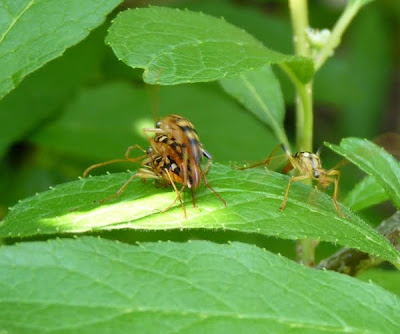
Some of these beetles were piled in a clump, as if they were struggling with each other.

Others were mating.

In some cases, more than two were involved in a mating session. I saw a few triple-decker mating groups. It is amazing that they can keep their balance in a position like that.

In the photo above, three are piled up, and a fourth looks like it wants to join. Three seemed to be the maximum number that would work, though. When more beetles got involved, the stack would usually fall apart.

Friday, June 11, 2010

Loose Feathers #242


Birds and birding news
Birds in the blogosphere
Oil Spill

Environment and biodiversity
Blog carnivals

Thursday, June 10, 2010

I and the Bird

I and the Bird #127 is online at The Drinking Bird.