Sunday, June 19, 2011

Dickcissel at Negri-Nepote

Yesterday morning I went over to Negri-Nepote Grasslands Preserve to look for a Dickcissel that had been reported there the weekend before, and then reported sporadically through the week. On the way out, I heard and then saw Grasshopper Sparrows pretty quickly. My route went through at least three distinct breeding territories. Chipping Sparrows, Field Sparrows, and a House Wren were also singing along the way. I had some nice looks at Field Sparrows close to the path. The pond had the usual summer grouping of swallows, an Eastern Kingbird, and a Killdeer. I think I also saw a Cedar Waxwing flying over the pond as well.

The Dickcissel had been reported in the area between the pond and the house in the middle of the preserve, so I waited along the main path there to see if it would appear. While I waited, I got to listen to Grasshopper Sparrows, Field Sparrows, and Indigo Buntings singing around me. A pair of Orchard Orioles flew pastin tandem. Tree Swallows darted back and forth, while one Tree Swallow seemed content to sit on top of a nestbox. After a while I decided to try my luck from a different position, so I followed the trail between the house and the pond. I searched around a bit more without spotting it, so I asked another birder named Doug if he had seen it. Sure enough, he had, and he pointed it out to me – both the perch where it was sitting and its song. Once he did point it out, the song suddenly sounded a lot more noticeable to me – I must have missed it among the ambient bird sounds that I had been hearing to that point. Doug was nice enough to let me look at it through his scope for a closer view. A spotting scope definitely helps for this bird since the viewing distance can be quite long for such a small bird.

The viewing distance was too far for me to attempt photographing the Dickcissel. (Here is a photo of one of the Negri-Nepote birds from another birder.) However, I did photograph some butterflies while I was there. Above is a Cabbage White, one of the most common butterflies in the area. This individual is a bit more yellow than most. The one below is an Eastern Tailed-blue, puddling on some mud.


Saturday, June 18, 2011

Six Years of Blogging

I published my first post on A DC Birding Blog six years ago today, June 18, 2005. Since then, I have kept it going on a regular basis, and on a daily basis for the last few years. I originally conceived the blog as a journal for my birding walks in Washington, DC. That is more or less what it was for the first two years. Then, in summer 2007, I moved to New Jersey. The locations of the birding walks changed, and I also began adding more content about insects as my interests shifted to butterflies, dragonflies, and finally moths. News about birds and the environment has been a mainstay of the blog almost since its beginning. The weekly "Loose Feathers" series, which gathers bird and environmental news from the preceding week, debuted in November 2005.

Since I started blogging, the blogosphere has changed quite a bit and its imminent death has been predicted several times. A lot of the blogs I enjoyed in my first year of blogging are now gone. When I started blogging, there was no Twitter, and Facebook was still restricted to college students. Bloggers found other interesting blogs through toplists and blog carnivals; both of those methods have since waned in favor of social media. Even I and the Bird, one of the longest-running and most popular blog carnivals, has ceased operations.

Very few of the blogs I read in 2005 are still active. Here are some that I remember reading back then:
I hope I did not miss anyone. There are of course many science blogs that have sustained operations since 2005 or earlier, but I am only including ones that I have been reading continuously since the early days of the blog. There are also many blogs that I read avidly that have since ceased publication or publish less frequently than they used to. Of course, the constant turnover in the blogosphere has also produced a lot of great bird blogs in the intervening years, and some of the ones I read most regularly now were started well after I started this blog.

I look forward to another year of blogging, and I hope this year is better than the last!

Friday, June 17, 2011

Loose Feathers #295


Birds and birding news
Birds in the blogosphere
Environment and biodiversity

Thursday, June 16, 2011

Celery Looper

I found this Celery Looper in the back garden yesterday. I would have missed it if it stayed still, but it flushed from one hiding place and landed in the grass, where its location was more obvious. Loopers as a group have a very distinctive shape. When they fold their wings tent-like over their backs, they appear to have a hump over their thorax and another a third of the way down the back. The outer end of the wing appears fan-like. The odd shape helps them disappear into the foliage. When a looper presses itself up against a dried leaf or plant stalk, it looks like just another dried leaf.

Celery Loopers feed on a variety of plants as larvae – including but not restricted to celery. Other host plants include blueberry, clover, plantain, and viburnum, as well as various cultivated vegetables. Adults are sometimes active during the day and nectar at flowers.

Wednesday, June 15, 2011

Four Geometer Moths

Two nights ago I put out the black light and sheet again to attract moths. During the summer I try to do a mothing session about once per week, but sometimes the intervals are longer. This week's session was slower than last week's. The starting temperature was about 15°F cooler than the previous week, plus the moon was nearly full. Both factors may have contributed to less activity at the sheet. Still, there was a nice group of moths. I have about 10 species identified so far, with a bunch more moths left for identification.

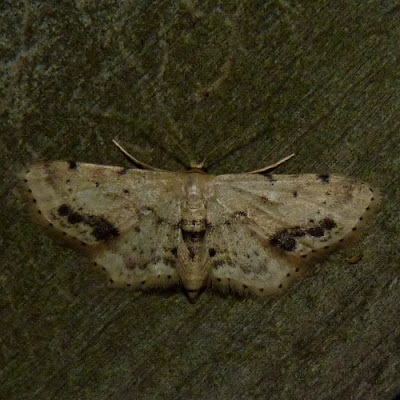
Here are a few geometer moths that showed up. In their larval stage, Geometer moths (family Geometridae) are known as inchworms. The caterpillars lack prolegs in the middle of their bodies, so they have a looping walk, as if they are measuring the earth inch by inch. The moth above is a Single-dotted Wave (Idaea dimidiata); I had this species in the yard last summer.

Many moths have fanciful English names, such as this one, which is known as The Gem (Orthonama obstipata). In this case, the name seems deserved, given this female's rich red and black coloration. This species was new to me.

This moth is a Common Tan Wave (Pleuroprucha insulsaria).

Adult geometers usually rest with the forewings and hindwings both spread out. So I found it odd to see this moth with its wings folded over its back, in the manner of a hairstreak or blue butterfly. Unfortunately I did not get a photo of its dorsal side, so I cannot be sure of the species. If anyone wants to suggest an ID, feel free to do so.