Saturday, March 31, 2012

Whooping Cranes Migrating Early

Whooping Cranes / USFWS Photo
You can add Whooping Cranes to the list of birds moving north early this spring.
It's been an unusual year for whooping cranes in Texas, and the endangered species' spring migration is the latest example. Researchers report several whooping crane families initiated their spring migration nearly a month earlier than usual, with some birds already having reached South Dakota.

Texans are asked to report sightings of these large white birds as they progress along their migration route northward from the coast through Central Texas and the Wichita Falls area.

After a winter distribution that surprised biologists and kept birders enchanted with unprecedented sighting opportunities for one of North America's most ancient bird species, the unusually early start of the migration to nesting grounds in Canada does not surprise Texas Parks and Wildlife Department biologist Lee Ann Linam.
I am not surprised either, given the unusually warm spring and last year's drought in the southern U.S.

Friday, March 30, 2012

Loose Feathers #336

Lesser Scaup / USFWS Photo
News about birds and birding
Nature blogging
Environment and biodiversity
  • The Xerces Society issued a report finding that neonicotinoid pesticides are harmful to honey bees and native bees. While they are not directly linked to colony collapse disorder, neonicotinoids make bees more susceptible to pathogens and parasites, including Nosema. Such pesticides are often poorly labelled and are approved for lawns and gardens at much higher application rates than for agriculture. Two studies published in Science this week reach similar conclusions; neonicotinoids make it more difficult for honey bees to find their way back to their colonies, and bumble bees have a harder time bringing enough food back to the colony to produce more queens. See also Tom Philpott's commentary.
  • Monarch butterflies in Mexico and the eastern U.S. could be down as much as 30% this year due to drought in Texas and the reduction of milkweed availability in breeding areas further north. The decline in milkweed is linked to widespread use of herbicide-resistant crops; application of such herbicides kills off milkweed, among other plants.
  • At least 17 European butterfly species have declined 70% in the last 15 years; one solution may be to maintain more open, agricultural-type habitat.
  • A group of scientists found coral beds in the Gulf of Mexico that are coated in brown goo, which is likely a result of the Deepwater Horizon disaster.
  • Meanwhile, Bottlenose Dolphins in Barataria Bay, which got a heavy influx of oil from the Deepwater Horizon rig, are very unhealthy.
  • The Academy of Natural Sciences in Philadelphia marks its 200th anniversary this year. It is the oldest natural history museum in the Western Hemisphere and has one of the largest collections in the world.
  • A boom in development is threatening Turkey's biodiversity, much of which depends on unprotected lands. Turkey has over 9,000 species of plants, 150 species of reptiles and amphibians, and 500 birds species recorded to date.
  • The Cox Hall Creek WMA (a.k.a. The Villas, a.k.a. Ponderlodge) was formally dedicated this week. The dedication was marked with a release of trout into the pond.
  • A new paper argues that the extreme weather events of the last decade are linked to climate change.

Thursday, March 29, 2012

New Greenhouse Gas Regulations

This week the EPA proposed its first-ever regulation of carbon dioxide as a greenhouse gas.

The proposed rule — years in the making and approved by the White House after months of review — will require any new power plant to emit no more than 1,000 pounds of carbon dioxide per megawatt of electricity produced. The average U.S. natural-gas plant emits 800 to 850 pounds of CO2 per megawatt; coal plants emit an average of 1,768 pounds of carbon dioxide per megawatt.

Industry officials and environmentalists said in interviews that the rule, which comes on the heels of tough new requirements that the Obama administration imposed on mercury emissions and cross-state pollution from utilities within the past year, dooms any proposal to build a new coal-fired plant that does not have costly carbon controls....

The rule provides an exception for coal plants that are already permitted and beginning construction within a year. There are about 20 coal plants now pursuing permits; two of them are federally subsidized and would meet the new standard with advanced pollution controls.
Based on the coverage I read, it looks like the coal industry and its political patrons are trying to paint this as a sign of the EPA having a radical agenda. The EPA only came to this point reluctantly, however. The EPA was bound by a Supreme Court decision in 2007 to determine whether carbon dioxide was a harmful pollutant as defined by the Clean Air Act. Once the EPA determined that carbon dioxide emissions are causing harm in 2009, it was bound by the Clean Air Act to issue regulations. Even so, the Obama administration waited three years after the initial determination to do something about it because they wanted Congress to pass a new climate change bill.

A potential downside of the new regulation is that it only applies to new power plants and not existing ones. So this will not lead to an immediate decrease in greenhouse gas emissions. That will only happen once older coal plants come offline and get replaced with cleaner power sources. However, David Roberts argues that regulations of existing plants are bound to come at some point.

Here’s the story: Once something is deemed a pollutant under the Clean Air Act (which, in the case of CO2, was settled by the Mass v. EPA Supreme Court case), then it must be regulated under Section 111 of the act, the New Source Performance Standards program.

Section 111b governs new sources. That’s what was issued today. But when EPA regulates under 111b, that triggers a legal obligation for it also to regulate existing sources under 111d.
Which is a nerdy way of saying: EPA is legally obligated to regulate existing power-plant sources of CO2.

All that remains is to determine the timing. A bunch of green groups sued EPA over their delay on CO2 several years back. The settlement that was reached obligated EPA to issue CO2 regs by last September. Obviously that didn’t happen. Green groups then agreed to a few extensions. They have taken the issuance of the rule today as a sign of good faith from EPA that it’s on track.

Regulation of existing sources under 111d is a much trickier, more difficult matter than regulation of new sources. There are genuinely novel questions of law and technology involved. EPA has been grappling with these questions, but it’s not easy and there are a great many interested stakeholders, to say the least. Even if it wanted to, EPA probably couldn’t get that rule done and issued before the election.
On the whole, I think this is a step in the right direction, though perhaps not one that will bear immediate fruit. If Obama is reelected, it would not surprise me to see some regulation of existing sources during his second term. Of course, if he loses, the new regulation could be watered down or rescinded entirely, though the latter would be in defiance of the Supreme Court.

Tuesday, March 27, 2012

Birding Hawaii

I'iwi / USGS Photo
Here is an interesting Washington Post article on birding in Hawaii.
Even before we’d spotted a single bird, we knew that we were in the right place, thanks to the ear of Jack Jeffrey, a former biologist with the State of Hawaii who now guides birding and photography tours. Just a few minutes from the parking lot of the Puu O’o Trail, he began identifying call after call. There were twittery trills, raspy kazoo blasts and what could have been R2-D2 chirps and beeps straight off the “Star Wars” soundtrack.

Jeffrey explained that recent research has traced the ancestry of nearly 60 species of nectar-loving Hawaiian honeycreepers back to a flock of finches from Asia that arrived nearly 6 million years ago (even before all the islands had formed). Of those 60 species, only 18 remain today. The honeycreepers, along with many other native animals and plants, have suffered pressures from development and from introduced predators and diseases. With so many unique species facing extinction, Hawaii is often described as the endangered species capital of the world.

Photographer Kim Hubbard and I spent eight days in Hawaii in December, mixing birding on Oahu and the Big Island with other sightseeing. We found that bird-watching served as a lens on the islands, allowing us to meet locals who were passionate and expert enough to share their insights and help us step off (or in one case very much onto) the beaten path.

Sitting on the edge of what was once a moving wall of lava, we looked straight out over the treetops. A buzzing sound that might have been a miniature helicopter announced the arrival of an apapane. This bird would fit in your palm; it’s as red as the ohi’a flowers. Its legs and slightly curved beak are black, its lower abdomen white. Unlike a hummingbird, with which it shares a zippy pace, it actually lands to feed on the flowers. Jeffrey described watching these birds as a series of three-second sightings. The pattern, he said with a metronome beat, is: “There it is, there it is, there it goes.”

Even though we were sitting in the open and chatting, the birds came closer and closer as they got used to us. Soon we spotted an ‘i’iwi with orange-red plumage. Its beak, a pale orange, curved to dip perfectly into the spray of stamens that form the blossom. The ‘i’iwi paused, then extended its neck to sing with full-bodied earnestness — operatic vigor in a tiny package.

Monday, March 26, 2012

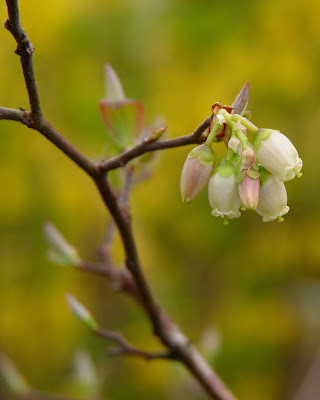
Blooming Blueberries

These tiny white and pink flowers are on a northern highbush blueberry (Vaccinium corymbosum). This shrub is native to North America and grows especially well in moist, acidic habitats like New Jersey's Pine Barrens. Cultivars of this species are grown commercially to produce the blueberries familiar from stores and farmer's markets. In the wild, this plant's natural form provides food for birds and other animals. I have tasted a few wild highbush blueberries on hikes and found them very sweet, more so than commercial blueberries, and without the bitter notes I sometimes detect with the latter.

Northern highbush blueberry serves as an important host plant for many insects. A search of the HOSTS database for Vaccinium corymbosum brings up 42 records involving at least 30 species of Lepidoptera. (A search for Vaccinium turns up over 1000 records.) There are probably many more insects in other orders that depend on the shrub in one way or another. One such species is the Blueberry Azure (Celastrina lucia), shown below.