Showing posts with label Human-Bird Conflicts. Show all posts

Thursday, May 24, 2012

Records of What Birds Ate

Photo credit: Caridad Bojorquez/Proteus Gowanus
The Patuxent Wildlife Research Center houses a unique collection of records about avian diets. The records were compiled by federal scientists of the late 19th and early 20th centuries who dissected the remains of 230,000 birds to analyze their stomach contents. While most of the jars that once preserved the stomach contents are gone, the records of their contents remain on hand-written notecards.
The 230,000 notecards that accompanied the jars sit in a musty basement, mostly forgotten. And they too may face destruction. As with many other historical collections, the United States Geological Survey, which now runs the center, has neither the personnel to digitize the collection nor the space to archive it properly. “If I disappear,” Mr. Droege said, “there will be no one left to champion it.”

The scientists who helped gather the collection published hundreds of articles, and even a few books, describing the food habits of more than 400 native species. Dozens of other scientists have used the collection to study how birds’ feeding habits, distribution and abundance have changed over the past 100 years. The collection, undertaken to determine how birds were harming humans, can now be used to determine how humans are harming birds.

Dr. Haas is using the collection to study how agricultural practices have changed bird diets. She said that during the 1950s, farmers in the South were encouraged to replace native grasses with cool-season grasses, which could provide food for livestock earlier in the springtime. Now several grassland birds are declining, and Dr. Haas suspects that it is because of the switch to nonnative grasses.

Jean-François Ouellet, a doctoral student at the University of Quebec at Rimouski, is using the collection to study evolutionary relationships between a bird’s size and the quality of what it eats. He said the collection was helpful for its detailed information about hundreds of birds across the country over different time periods. 
It would be a shame if these historical records disappeared. Perhaps the cards could be scanned and entered by volunteers, in a manner similar to the existing North American Bird Phenology Program.

Tuesday, May 22, 2012

Birds Hitting Windows in Philadelphia

Like in other cities, buildings in Philadelphia's Center City have reflective glass surfaces that fool birds so that birds die in window strikes. Two researchers that have been studying the problem estimate that about 1,000 birds die each year in their four-block study area on Market Street. Most of the victims are migratory songbirds such as Ovenbirds and White-throated Sparrows, but they also include American Woodcocks and Wild Turkeys. Possible solutions, like elsewhere, involve shutting lights off at night during periods of heavy migration and incorporating designs that make glass surfaces more visible to songbirds:

Films applied to the glass to make it visible are one idea. At Temple University, art students held a competition to come up with attractive and effective designs. The winning version resembled sheet music with the notes shaped like birds.

Another student cut translucent film into the shape of molecules for the chemistry building's windows.

A New York company, SurfaceCare, provided a film with small, almost imperceptible, black stripes for the Bear Country exhibit at the Philadelphia Zoo, which, like many other zoos, has a combination of glass enclosures and trees. The bird strikes stopped.

SurfaceCare owner Marc Sklar is looking at new technologies, including glass that has elements in the ultraviolet light spectrum, which humans can't see but birds can.

Christine Sheppard, a bird collision expert with the American Bird Conservancy, has been testing prototypes of bird-friendly glass at a bird-banding station near Pittsburgh. She said the results could be used to write guidelines for architects.

"Nobody wants to kill birds," she said. But, still, "nobody wants more rules and regulations." Her goal is to educate.

"There are lots of beautiful buildings that are very bird-friendly," she said. "You can be creative and do architecture that will win awards" and still not kill birds.

Recently, the national green building certification program - Leadership in Energy and Environmental Design (LEED) - began a pilot program that gives buildings points for having bird-friendly windows.

"So-called green buildings . . . are never green to me, no matter what their LEED award, if they kill birds," Muhlenberg's Klem said.

Chicago and San Francisco require that new buildings and major renovations incorporate bird-safe elements.

Minnesota requires that all state buildings turn off lights during migration. Michigan's governor issues an annual proclamation declaring migration "safe passage" dates and asking that buildings remain unlit at night.

A year ago, Illinois Congressman Mike Quigley introduced national legislation, still pending, to mandate bird-friendly construction for federal buildings.

Saturday, February 04, 2012

Protection for Piping Plovers at Cape Hatteras

Piping Plover chick / USFWS Photo
A long and bitter process has resulted in a new regulation governing off-road vehicle (ORV) use at Cape Hatteras National Seashore in North Carolina. The purpose of the regulation is to protect the nests and young of Piping Plovers and other beach-nesting birds like terns and shorebirds.
The Park Service’s new rules allow ORV use on the majority of the seashore, with 28 of the seashore’s 67 miles of shoreline set aside as year-round ORV routes, and 13 miles seasonally open to ORVs. Only 26 of shoreline are designated as year-round vehicle-free areas for pedestrians, families, and wildlife. The plan also proposes new parking facilities, ORV ramps, and water shuttles to increase visitor access to beaches....

Beach-nesting birds and sea turtles reached alarming lows within the National Seashore under the old unmanaged beach-driving scenario, but showed signs of recovery after temporary rules were implemented in April 2008. No piping plover chicks survived to fledge (learn to fly) in 2002 and 2004, but 15 chicks fledged in 2010 and ten fledged in 2011. Only 44 sea turtle nests were recorded in 2004, but a record-breaking 153 sea turtle nests were recorded in 2010 and 147 in 2011.

The new rule was published in the Federal Register on January 20 and can be found at www.federalregister.gov. It designates ORV routes at the Seashore, establishing requirements to obtain a permit, and imposing date and time and other restrictions related to operation of ORVs, including vehicle and equipment standards.

New rules ordinarily go into effect no less than 30 days after publication in the Federal Register, however, the Park Service has found that good cause exists to truncate this period, and has brought the date forward to February 15. By this date, the public will have had 415 days’ notice of the decision (the Record of Decision was made available on December 28, 2010) that forms the basis of this rule, so further waiting would not appear to be necessary. Further, the shorebird breeding season at the Seashore begins in early March. The Park Service determined that implementation of the rule would be most effective if the designated ORV routes and ORV permit and education requirements were implemented, and signs reflecting the new requirements were installed, prior to the start of this year’s breeding season.

A permit will be required for each vehicle, with permit holders required to watch an instructional video. Permit fees have not been announced, but are expected to be set between $30 and $150 depending on the length of the permit.
It remains to be seen if this was what the plover population needed, but the early results look promising. Hopefully it will at least consolidate the gains made over the past few years while the temporary rules were in place.

Tuesday, January 31, 2012

Crow-killing in Germany

Hooded Crow in Berlin / Photo by pelican
A hunting group in Germany that calls itself the "Crowbusters" is trying to kill as many crows as possible.
The Crowbusters' kill rates are unusually high thanks to their military-grade equipment. During a hunt in the Upper Franconia region of Bavaria, the Crowbusters impressed local hunters by bringing down a total of 316 "crap-scratchers." Farmers, who don't like it when curious crows peck at the plastic covers on silage bales, had spread liquid manure on their fields to lure the birds.

The headline "80 Against Unlucky Raven" appeared in a Wild und Hund story describing the biggest crow hunt the publication had ever organized. The shootout in the sky took place last year in the Münsterland region of northwestern Germany, and it was broadcast live on the online forum of Wild und Hund.

By the end of the hunt, 333 crows lay dead, 80 percent of which were young birds. Six magpies also fell victim to the slaughter. In a hunt like this, says ornithologist Ulrich Mäck, it's almost impossible to avoid killing protected species, such as rooks and jackdaws. "Especially during the colder half of the year," he adds, "birds in the crow family tend to fly in mixed flocks."
The excuse for this slaughter is that crows are causing the declines of rabbits, gamebirds, and songbirds – declines that are more likely caused by the spread of agricultural practices that reduce the hedgerows and meadows that provide habitat for those birds and animals. In other words, killing large numbers of crows is unlikely to helps those birds and animals and may hurt some protected species that have the misfortune of associating with large crow flocks. The good news is that the excessive crow-killing has aroused some opposition, even among hunting organizations, but it remains to be seen whether this opposition will be able to rein in the Crowbusters.
"I've never experienced such feverish hunting of a particular species, not even when it comes to foxes," says Johann Beuke, a 56-year-old resident of Twistringen, a town in Lower Saxony, and a member of Germany's ÖJV ecological hunting association. According to Beuke, crow populations are particularly threatened by the fact that many German states have bowed to hunter pressure by virtually eliminating hunting off-seasons. In doing so, they are contravening not only an EU directive on the conservation of wild birds, but also Germany's Animal Protection Act. In an attempt to put a stop to what Beuke calls "extermination campaigns," the ÖJV has teamed up with Friends of the Earth Germany (BUND) and the Nature and Biodiversity Conservation Union (NABU).

These large-scale killing sprees are even too much for some conservative hunters. Harry Neumann, a local BUND representative, convinced Klaus Skowronek, the head of a hunting club in the western German Westerwald mountains, to no longer allow the Crowbusters to hunt in the region. "As far as we're concerned, this area is now a no-go," Skowroneky says, adding that he finds "crow pingpong distressing."

Even the conservative German Hunting Association (DJV) has recently decided that the "excesses" and "questionable images" associated with the Crowbusters' actions could hurt the image of hunting in general. In late February, the association plans to address the problem of these marauding crow killers.
Hopefully this senseless practice will end soon.

Wednesday, January 04, 2012

Birds and Fireworks

Last year, thousands of blackbirds died on New Year's Eve in Beebe, Arkansas. This year it happened again, though in smaller numbers.
"Well, there was just birds falling down on the street and people dodging and missing them," Taylor said. "And we were down the street picking them up. We got called out by the chief and we all [came] out trying to pick them off the street."

Taylor added that the Game and Fish Department took about 30 of the nearly 100 birds for testing to try to determine what happened.

Fireworks were blamed for the deaths of thousands of blackbirds last year, but it's unclear whether fireworks were the cause this time. Police imposed an impromptu ban on fireworks when the birds began falling this year.

Lt. Brian Duke of the Beebe Police Department told ABC this year wasn't nearly as bad as last year, when the birds covered the streets of Beebe. This year, they were concentrated in a smaller area and the birds were cleaned up quickly. There haven't been any reports of people being hit by a falling bird.

Biologists said last year's kill was caused by birds who were spooked off their roosts by the loud explosions and began flying into homes, cars, telephone poles and each other.
Apparently the problem of birds being startled by fireworks is not limited to Arkansas.
It turns out that birds are easily startled by fireworks. A study in the November/December issue of Behavioral Ecology used weather radar to track birds disturbed by New Year’s Eve fireworks for three years in the Netherlands. They found that thousands of birds took to the skies shortly after midnight and didn’t settle down again until 45 minutes later.

The scientists estimated that hundreds of thousands of birds, including several species of migratory waterfowl, were disturbed by the fireworks each year in the Netherlands alone. “The unexpected loud noises and bright lights fireworks produce are probably a source of disturbance for many species of domestic and wild animals,” the scientists wrote.

Most of the time, birds won’t die from the fireworks displays, as they did in Arkansas, the researchers note. But they still suffer from disrupted sleep, interrupted feeding and the energetic costs of flight and resettlement.
This is such a consistent problem that perhaps the presence of large bird flocks should be a consideration in the timing and location of fireworks displays.

Monday, December 19, 2011

Fishing Line and Birds

At one time or another, we have probably all seen a bird hampered by fishing line, with the line wrapped around its legs or tangled elsewhere on its body. This is a widespread problem, especially since plastics line fishing line persist in the environment.

The problem is not new — or limited to Prospect Park. Birders in other city and state parks report similar cases. The Ocean Conservancy in Washington points out that monofilament fishing line, which is made from an individual fiber of plastic, has been in use since World War II, and as the decades pass, it has accumulated in the water and on land. For a quarter-century, the conservancy has organized coastal cleanups throughout the world on a single day in September. Over that time, 1,340,114 pieces of discarded fishing line have been collected, according to the group.

“Plastics in general are the most persistent forms of marine debris,” said Nicholas Mallos, a conservation biologist with the conservancy. “Once monofilament line becomes loose in the marine environment, it poses a serious threat.”

Birding groups and wildlife experts say that most fishermen and women are quite likely unaware of the impact on wildlife. The solution, they contend, is more education, as well as the availability of secure receptacles for old fishing line and hooks. Open trash cans easily overflow, they say, and the wind blows the line away.

Monday, November 21, 2011

Salton Sea's Future in Doubt

Salton Sea in California is well known among birders for its breeding populations of waterbird species and the migratory birds each year. Because of changes in the amount of water runoff to the sea, its future as bird habitat is in question. The sea is rapidly evaporating, and its edges are turning into dusty flats. This situation is likely to get worse in the future without active intervention.

With evaporation outpacing incoming agricultural runoff, a thin sheet of water less than an inch deep and 100 yards wide on the east side of the sea's Mullet Island is all that protects tens of thousands of breeding and roosting cormorants, pelicans and herons from coyotes and raccoons....

Environmental conditions are expected to get much worse in a few years at the Salton Sea, a non-draining body of water with no ability to cleanse itself. The sea was created in 1905, when the Colorado River broke through a silt-laden canal and roared unimpeded for two years into the Salton Sink.

Irrigation runoff traditionally helped stabilize the salinity of the sea, and enabled fish to thrive and make the region a haven for tens of thousands of birds and migratory waterfowl, including endangered species such as peregrine falcons, bald eagles, Yuma clapper rails and pelicans.

As it stands, salinity levels at the Salton Sea are about 50,000 parts per million parts of water, authorities said. By comparison, the salinity level of the Pacific Ocean is about 35,000 ppm.

Long-predicted catastrophic changes may begin to unfold in 2017, after an abrupt decrease in the amount of water flowing to the Salton Sea....

The surface will drop about 20 feet by 2030, Cohen said, shrinking the sea's volume by more than 60% and tripling its salinity. The effects will include the loss of fish and the tens of thousands of birds that eat them. The birds that remain will suffer from disease and reproductive deformities.
There is currently a lawsuit underway that seeks to remedy some of the problems that were not addressed in a water deal from 2003 that affects the status of the Salton Sea.

Saturday, November 19, 2011

Killing Songbirds for European Cuisine

In yesterday's Loose Feathers, I linked to a report on an incident in which Hungarian officials seized a shipment of about 10,000 illegally-killed songbirds. The dead songbirds were most likely headed for restaurants in northern Italy. Traffic in wild songbirds is unfortunately routine in Europe, even though it is officially illegal in most of the EU. The most famous of the trafficked songbirds is probably the endangered Ortolan Bunting, part of Francois Mitterrand's last meal. However, many other species are also involved. Conservation organizations in Europe are doing their best to curtail the trade in songbirds, with mixed success so far.

Bee-eater / Photo credit: BirdLife Cyprus
Cyprus has been a center of songbird trapping, particularly during migration seasons when many birds are passing through the island on their way to and from mainland Europe. This fall almost 867,000 birds had been killed by mid-October.
The toll is estimated on the basis of field data from BirdLife’s ongoing field monitoring of trapping activity with mist nets and limesticks, part of a systematic surveillance programme. This latest estimate – 866,905 birds- represents the number of birds killed between Thursday 1st September and Sunday 9th October 2011. The trappers are after Blackcaps and other songbirds, which will end up as illegal, and expensive, ambelopoulia delicacies served up in law-breaking restaurants, allowing the trappers to make huge profits. The first estimate for the autumn 2011 season, posted on September 12th, was for almost 90,000 birds, but trapping has gained pace since then. The estimate will be updated every Monday until the end of October.
BirdLife Cyprus is asking birdwatchers and other wildlife lovers to sign an online petition asking the government of Cyprus to intervene. So far over 15,000 people have signed.

Monday, November 14, 2011

Animals Using Culverts to Cross Roads

Stone culvert / Photo by Wikipedia user Valerius Tygart
Researchers in Maryland studied whether and how animals (including birds) were using culverts to cross under roads.
Raccoons will use any kind but deer avoid culverts with cobbled floors and eastern gray squirrels don’t seem to like arch-shaped passages, the study’s lead author, ecologist J. Edward Gates, said Friday. Great blue herons prefer box-shaped culverts with sandy bottoms, the study found....

Culverts are tunnels, usually made of concrete or metal, that allow water to flow beneath roadways. Animals moving along stream banks may naturally follow the water through culverts, Gates said.

Researchers documented 57 species using the conduits, including nesting barn swallows, feral cats and white-tailed deer — a species of particular concern because they cause dozens of deaths in collisions each year around the country....

The study found deer using tighter passageways than previously documented — as small as 3.2 feet high and 4.7 feet wide....

He said preferences for certain culvert shapes may have more to do with what’s on the tunnel floor. Many box-shaped culverts studied were made of concrete whereas the rounded conduits were all made of corrugated metal. The boxy shape preferred by herons also provides room to spread their wings and quickly escape, the study says.
The study was funded by the Maryland State Highway Administration to see if culverts could be used to provide wildlife with safer ways to cross roadways. Highways present a real barrier to large wildlife. If they choose to cross, they risk death or injury. If they choose not to cross, they lose access to the foraging habitat on the other side of the road as well as the opportunity to mate with members of their species that live on the other side. (The latter is especially a problem when endangered or declining species are involved; in the mountain west, wildlife bridges are being built over interstates to avoid genetic isolation.) For drivers, there is a risk of vehicle damage or injury when larger animals try to cross the road. Perhaps the solution to the problem is more or better culverts where roads can accommodate them.

Thursday, November 03, 2011

Green Standards to Incorporate Bird Safety

For a long time, green building standards, as codified by the LEED program, focused on a building's energy use, often to the exclusion of other environmental considerations. One significant problem is that LEED-certified buildings often have large expanses of glass to let in light and heat and reduce energy use. Those same energy-efficient windows attract birds, which crash into the windows when they mistake reflections for trees and sky. Thanks to the work of the American Bird Conservancy and the Bird-Safe Glass Foundation, LEED certification will soon include credits for reducing bird fatalities.

To earn the credit, buildings must comply with one facade requirement, one interior light requirement and one exterior light requirement and develop a monitoring program.

The facade requirement focuses on the creation of “visual noise” to help birds distinguish inviting sky from unwelcoming wall by the making glass less reflective and more textured and/or opaque.

The lighting requirements can be met through actions as simple as turning off all the interior lights in a building at night or making sure that exterior lights are not angled up into the sky.
This looks like a step in the right direction. A green building ought to be safe for wildlife, to the extent that this is possible.

Wednesday, October 26, 2011

Boreal Habitats and Birds at Risk

Oscar Lake in the Northwest Territories
©D. Langhorst, Ducks Unlimited
Three conservation organizations (Nature Canada, NRDC, and the Boreal Songbird Initiative) have issued a report discussing the threats to birds in three areas of the boreal forest that are currently coming under increasing pressure from human activity. You can view a quick summary, a press release, or the full report (pdf). The forests and wetlands of the boreal are home to billions of birds from over 300 species, which use the habitats for nesting, and in some cases wintering, territories. That includes more than half of the world populations of 96 species. Alterations to those habitats, especially to water quality, will effect how well they can support bird life. Many species that breed in the boreal forest winter in the United States or further south. Changes in boreal habitats could, in turn, affect how many birds we see during spring and fall migrations.

Major flyways coming out of Canada's boreal forest
©Boreal Songbird Initiative
Here are a few affected areas discussed in the report:
  • In the Hudson and James Bay Lowlands, forests were flooded as part of hydroelectric projects. The area provides breeding habitat for 28 waterfowl, 21 other waterbirds, and 19 shorebird species. Hydroelectric energy is clean in the sense that it does not produce carbon emissions, but it comes with the cost of lost breeding grounds for birds and contaminated fishing areas for native inhabitants.
  • At the Peace-Athabasca Delta, tar sands mining is reducing water quality, and flows have dropped. The delta is recognized as a global IBA and a significant wetland under the Ramsar Convention. It is home to 215 bird species, including the endangered Whooping Crane, which breeds in Wood Buffalo National Park. The delta itself is protected, but the waters flowing into the delta are not, and those upstream activities threaten the productivity of the wetlands downstream.
  • Logging activity in the Lake Superior Watershed is reducing biodiversity and removing important food sources for the millions of birds that live there. Lake Superior is the largest freshwater lake on earth and drains over 49,000 square miles, much of which lies in the boreal forest. Bird species that breed in this watershed include several that depend on spruce budworm outbreaks, which are reduced when timber companies spray with pesticides.
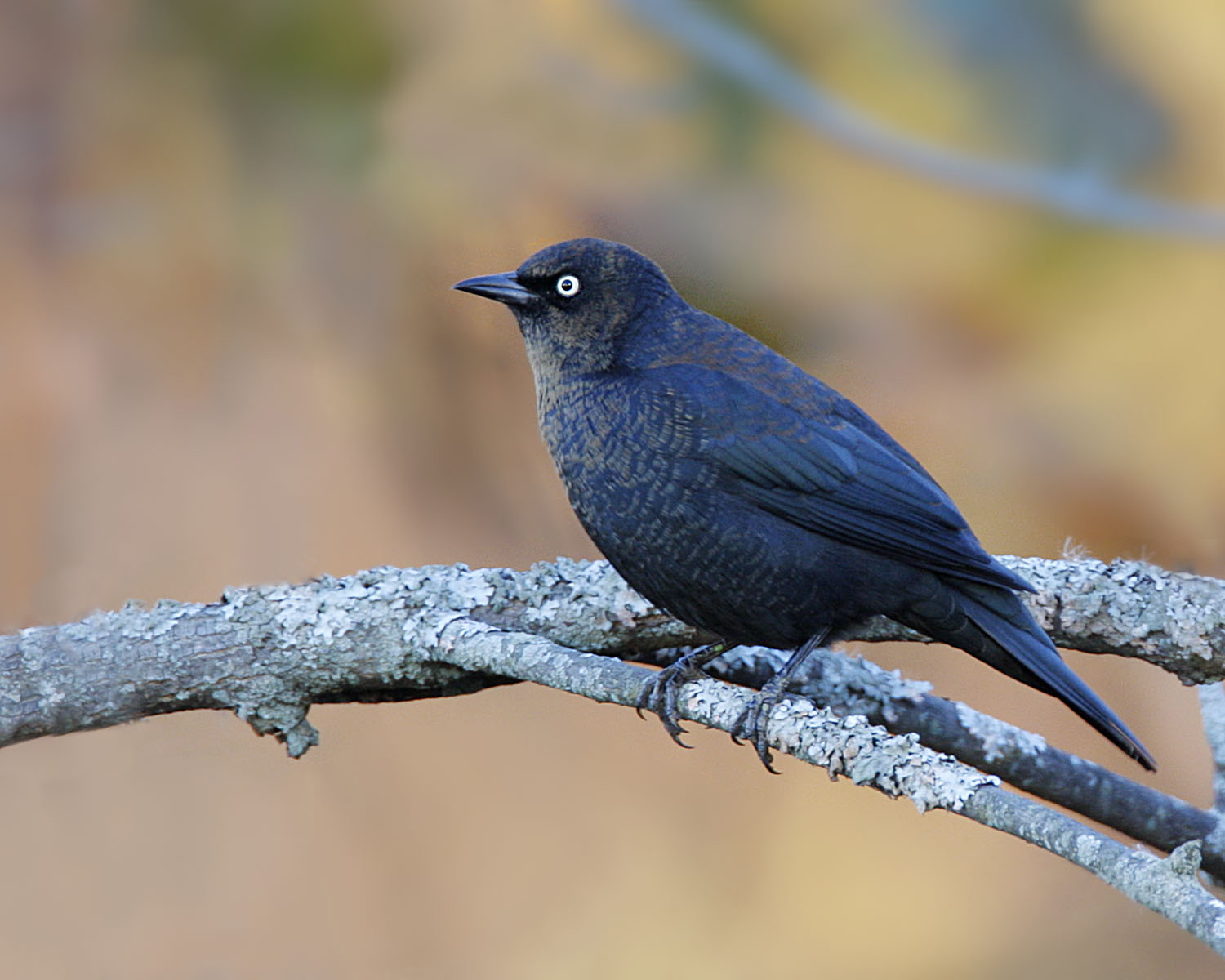
Rusty Blackbird
©Jeff Nadler
The boreal forest provides habitat for threatened species such as the Rusty Blackbird, Yellow Rail, and Whooping Crane. Conserving those and other species will require maintaining human activities in the forests at a sustainable level.

Sunday, September 25, 2011

A Threat to the Winter Refuge of Whooping Cranes?

If you have been following weather news in North America, you may be aware that Texas is in the midst of a prolonged drought that is extreme even by that state's standards. That drought has been exacerbated by one of the hottest summers on record. That situation is unpleasant for the people who live there and sets up battles over water rights. One of them concerns the winter residence of endangered Whooping Cranes.

Whooping Cranes at Aransas National Wildlife Refuge / USFWS
The western migratory population of Whooping Cranes breeds in Wood Buffalo National Park in northern Canada and migrates south to Aransas NWR for the winter. The refuge protects freshwater and brackish marshes where the cranes can forage. Unfortunately these marshes are now threatened by the recent drought to the extent that their water chemistry is changing. Conservationists are seeking to change water usage upstream along the Guadeloupe River to protect the cranes' winter home.
In drought-stricken Texas, heavy water use by chemical plants, refineries, and cities has left less fresh water for estuaries downstream, helping raise salinity levels in the coastal marsh 175 miles southwest of Houston. So environmentalists have sued state regulators to restrict water use along the river to protect the habitat of the last wild flock of whooping cranes that spend each winter there. But Dow Chemical (DOW), with a plant just upstream from the cranes, says it was there first. Citing the state’s first-come-first-served water-use regulations, Dow claims permits dating back to the 1940s allow it to use as much of the Guadalupe River’s output as it wants.

All this will be aired in federal court in December in a case that threatens to upend long-standing water rights....

Due to Texas’ historic drought, the Guadalupe’s flow is down by more than 60 percent at Victoria, roughly 20 miles upstream from the Aransas National Wildlife Refuge, the cranes’ winter range. In September the refuge’s marshes were three times saltier than normal. The birds migrate from Canada each year to spend the winter feeding on crabs and berries along the Texas coast. The U.S. Fish and Wildlife Service counted 571 wild and captive whooping cranes in July 2010. The Aransas group makes up half that number and is the world’s last migrating flock that can sustain itself in the wild.

The coastline from just east of the cranes’ refuge to the Louisiana border bristles with the world’s largest concentration of petrochemical and refining complexes, many of which rely on river water. An association including owners of five petrochemical plants near the refuge, including Dow, DuPont (DD) and Lyondell Basell (LYB), several power plants, and a nearby steel mill, have sided with Texas authorities to defend the allocation system, while some coastal towns and businesses that rely on healthy bays and estuaries support the environmentalists.

The two sides are far apart. LaMarriol Smith, the river authority’s spokeswoman, says that giving more water to the cranes “could basically wipe out economic development, especially in the lower end of the basin.” Yet Charles Smith, a county commissioner in Aransas County, counters that his county’s economy depends on tourists who fish, hunt, and bird watch along the coast and commercial fishing that relies on proper salinity levels maintained by adequate freshwater inflows. Says Smith: “Estuaries are the most productive zones on the planet—the cradle of life—and I think our cradle is being robbed.
It should be noted that this is not a simple conflict between birds and petrochemical companies. There are residents upstream who need drinking water, and there are fishermen downstream whose livelihoods depend on healthy estuaries. Ecotourism provides an additional economic incentive to maintain the estuaries. The endangered status of the Whooping Cranes may be the legal tool used to save the marshes, but if the suit succeeds, they are unlikely to be the only beneficiaries of a change in water rights.

Tuesday, January 18, 2011

A Saner View of Bird Deaths

Since the first mass bird deaths were reported on New Year's Day, a new round of proposed explanations has accompanied each additional bird kill – some plausible, others far-fetched, still others downright loony. The reality is that there are many bird deaths every day. Some birds die from natural causes or predation, and others are killed because of dangers introduced by humans. This article puts the deaths into some perspective:

Even without humans, tens of millions of birds would be lost each year to natural predators and natural accidents — millions of fledglings die during their first attempts at flight. But according to the Fish and Wildlife Service, people have severely complicated the task of survival. Although mortality rates are difficult to calculate for certain, using modeling and other methods like extrapolation from local research findings, the government has come up with estimates of how many birds die from various causes in the United States.

Some of the biggest death traps are surprising. Almost everyone has an experience with a pet proudly bringing home a songbird in its jaws. Nationally, domestic and feral cats kill hundreds of millions of birds each year, according to the government. One study done in Wisconsin found that domestic rural cats alone (thus excluding a large number of suburban and urban cats) killed roughly 39 million birds a year.

Pesticides kill 72 million birds directly, but an unknown and probably larger number ingest the poisons and die later unseen. Orphaned chicks also go uncounted.

And then there is flying into objects, which is most likely what killed the birds in Arkansas. The government estimates that strikes against building windows alone account for anywhere from 97 million to nearly 976 million bird deaths a year. Cars kill another 60 million or so. High-tension transmission and power distribution lines are also deadly obstacles. Extrapolating from European studies, the Fish and Wildlife Service estimates 174 million birds die each year by flying into these wires. None of these numbers take into account the largest killer of birds in America: loss of habitat to development.

All of this explains why about a quarter of the 836 species of birds protected under the Migratory Bird Treaty Act are in serious decline. For a third of the other birds there is not enough information to be sure about the health of their populations.
It is unfortunate that conservationists and responsible reporters have had to counter misinformation in the aftermath of several large bird kills. However, it is good to see more information on human-induced bird deaths making it into mainstream publications. Most of the numbers above were familiar to me, as I expect they will be to many readers. But that is a result of my reading bird blogs and conservation-oriented magazines over the past decade. It would be helpful for bird conservation if more people became aware of how many bird deaths are caused by common hazards.

Wednesday, January 05, 2011

Mystery Bird Deaths, on a Massive Scale

New Year's Eve in one Arkansas town was the occasion for a mass die-off of Red-winged Blackbirds – about 5,000 by most accounts. Since then, another 500 blackbirds have died in Louisiana.

Today it emerged that about 500 red-winged blackbirds and starlings had been found dead in Louisiana. Their tiny corpses littered a short stretch of highway near the city of Labarre after apparently falling dead from the sky.

That would be spooky enough. But the Louisiana bird die-off came just a few days after up to 5,000 blackbirds fell to earth in neighbouring Arkansas in the small town of Beebe. Residents there had reported stumbling upon the bodies littering the ground and even being hit by them as they fell. One woman said she was struck while walking a dog. Another avian corpse bounced off a police car.

In even more grim news, anglers and other members of the public reported that more than 80,000 drum fish had suddenly died in the state's Arkansas river, about 100 miles west of Beebe. The silvery bodies of the fish floated in the river and washed up on its sides having died at roughly the same time. In another incident, hundreds of miles away on the Maryland coast of Chesapeake Bay, tens of thousands of dead fish also washed up on the shore.
Local biologists ascribe the deaths in Arkansas to shock, either from a storm or from fireworks.
The birds' deaths, however, are a deeper mystery. Officials were still collecting bodies in Louisiana but have already examined those from the incident in Arkansas.

They concluded that the birds had suffered internal trauma. That could have happened if a single flock had suddenly got caught in a violent and unusual storm. Or, it has been speculated, a local fireworks display could have startled the birds so badly that they were unable to prevent themselves from flying into trees, pylons and houses....

Louisiana's state wildlife veterinarian said yesterday at least some of an estimated 450 birds that died near Baton Rouge may have flown into a power line.

Jim LaCour said that the grackles, starlings, brown-headed cowbirds and red-winged blackbirds had broken beaks and backs.
These are all strange events, even if the explanations turn out to be correct. Mass bird deaths happen and are reported fairly regularly. In most of those cases, though, the reason turns out to be poisoning, through bait left out for other animals. If the Arkansas event was precipitated by the fireworks show, I wonder how many other times fireworks shock birds enough to kill them.

Thursday, November 04, 2010

Bad Use for a Beer Can

Someone in the San Francisco Bay Area has apparently been capturing gulls and putting beer can collars around their necks. As you might expect, this is cruel to the gulls and violates federal law. If you live in the Bay Area and see one of the gulls, let the International Bird Rescue and Research Center know by calling (707) 207-0380 Ext. 110 or emailing no_cal_center@ibrrc.org.

Thursday, July 15, 2010

Canada Goose Cull in Prospect Park

Ever since US Airways Flight 1549 crash-landed in the Hudson River after hitting a flock of geese in 2009, aviation officials and the U.S. Department of Agriculture have sought to reduce and harass New York City's Canada Goose population. Flocks of geese have been chased away from the city's airports, and some resident geese have been culled. Last week, the control effort became very noticeable to residents when all of the 400 Canada Geese in Brooklyn's Prospect Park disappeared overnight.

On Monday, the answer emerged. Wildlife biologists and technicians had descended on the park Thursday morning and herded the birds into a fenced area. The biologists, working with the federal Agriculture Department, then packed the geese two or three to a crate and took them to a nearby building where they were gassed with lethal doses of carbon dioxide, Carol A. Bannerman, a spokeswoman, said.
This was one of the largest culls so far; last summer 1,235 geese were killed. The culls are timed to catch the geese when they have molted their flight feathers and temporarily cannot fly. A summer cull traps mostly resident breeding geese, not the migratory geese that arrive in the fall and depart in the spring.
Most of the geese at the park were probably year-round residents, said Paul D. Curtis, an associate professor of wildlife sciences at Cornell University. Dr. Curtis said there were two types of Canada geese in the region: those that migrate north to nest during the summer and those that stay close to the city. Even to biologists, Dr. Curtis said, they are nearly indistinguishable.

In the early 1900s, Canada geese were nearly extinct. In an effort to rebuild the population, they were brought to New York from the Midwest. In the 1930s, geese were added to be hunted.

Agriculture Department specialists started removing geese this year in mid-June. They expect to complete their schedule of roundups by the end of the week, Ms. Bannerman said.

Elsewhere in the country, nuisance wildlife birds are usually chased away by border collies or firecrackers. But in New York, Ms. Bannerman said, there is no relocation program for the geese, and they must be euthanized. Another method for controlling the birds is coating their eggs with corn oil, to prevent them from hatching.

The carcasses of the Prospect Park geese will be double-bagged and dumped in a landfill. Other states use different methods, like turning the geese into food or animal feed. This year, the Agriculture Department donated 900 pounds of goose breast to food pantries in Pennsylvania.
Many residents are upset about the disappearance of the geese. Some are venting in Corey's thread about the cull on 10,000 Birds. That the cull targets resident geese raises my eyebrows a bit. Forensic tests in the wake of the Flight 1549 incident showed that the geese involved were migratory, most likely from Labrador. Given that knowledge, I wonder whether a cull of resident geese is really necessary. Now there may be good reason for culling resident geese, but it seems wasteful without a direct link to air safety. It also seems wasteful that the dead geese are just being dumped in a landfill.

Wednesday, February 24, 2010

Wind Farm Proposed for Puerto Rican IBA

A wind farm has been proposed for a site within Puerto Rico's Karso del Sur Important Bird Area.

The windfarm was proposed for construction on forested land that is both ecologically fragile and exceptionally important for biodiversity. This karst limestone area has been designated by the Department of Natural and Environmental Resources as a 'High Conservation Priority' and borders the Guánica Biosphere Reserve.

The forests and shrubland in this IBA are home to 19 (of the 23) restricted-range species found on Puerto Rico and the Virgin Islands, including the largest known population (c.20% of the total) of the Critically Endangered Puerto Rican Nightjar Caprimulgus noctitherus. The IBA also supports a regionally significant breeding population of Roseate Tern Sterna dougallii. Small numbers of Brown Pelican Pelecanus occidentalis nest on Don Luis Cay—one of the few nesting locations for the species in Puerto Rico.

"There are alternative and better locations for wind projects in Puerto Rico. However, the proponent refused to negotiate an exchange of development rights to relocate the project to an appropriate place", said SOPI spokesperson, Luis Silvestre.

The location for this particular development was deemed inappropriate. It was expected that construction and operation of the industrial windfarm would have caused significant negative impacts to the area's unique habitat and biodiversity. The area is also home to Puerto Rican Crested Toad Peltophryne lemur and the endemic Blue-tailed Ground Lizard Ameiva wetmorei. The IBA has more than 700 plant species including the Critically Endangered Woodbury's stopper Eugenia woodburyana, Vahl's boxwood Buxus vahlii and Puerto Rico manjack Cordia rupícola, and the Endangered lignumvitae Guaiacum officinale and Stahlia monosperma.
I support wind energy when thorough environmental reviews are completed and turbines are sited and operated in ways that cause the least amount of damage to birds and other wildlife. This project is an example of exactly what not to do. Wind farms can harm wildlife in two ways. One way involves bird collisions with the blades or turbine towers; this is probably the best known danger. In addition, bats may be harmed by changes in pressure around the blades.

The second way wind farms harm wildlife is through the destruction and degradation of their habitats. Land needs to be cleared for the turbine site and for roads to transport construction material to the site. What wildlife habitat then remains around the site will be more vulnerable to invasive species and less able to support species that specialize in the habitat that was cleared.

Clearing land and building an industrial wind farm in an Important Bird Area should be out of the question, especially in an area with so many sensitive and restricted-range species. Putting turbines in a bird-rich area like an IBA is likely to result in too many collisions, some of which will be critically endangered birds like the Puerto Rican Nightjar. Many of the species that inhabit the IBA are classified as critically endangered or endangered precisely because their range is so small. Any further range reductions that occur because of destroyed habitat will hasten the species' slide towards extinction. For those reasons, building a wind farm at sites like this will not be appropriate. I am glad to see that the Planning Board of Puerto Rico has blocked the site permit.

Saturday, December 12, 2009

Some Good News for Migratory Raptors


Earlier this week, the U.S. House of Representatives passed H.R. 2062, the Migratory Bird Treaty Act Penalty and Enforcement Act, by a voice vote. (Search thomas.loc.gov for the bill number if the link does not work.) The bill increases penalties for killing birds protected under the Migratory Bird Treaty Act. Particularly egregious killings would be treated as felonies with a fine of up to $50,000 and/or imprisonment for up to two years.

A version of this bill has first introduced by Rep. Peter DeFazio (D-OR) two years ago in response to high-profile arrests of several roller pigeon racers. Roller pigeons have an unusual trait that leads them to tumble in midair; this in turn attracts the attention of raptors who see them as an easy meal. These particular individuals were caught because they admitted systematically killing raptors to undercover agents. The U.S. Fish and Wildlife estimates that roller pigeon clubs were responsible for the deaths of up to 3,000 raptors annually on the West Coast.

The bill still needs to pass the Senate, but since the terms do not seem particularly controversial, it ought to pass.

Monday, October 26, 2009

Sage Grouse and Energy Development in the Intermountain West


A new study of Greater Sage Grouse predicts that continuing energy development along current lines would lead to a 7-19% reduction in the Greater Sage Grouse population.
Sage-grouse populations are considered indicators of ecosystem health and have been closely monitored by state game and fish agencies over the past decade. The greater sage-grouse is currently a candidate for Endangered Species listing -- a result that would have far reaching implications for a wide range of industries in the region.

"Sage-grouse are useful in prioritizing conservation because their abundance is indicative of large and intact shrub-dominated grasslands, the most endangered ecosystem in North America," said study co-author, Dr. David Naugle, Associate Professor, University of Montana. "Challenges with sage-grouse are a harsh reminder that the value of small-scale conservation actions may be negated if large-scale cumulative impacts are ignored."

The new study and its detailed maps of the Intermountain West indicates that future oil and gas drilling could impact up to 9.1 million acres of sagebrush shrub lands and 2.7 million acres of grasslands -- key sage-grouse habitat.
How to balance energy production and the welfare of Sage Grouse and other grassland animals is a pressing issue. Demand for energy is constantly increasing due to population growth and new technologies, as well as economic development elsewhere in the world. Since 1950, energy demand has increased by 50%, and the same increase is expected over the next two decades. As a result, governments and the energy industry feel the need to expand energy production into areas where it would probably be better if they did not go. Drilling on the grasslands of the intermountain west is detrimental to a variety of grasslands specialists, especially the Greater Sage Grouse.

It would be better for the energy companies if they could figure out how to reduce their impact on grasslands now. If not, Greater Sage Grouse will have to be listed as an Endangered Species (it probably should have been listed already), and more severe restrictions will have to be set until the population is stable again. Unfortunately this press release does not offer any suggested solutions; I am not sure if the authors of the study do.

Thursday, September 17, 2009

Charges Filed in Syncrude Duck Deaths Case

Here is a brief update on the Syncrude incident from May 2008. If you remember, 1,603 wild ducks landed in a retention pond holding the toxic oil tailings that result from Syncrude's oil sands operation. The company faces charges of violating both the federal Migratory Birds Convention Act and provincial environmental laws. It just pleaded not guilty and plans to fight the case.

Robert White, Syncrude’s lawyer, later told reporters the oil company has already expressed “deep regret” and “spent a tremendous amount of money to ensure it didn’t happen again.”

“To now charge us and bring us to court is not going to bring back 1,603 ducks,” he added.

Mr. White rejected a reporter’s question about whether Syncrude thought it was above the law.

“Of course not,” he said. “However, the law has recognized for a long time that when people do their best to avoid something, then that isn’t a matter for charges. That’s a matter for fix-up.”
I am glad that the company has acknowledged the problem and apologized. The trouble for Syncrude is that this is not a single isolated incident. It has a long record of migratory bird deaths, with hundreds of bird dying in its tailings ponds annually. The company clearly needs to do more to prevent these deaths from happening, and it is right for the Canadian government to enforce its laws.

Now if only the government had a good solution for the other environmental problems with the oil sands industry.