Showing posts with label Kingman Island. Show all posts

Sunday, April 29, 2007

Greenhouse Gas Emissions Increase in DC Area

The Washington Post reports that greenhouse gas emissions in the DC metropolitan area have increased rapidly over the past five years. From 2001-2005, greenhouse gas emissions have increased by about 5.6% nationally. Around Washington, D.C., emissions rose by 13.4% over the same period. The main culprit seems to be the rapid growth of the city's exurbs, which require longer commutes between work and home, and an increased need for electricity as a result of new real estate development.

Emissions jumped the most in suburban Virginia, where the estimate shows an increase of more than 18 percent. Emissions from the Maryland suburbs grew less, about 11 percent, but that rate still outpaced the country's.

The brightest news came from the District, where emissions grew 6.7 percent. D.C. officials said they think the relatively low increase is partly a sign of changing behavior: Residents were leaving their cars at home and walking, biking or taking public transit.
The continued increase in emissions, which has outpaced population growth in the region, makes the passage of emission reduction legislation more pressing. In particular, the clean cars initiative should help to reduce at least some emissions (see here). Virginia's emissions problems are stickier because of exurban development, and reduction there will probably not happen unless adequate public transportation connects those exurbs to D.C. The good news is that the Orange Line will eventually be extended; the bad news is that the extension will still leave quite a lot of northern Virginia without easy Metro access.

Kingman Island

In other local news, Kingman Island had its grand opening yesterday. Kingman and Heritage Islands, in the Anacostia River near RFK Stadium, will eventually host an environmental education center and nature trails. For the moment they are still closed to the public at most times. The future of the center appears somewhat uncertain since funding remains a problem. However, the times seem propitious for Kingman to become a valuable resource for the District.

Saturday, April 21, 2007

Anacostia Watershed Cleanup

Today I participated in an Earth Day cleanup, sponsored by the Anacostia Watershed Society and the Earth Conservation Corps. The cleanup was conducted throughout the Anacostia Watershed. I was among the 200 volunteers who worked on lower Kingman Island.
Kingman and Heritage Islands were both created from dredge spoil when the Anacostia River was dredged in the early twentieth century. In the late 1990s, residents stopped an attempt to build a large amusement park on the two islands. At that time, the District agreed to restore the islands as a nature preserve and build an environmental education center on lower Kingman. (See the master plan, tree groves project, and AWC Kingman Island page.)

At the end of the cleanup, ECC leaders announced that volunteers had collected 321 bags of trash. That figure probably did not include the corroded chairs, metal pipes, bricks, and various car parts that were lined up for removal. The contents of my two trash bags consisted mostly of styrofoam objects. They were a lot of coffee cups, with some fast food containers and plates. Then of course there were smaller helpings of bottles and aerosol cans. (A few areas had lots of plastic bottles, but I was not in one of them.)

One area where I worked was loaded with garlic mustard. In fact I came across several areas infested with the noxious stuff as I walked up and down the island. I was tempted to work on removing that instead of the trash, but there was far too much for one person - even in that relatively small area.

As I picked up trash and debris, I noted many birds around me. Northern cardinals, white-throated sparrows, and American goldfinches were singing with full voices up and down both islands. A Caspian tern flew upstream along the river at the beginning of the morning; as the cleanup ended, a common yellowthroat was singing near the bridge on lower Kingman. Being close to the ground made me more attentive to mollusks (or ex-mollusks), pictured at left. One snail shell in particular was quite beautiful. The table below shows the animals I noted in the course of the day.

SIGHTINGS

BIRDS:
29 species
Double-crested Cormorant
3
Great Blue Heron
1
Canada Goose
6
Mallard
4
Osprey
2
Bald Eagle
1
Killdeer
2
Ring-billed Gull
5
Caspian Tern
1
Rock Pigeon
10
Belted Kingfisher
1
Downy Woodpecker
1
Northern Flicker
1
Tree Swallow
5
Northern Rough-winged Swallow
2
Carolina Wren
2
American Robin
10
Carolina Chickadee
2
Fish Crow
1
European Starling
5
Common Yellowthroat
1
Chipping Sparrow
1
Song Sparrow
1
White-throated Sparrow
10
Northern Cardinal
10
Red-winged Blackbird
5
Common Grackle
15
American Goldfinch
20
House Sparrow
2


MAMMALS:
1 species
Beaver
1


INSECTS:
5 species
Cabbage White
1
Clouded Sulphur
1
Spring Azure
1
Mourning Cloak
1
Damselfly sp.
2


MOLLUSKS:
4 species
Gastropod sp. #1
1
Ventridens ligera (?) *

4
Bivalve sp.
1
Leopard Slug
1


REPTILES:
1 species
Eastern Painted Turtle
2

* Thanks to Aydin for suggesting an identification.

This weekend is the start of National Wildlife Week. Some bloggers are participating in the first annual Blogger BioBlitz and posting photos to the NWW Flickr Group in honor of the occasion.

Update: See the Washington Post for coverage of Saturday's cleanup at other locations. The article included this excerpt:
One crew from Washington Community Fellowship Church on Capitol Hill and the city's Cornell Club worked on a section of the river under the New York Avenue bridge. They found an old chair, plastic toys and a seemingly lifetime supply of 7-Eleven cups and McDonald's containers.

"The amount of Styrofoam was amazing," said Cornell Club member Cheryl Martson. "I will never use Styrofoam again."
I can understand that feeling.

Saturday, May 20, 2006

Canada Geese and Anacostia Wetlands

The Anacostia River has long suffered from neglect and pollution. Just recently it was branded as one of the most polluted rivers in America, after up to 68% of brown bullhead catfish from the river were discovered to have liver tumors. In the last few years, the District government has focused on ways to clean up the river and "revitalize" the waterfront.

A large part of the publicity has focused on economic development, which is being overseen by the Anacostia Waterfront Corporation, a semi-public entity. The economic development includes the new baseball and soccer stadiums being built at the mouth of the Anacostia, as well as other initiatives. Somewhat less publicity has been given to efforts to restore the Anacostia wetlands that formerly provided habitats for many animals and would improve the water quality dramatically by removing excess nutrients.

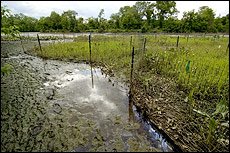
Over a decade ago, the wetlands of Kenilworth Marsh were rebuilt into a healthy ecosystem. Now, the focus is on Kingman Lake. Since 2000, there has been a major effort to replace the wetlands south of Benning Road that were destroyed by an Army Corps of Engineering project in the early twentieth century. Initially the restoration program was successful; the ground was built up, native marsh grasses were planted in fenced areas, and the plants thrived. But this did not last last when fences were removed.

This week's Washington City Paper has profiled one of the major challenges in restoring the former wetlands on the Anacostia: resident Canada Geese. Whenever fencing around replanted grasses came down, either because it was removed or because it fell down, geese would enter the replanted areas and eat down the grasses. In the second year of the project, geese ate 80% of the area that had been replanted the year before. What is worse, the resident geese eat the grasses all year, including in the summer when the same plants could be used by bitterns, rails, and other migratory marsh birds. The resident Canada Geese are a midwestern subspecies imported for hunting in the 1950s; it is the largest subspecies, Branta canadensis maxima, and it is extremely sedentary.

One measure of the success of marsh restoration is the success of wild rice, a dietary staple for both songbirds and gamebirds. Unfortunately, the Canada Geese love wild rice as well, and will eat the plants down - grains, leaves, stems, and all. Planting unpalatable species might discourage the geese, but would likely have the same effect on the animals the restoration is supposed to attract.

The options to solve the population issue all have problems. The current situation - spending millions on replanting only to have the plants mowed down - is clearly not tenable. Scaring away geese with dogs and various noisemakers only works temporarily; geese come right back as soon as the show is over. Egg addling will keep the population in check, but will not lead to a significant decrease for some time; this option has been in use for several years already. Lethal control, an option now under consideration, would reduce or eliminate most resident geese, has its own ethical questions and would certainly face public opposition and lawsuits.

What will happen with the marsh restoration project remains to be seen. Rebuilding the Anacostia wetlands is a key part of restoring a healthy river. Because the river is part of the Chesapeake watershed, improving water quality here has a regional impact as well. Unfortunately the project cannot make significant progress with the current balance.