Showing posts with label National Mall. Show all posts

Friday, June 22, 2007

Evening on the Mall and Two Years of Blogging

After a week of hot and sticky weather, today was actually fairly comfortable. This evening I walked over to the Capitol to enjoy the change.

As usual, there is a contingent of mallards on the Capitol's reflecting pool. Some were guarding ducklings. Most of the males were molting, as in the photograph below. One hooded merganser was swimming by itself in the middle of the pool.

Red-winged blackbirds take advantage of the lush foliage of the Indian Museum's wetland pond. I am pretty sure they breed here, but I have yet to spot a nest.


All around the Mall, I could hear the begging calls of young birds. The mockingbirds below were in the midst of an exchange in a tree on the Capitol's west lawn.

I missed my blogiversary earlier this week. I started this blog two years ago on Monday. Now, over 900 posts later, I cannot believe the time has passed so quickly.

Saturday, June 16, 2007

The Sinking of the Jefferson Memorial

The Washington Post reports today that the Jefferson Memorial is having problems with stability because the land around the memorial is sinking.

The big problem seems to be a section of the sea wall that is breaking from the memorial's plaza and settling into the Tidal Basin. The "ring road" along the memorial's circumference also seems to be shifting, officials say.

Such movement is an alarming -- and chronic -- problem at the Jefferson Memorial, which was built in the late 1930s and early 1940s atop pilings and caissons sunk into an artificial mud flat that is about 100 feet deep. Engineers have been struggling for decades to keep everything firmed up.

[...]

Since then, the western section of the sea wall, which separates the memorial complex from the Tidal Basin, has dropped in places about six inches below the plaza, which it adjoins.

And the ring road, which wraps around the memorial, has also slipped several inches in spots. It is patched where it meets the plaza.

[...]

Park officials are also concerned about the flooding that for the past few years has inundated parts of the southern rim of the Tidal Basin just west of the memorial at high tide. The water covers sidewalks and landscaping and forces the park to close walkways and post signs about the high tides.
The core issue is that the monument is built on top of fill that was dredged from the Potomac River during a project to deepen a shipping channel. While the engineers took steps to ensure stability, such as driving pilings to the bedrock, the site has had problems with subsidence from the beginning. I have noticed this problem myself during my occasion walks along the Tidal Basin and Hains Point. At several points, the sidewalk takes a funny angle, does not align with the seawall, or appears to have little supporting it underneath. I am glad to see that NPS engineers are on the case.

Saturday, March 31, 2007

Flicker Fallout

This morning I birded at the National Arboretum. I was looking for some specific early-spring migrants, so I started out in the state tree grove. This is an area with lots of pines, and so it frequently has a pine warbler or two in March and April. Sure enough, there was one singing, but it would not show itself.

While the pine warbler made itself invisible, other birds let themselves be seen. In particular, there were a lot of northern flickers hanging around the state tree grove and picnic area. When I say "a lot," I mean something like two dozen. There were flickers on the ground, there were flickers in the trees, there were flickers in flight, there were flickers everywhere I looked. These must have arrived in a major wave last night.

There was a native plant symposium today, so the grounds were more crowded than usual, mainly around the visitor center where there was a plant sale. Fortunately, the Arboretum is large enough that I can bird in relative peace despite the presence of a busy symposium. The species count is a little low today because I focused my attention on a few less birdy areas to look for specific birds.

SPECIES SEEN: 28

Canada Goose
Mallard
Turkey Vulture
Red-tailed Hawk
Ring-billed Gull
Rock Pigeon
Mourning Dove
Yellow-bellied Sapsucker
Downy Woodpecker
Northern Flicker
Pileated Woodpecker
Eastern Phoebe
Golden-crowned Kinglet
Northern Mockingbird
Eastern Bluebird
American Robin
Carolina Chickadee
Tufted Titmouse
Blue Jay
European Starling
Pine Warbler
Eastern Towhee
Chipping Sparrow
Song Sparrow
Dark-eyed Junco
Northern Cardinal
Common Grackle
Brown-headed Cowbird

Thursday, March 22, 2007

Spring

Magnolias at the National Gallery

Daffodils at the Capitol

I saw two raptors this afternoon. As I was waiting to cross a street downtown, I saw a peregrine fly past. It circled twice overhead and then flew off. Later in the evening, I spotted a Cooper's hawk perched at the top of a tree on the Capitol's west lawn. It took off and went into a glide, scattering the grackles in nearby trees.

Sunday, March 18, 2007

A Day for LBJs

Birders have adopted a term "little brown jobs" (abbreviated "LBJs") as shorthand for any of the small brown bird species. "LBJ" refers principally to sparrows, but may include female finches, female buntings, pipits and larks, some warblers, some icterids, and even some thrushes, depending on one's perspective. The term expresses the mix of frustration and endearment that birders feel towards small brown birds. Perhaps the frustration of trying to differentiate cryptic birds is more prevalent. But even the most frustrated birder can find something to like among the small brown birds. These are, after all, among the most common birds that we encounter out in the field. Even in the city, it is hard not to see a few on any given walk. Today I saw more than my usual share of LBJs.

I started out at Constitution Gardens, and immediately I saw an adult bald eagle circling the Washington Monument. The lake at the gardens held basically the same group of waterbirds as the last time I visited: American wigeons, ring-necked ducks, lesser scaup, American coots, and superb redheads. A new waterbird species for this week was pied-billed grebe. The number of common grackles on the Mall has been building, and today I saw my first red-winged blackbird of the year. A few song sparrows and many robins worked the grassy areas around the lake.

From there I walked over to the DC WWI Memorial. As usual, the area around the memorial was quiet, but the azalea bushes held a trio of fox sparrows. All three let me approach closely for better looks at their rich rufous plumage.

The Tidal Basin and river held numerous double-crested cormorants. Cormorants are clearly making a push northward, but I am not sure that their numbers have peaked yet. Lesser scaup are also on the move. There were several large flocks on the Tidal Basin, river, and Washington Channel. Red-breasted mergansers are also passing through. A sure sign of spring is the return of the railroad bridge ospreys. One was arranging the nest on top of the trestle, and a second was perched on the piling below.

As I made my way south to the point, strong winds made it difficult to see what might be on the river. So I stayed close to the golf course fence instead. As a result, I got a decent look at a swamp sparrow. Near the point I deviated from my original plan and approached the river walk again. As a result of that chance decision, I saw two American pipits on the concrete path. This was a chance sighting in a second way as well; since the first bird I saw on the path was a song sparrow, I assumed the others would be as well, but took a second look anyway. (It is always a good idea to take a second look!) It was only then that I noticed the thrush-like posture, ungainly strut, and bobbing tail that are characteristic of American pipits. This was an exciting sighting since I have only seen pipits once before. There was a third pipit on the other side of the point. At the tip of Hains Point, I spotted three Bonaparte's gulls among the fleet of ring-billed gulls.

On the way from Hains Point, I encountered yet another odd LBJ. After checking through the various field marks - notched tail with white outer feathers, white eye ring, white supercilium with hatching, striped breast, etc. - I determined that the bird was a vesper sparrow. Like today's fox sparrows, this vesper sparrow was very cooperative and stayed in the grass about five feet away while I examined it in detail. It is not every day that one gets such a good look at an unusual bird.

Before calling it a day, I stopped by the Indian Museum to check the wetland display. Oddly enough, that was where I saw my first white-throated sparrows of the day. I am not sure how I went almost a whole day without seeing them. A final treat was a Cooper's hawk circling the Capitol's reflecting pool.

SPECIES SEEN: 41

Pied-billed Grebe
Double-crested Cormorant
Canada Goose
American Wigeon
Mallard
Redhead
Ring-necked Duck
Lesser Scaup
Red-breasted Merganser
Osprey
Bald Eagle
Cooper's Hawk
American Coot
Ring-billed Gull
Great Black-backed Gull
American Herring Gull
Bonaparte's Gull
Rock Pigeon
Mourning Dove
Downy Woodpecker
Northern Flicker
Eastern Phoebe
Golden-crowned Kinglet
Northern Mockingbird
American Robin
Tufted Titmouse
White-breasted Nuthatch
Blue Jay
Fish Crow
European Starling
House Sparrow
House Finch
American Goldfinch
Vesper Sparrow
Fox Sparrow
Song Sparrow
Swamp Sparrow
White-throated Sparrow
Dark-eyed Junco
Red-winged Blackbird
Common Grackle

Roll mouse over images for attribution and species name.

Sunday, March 04, 2007

Wind and Waterbirds

As I mentioned in a prior post, some redheads were reported in the course of the Great Backyard Bird Count, and were reported again this past week. Today I finally walked down to Constitution Gardens to look for them. Today was one of those changeable, blustery days typical of late winter with the sun going in and out of the constantly moving clouds. I have visited Constitution Gardens on such days before. The pond there is somewhat sheltered from the winds, so it provides an inviting resting point for waterfowl.

As reported, several redheads were in the Constitution Gardens lake. I counted six - four males and two females. Redheads are always a treat, so I stood and watched them bobbing in the midst of a small crowd of American wigeons, lesser scaup, and ring-necked ducks. Oddly enough, I have now seen redheads more frequently in DC than canvasbacks; that says more about the random character of finding waterfowl in this city than the species' relative abundance. Elsewhere on the lake, a few American coots with the lake's usual denizens. One was displaying the white underside of its tail; I am not sure of the meaning of this display - whether it is a sign of fear or a rush of hormones.

From Constitution Gardens, I walked past the WWII Memorial to the DC WWI Memorial. The reflecting pool was almost bone dry. A large flock of robins foraged in the leaves and bushes around the WWI Memorial. A small flock of juncos was also present, along with a small helping of white-throated and song sparrows.

The Tidal Basin held more lesser scaup, as well as both red-breasted and common mergansers. The biggest surprise was mammalian rather than avian. A beaver was sitting near the Tidal Basin's outlet bridge! Not having had a good look at one before, I was amazed by how large it was. Its presence may be bad news for the cherry trees, but I was certainly happy to see it.

Because of the strong northwest winds, birding along the river was nearly impossible. All I could find there were a few dozen lesser scaup. Conditions were better on the Washington Channel, which is more sheltered than the river side of East Potomac Park. There were yet more lesser scaup, the usual winter gulls, plus my first double-crested cormorants of the year (in D.C., anyway).

One reason I had pushed on to the river and the channel, even though I was somewhat tired by that point, was that I was hoping that I might find a pied-billed or horned grebe. The bad news is that I did not see either species. The good news is that I saw a red-necked grebe instead. Not only did I see one, but it was one of the best views I have had, of any grebe. Distinguishing winter-plumage red-necked and horned grebes can be tricky at a distance, but up close the differences in head and bill shape really stand out. This bird had the typical heavy and straight yellow bill that is typical of the red-necked variety, as well as the blocky head. (Horned grebes have a stubbier bill and more triangular head.)

It was a great day of birding, but by the time I got home, I was pretty worn out (thus the late post). While our temperatures are still in a relatively cold pattern, birds are clearly on the move. It is a trickle now, but in the next few weeks the pace will accelerate. If you live in Washington, go see the redheads and red-necked grebe while they are still around. With migration under way, they probably will not stay long.

SPECIES SEEN: 34

Red-necked Grebe
Double-crested Cormorant
Canada Goose
American Wigeon
Mallard
Redhead
Ring-necked Duck
Lesser Scaup
Red-breasted Merganser
Common Merganser
Turkey Vulture
Red-tailed Hawk
American Coot
Ring-billed Gull
Great Black-backed Gull
American Herring Gull
Rock Pigeon
Mourning Dove
Downy Woodpecker
Golden-crowned Kinglet
Northern Mockingbird
American Robin
Blue Jay
American Crow
Fish Crow
European Starling
House Sparrow
American Goldfinch
Song Sparrow
Swamp Sparrow
White-throated Sparrow
Dark-eyed Junco
Northern Cardinal
Common Grackle

Sunday, February 18, 2007

GBBC Day 3: Potomac Waterfront


Today I ventured down to the Tidal Basin and Hains Point to look for birds. The Tidal Basin was almost completely frozen over, with only a few ring-billed gulls standing on the ice. The Washington Channel was also mostly frozen. It was frozen across in some places, open in others, and partly open with chunks of floating ice in other places. The areas around the boat docks on the far side of the channel were mostly open; these patches held small groups of mallards and coots. Hundreds of the three local gulls huddled in large flocks on the ice. Other waterbirds included a red-breasted merganser on the channel and a dozen lesser scaup on the Potomac. I was surprised to find seven great-blue herons during my walk; they must have fled from other areas in D.C. to find open water. About half way to the point, I saw a merlin perched in a tree. It was quite close to the road and did not flush when I approached. A juvenile bald eagle was perched on the large snag at the end of the golf course, while crows mobbed around it. Not too many songbirds were visible around the park. Most of the songbirds I saw were clustered in a few areas sheltered from the wind.

In the late afternoon I walked over to the Indian Museum to see what was around. Mostly the birds were the same as on Friday, but I did find a couple swamp sparrows in the museum's wetlands area. As I stood to watch them, a snow shower suddenly arrived. The flakes fell so densely that I could not see the Capitol from the Museum. The snow fell furiously, but the shower did not leave much behind.

Checklist from Hains Point and the Tidal Basin:

Canada Goose1,400
Mallard17
Lesser Scaup12
Red-breasted Merganser1
Great Blue Heron7
Bald Eagle1
Red-tailed Hawk1
Merlin1
American Coot6
Ring-billed Gull440
Herring Gull285
Great Black-backed Gull90
Rock Pigeon22
Mourning Dove1
Downy Woodpecker2
Blue Jay4
American Crow25
Fish Crow20
Tufted Titmouse6
Golden-crowned Kinglet1
American Robin40
Northern Mockingbird1
European Starling40
Cedar Waxwing11
Song Sparrow1
White-throated Sparrow4
Dark-eyed Junco3
Northern Cardinal2
House Sparrow35

Checklist from the Indian Museum and Capitol grounds:

Mallard60
Ring-billed Gull40
Downy Woodpecker1
White-breasted Nuthatch1
American Robin25
European Starling65
Swamp Sparrow2
White-throated Sparrow7
House Sparrow12

Birders in Washington, D.C., have now broken the record for species reported for the GBBC in this city. As of 8:30 pm, the count for D.C. stood at 60 species; the record had been 59, set in 2005. That year also set a record for the number of submitted checklists with 51. So far this year, 32 checklists have been submitted, so we are unlikely to reach that record. However, this year will have the highest number of individual birds reported, with 6,216 so far. Below is the distribution map as of Sunday night.

Thursday, January 18, 2007

Thursday Gull Trio

It has been a while since I did a gull photograph post. Here is a trio of ring-billed gulls that I found at the Capitol's reflecting pool earlier this week. I took the photos in quick succession.


Tuesday, January 16, 2007

Capitol Birds

Yesterday afternoon I walked around the reflecting pool in front of the Capitol. Most of the birds there were ring-billed gulls like the birds above. There was a small flock of mallards as well. To my surprise, two lesser scaup - a male and female - flew past and landed in the middle of the pool. I think today was the first time I have seen scaup at that location.

Two red-tailed hawks were circling together over Constitution Avenue and landed on top of the Labor Department. Later I saw the two circling together again, and later still, I saw one perched in a tall willow oak on the grounds of the Capitol. Could we have a pair downtown? This will bear watching.

The Indian Museum wetlands had the usual flock of mallards. I saw that an unusual-looking duck had joined the flock again. My guess is that this bird is a mallard X black duck hybrid. It looks mostly like a black duck, but it has a green crescent running along the top and back of each side of its head.

Today's sunset was gorgeous. There was just the right mix of sun and clouds to make for a dramatic sky. I shot the picture above from next to the reflecting pool; the picture below was taken near the Senate office buildings.

Sunday, November 12, 2006

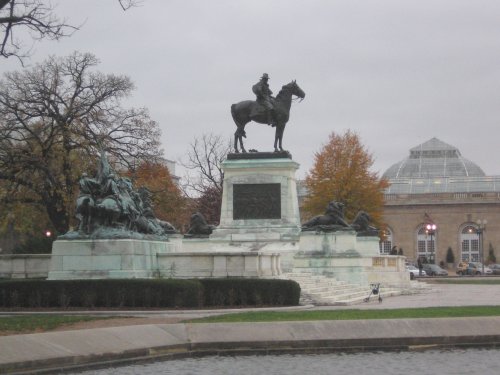
Gloomy Grant

Very few birds were in the vicinity of the reflecting pool this afternoon. No ring-billed gulls at all were present. They must have been taking cover from the wind and rain somewhere else.

Tags:

Thursday, November 02, 2006

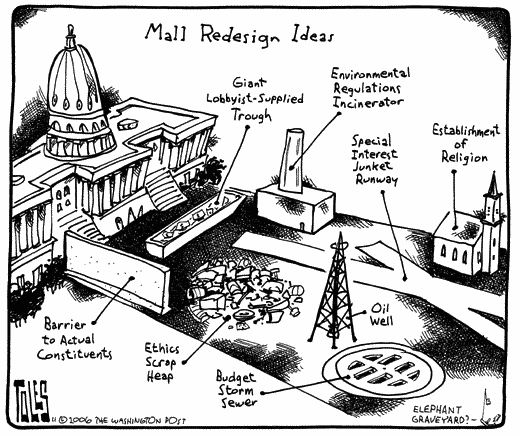
The New Mall

Following up on yesterday's story, here is a cynical view of what a redesigned National Mall may look like.

Cartoon by Tom Toles of the Washington Post.

Wednesday, November 01, 2006

Rethinking the Mall

The National Park Service is undertaking a major planning process to improve the National Mall. The goal is to create a new plan for the Mall on the scale of the century-old McMillan Plan. It will guide future building projects for museums and monuments, addition of amenities for tourists, and general improvement of the grounds. The Park Service is seeking comments from individuals around the country - both experts and visitors - to inform the process.

In addition to attracting millions of tourists and demonstrators, the Mall is also the preferred address for dozens of monuments, memorials and museums. Federal officials have tried to encourage pocket parks and intersections throughout the city as future sites for dozens of projects waiting in the wings, but the quandary is that everyone wants to be on the Mall.

Architects, planners, historians and tourists will be among those asked to suggest a future look and feel for the Mall: Should it be about formal gardens and fountains, or baseball games, gift shops and hot dog stands?

The Mall serves many purposes: It is the equivalent of Paris's fabled gardens of the Tuileries, the political gathering space of Beijing's Tiananmen Square, the open space of London's Hyde Park, the sports haven of New York's Central Park and the museum row of any international city.

Trying to meet all these demands in one space can create a park that is frayed, unable to handle the crowds and not true to its iconic nature.

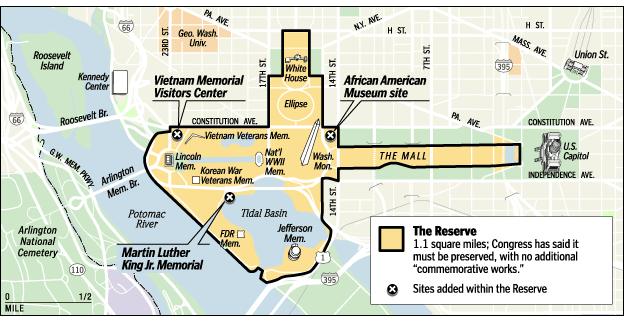
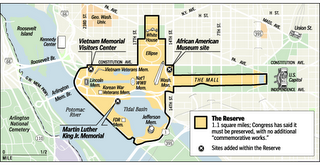
Some movement has already been made in this direction. Parts of the Mall are fenced during the winter to allow grass to recover. Congress has passed a Reserve Act to prevent further building in certain sections of the Mall to prevent them from being overcrowded. (Of course, it has not stopped several building projects since the law was passed.) The image below, from the Post article, shows the reserve area in yellow.
To comment on the Mall's future, you can visit the NPS website devoted to the project. Not all pages on that site are ready yet, so be patient with it.

Saturday, October 28, 2006

Fall on the Mall

The garden at the National Museum of the American Indian continues to turn up some good-for-downtown birds. This afternoon the bushes along 3rd Street SW were full of birds hopping and flying back and forth. There were loads of ruby-crowned kinglets, at least one hermit thrush, a first-fall male common yellowthroat, and plenty of white-throated sparrows. All of these were at very close range; all were within ten feet and many were within five feet of me.

The rest of this post consists of photographs from this afternoon on the Mall.

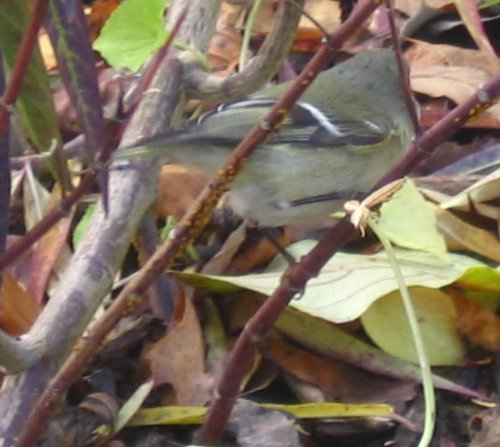
Two birds from the Indian Museum gardens: a mourning dove and a speedy kinglet.
The last two photographs are from the new garden adjacent to the U.S. Botantical Garden conservatory.

Wednesday, October 25, 2006

Gulls Are Back

Over the past month, ring-billed gulls have been returning to their usual winter haunts around downtown Washington. This morning I got to look at at mix of adult and sub-adult gulls around the reflecting pool in front of the Capitol. They are not quite up to their peak winter numbers yet, but they will be soon.

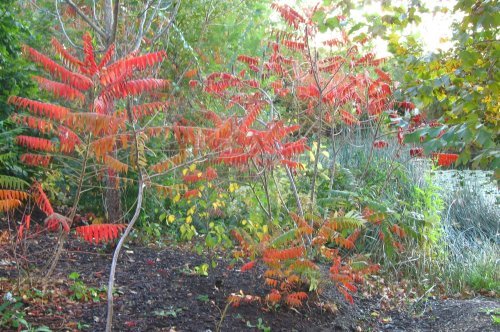
I stopped by the National Museum of the American Indian to see what was in the garden. Sumacs (pictured below) are blazing red right now. In addition to the usual white-throated sparrows around the pond, there was at least one lingering red-winged blackbird. Over in the squash garden on Independence Avenue, a common yellowthroat caught my eye. As I stopped to look at that bird, a winter wren popped out of the foliage! Not bad for downtown D.C.

SPECIES SEEN: 13

Mallard
Cooper's Hawk
Ring-billed Gull
Rock Pigeon
Mourning Dove
Winter Wren
Northern Mockingbird
Blue Jay
European Starling
House Sparrow
Common Yellowthroat
White-throated Sparrow
Red-winged Blackbird

Friday, October 06, 2006

New Addition to the US Botanical Gardens

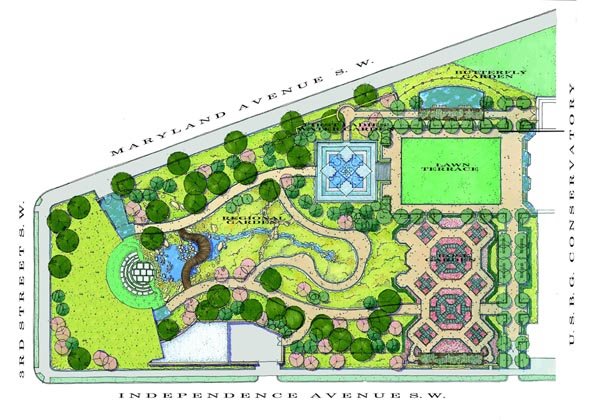
The U.S. Botanical Gardens, located on the west side of the U.S. Capitol, recently constructed a new three-acre garden. The National Garden opened to the public this past Sunday, October 1. It consists of several interlinked parts: an open lawn, a butterfly garden, a rose garden, and a garden of regional plants placed around a meandering stream. A fountain and amphitheater round out the garden. Right now, the gardens do not look like much because the plants are still very young. But I expect that in a year or two the beds will be bristling with flowers.

Unfortunately, the gardens are surrounded by a gated fence, and the access hours for the National Garden appear to match those of the Conservatory. So Bartholdi Park may still be the USBG's only option for an evening walk.

Plan of the National Garden / USBG

Of course, as a birder I want to know what the birding possibilities for the new gardens will be. The shrub cover is not quite dense enough to attract many species, and the downtown location makes bird diversity unlikely. Still, this evening I spotted a few species, including mourning doves, a song sparrow, and my first white-throated sparrow of the fall. Best of all was a flock of palm warblers - more than 10 - all twitching and pumping their tails as they foraged on the ground. There may have been a common yellowthroat and yellow-rumped warbler in the mix as well. That is pretty good for downtown D.C.
The east end of the National Mall now has a belt of gardens, running from Bartoldi Park on the south side of Independence Avenue, through the new National Garden, to the garden of the National Museum of the American Indian. None of this is prime habitat, but all three spots ought to attract some migrants in spring and fall. It makes another option for walking and casual bird watching.

Saturday, August 12, 2006

Mall Robbers Arrested

Here is some good news.

The five robbers who frightened and assaulted tourists on the Mall in recent months were a group of young neighborhood friends who rode the Metro to a site they thought was a "sweet spot," officials said yesterday.

U.S. Park Police have charged the District residents, ages 16 to 22, with crimes related to five incidents on the Mall in which 12 tourists were attacked, some of them viciously, in May and July. Officials said the suspects were traced through credit cards and a stolen cellphone.
I would not advise walking on the Mall alone at night now, but it is good to know that this particular group is off the streets.

Monday, June 26, 2006

Birds on the Mall

Early this morning I took a walk on the Mall while there was a substantial lull in the torrential rains that have been falling on the District. As I often do, I walked over to the National Museum of the American Indian to check out what was going on the marsh. The vegetation there has become so lush that one can imagine being outside of the city.

Well, it takes more than a little imagination to forget the location. Though it is hidden from view by the dense foliage, there is a street close by with regular traffic, and the noise is hard to avoid. Still, the marsh has become very appealing. It has been planted with multiple species of aquatic or semi-aquatic plants. I do not pretend to be an expert on such things, but in the marsh itself I have picked out cattails, wild rice, water lilies, and a plant that resembles arum (except with purple flowers). And that is not counting the trees and various plants along the banks. It has turned out to be a delightful little spot. The birds like it, too.

Red-winged blackbirds appear to be breeding here. I have seen them in the garden repeatedly over the past few weeks. Last week, on one visit I saw a female red-winged blackbird feeding a youngster. She was walking around on the lilypads, carefully stepping from one to another. Every so often she would stop and look under one. Finally she found what she was looking for and carried the prey up to feed her fledgling, which was perched on a cattail stalk.

Rock pigeons, of course, are at home all over the Mall. The bird above is a variant form. While most rock pigeons are slate-gray, many come in a variety of whites, browns, blacks, and grays that differ from the standard model.

Even though the sun broke through briefly, you can see the storm clouds already rolling in for the next wave of rain.

Update: From the Post:

By midnight last night, a total of 9.94 inches of rain had fallen at Reagan National Airport in the two days since midnight Saturday. That was believed to be the highest rainfall figure recorded there for any two consecutive calendar days. The 7.09 inches of rain recorded at the airport in the 24-hour period from 7 a.m. Sunday to 7 a.m. yesterday is second only to the 7.19 inches recorded when remnants of Hurricane Agnes passed through the region in June 1972.
A Feel Good Production has pictures from a flooded Rock Creek.

Tags:

Wednesday, May 03, 2006

Migrants on the Mall

After seeing that there had been a strong push of migrants last night, I decided to check out one of DC's migrant traps. I took the Metro over to the west end of the Mall and birded the areas around the DC WWI Memorial and Constitution Gardens. Birds other than starlings, house sparrows, robins, and the like are always a little sparse, but there were some good ones mixed in.

Starting out at the WWI Memorial, I heard Baltimore oriole, yellow-rumped warbler, and black-throated blue warbler in quick succession. A little digging turned up some wood thrushes and a singing veery. There were lots of brown thrashers and gray catbirds hanging around in the same wooded patch.

Moving on to Constitution Gardens, I found many more yellow-rumped warblers, which were everywhere today. Hearing a yellow warbler, I stopped to take a look. Instead of the yellow, I saw my life Cape May warbler. It was busy foraging in one of the locust trees at the west end of the lake. It was a male, with the orange cheek patches and lemon yellow head and breast. The best part was that it was at an easy viewing height and sat more or less out in the open for a long time.

From there I walked over towards the Vietnam Memorial and found a few more birds. (I do not take my binoculars down into the memorial, but walk around the outside.) A singing scarlet tanager gave great looks; after seeing it, I was sorry not to have included it in my top ten. Nearby a prairie warbler was singing its buoyant buzzy song. Among the many wood thrushes, I found a couple of lingering hermit thrushes. Those will not be around much longer.

These two areas are good migrant traps because of their relationship to the rest of the Mall. There are shady strips running the length of the Mall, but for most of its length, the trees are mostly American elms with high canopies and no understory. On both sides of the reflecting pool, however, there are fewer elms and more varieties of oaks, horsechestnuts, willows, and locusts. Along with the more diverse canopy, there is substantial understory in places, with plots of hollies, azaleas, and other shorter trees and shrubs.

SPECIES SEEN: 37

Canada Goose
Mallard
Osprey
Ring-billed Gull
Rock Pigeon
Mourning Dove
Chimney Swift
Northern Flicker
Carolina Wren
Gray Catbird
Northern Mockingbird
Brown Thrasher
Veery
Hermit Thrush
Wood Thrush
American Robin
Blue-gray Gnatcatcher
Blue Jay
American Crow
European Starling
House Sparrow
Red-eyed Vireo
House Finch
Northern Parula
Yellow Warbler
Cape May Warbler
Black-throated Blue Warbler
Yellow-rumped Warbler
Black-throated Green Warbler
Prairie Warbler
Scarlet Tanager
Eastern Towhee
Song Sparrow
White-throated Sparrow
Red-winged Blackbird
Common Grackle
Baltimore Oriole

Thursday, March 30, 2006

Birds, Bats, and Blossoms

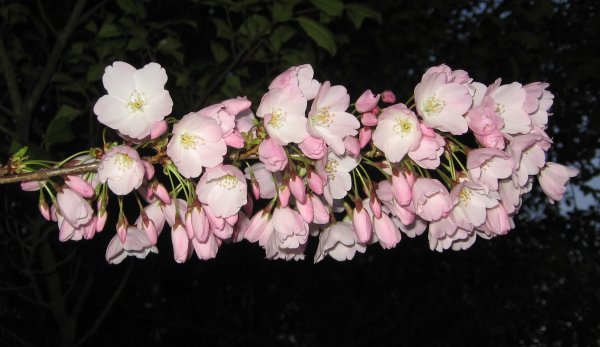
This evening I made my obligatory visit to see the famous cherry trees and do a little birding. The blooming of the cherry trees around the Tidal Basin is one of the annual markers of spring in Washington, DC. The plantings here originated as a gift of 3,020 trees from the City of Tokyo in 1912. The trees are mostly of the Yoshino cherry variety, with several other types mixed in as well. In their peak blooming period, the trees look like they support a delicate snowfall.

The walkways of the Tidal Basin become packed with pedestrians during the trees' peak blooming period. Even on a weekday evening - generally off-peak for visitors - it was still pretty crowded in places. Since the walkways have no guardrails, this necessitates paying close attention to where the water is and where other people are. This is not good for anyone with a bad sense of balance or with fear of heights. I am surprised that there are not more stories of people falling into the water here.

But, onto the birds.... I started off my birding by mistaking a great black-backed gull for a bald eagle. I saw the dark wings and white head and tail of the distant bird, and my mind leapt to a more desirable conclusion. My mistaken first impression was soon corrected when I looked at it through my bionculars.

One American coot still lingers on the Washington Channel, and a few lesser scaup were in the Potomac. I did not see any of the grebes or other waterbirds that have been reported from this area for the past few weeks. But the spring birds are arriving. Double-crested cormorants continue to pass through in small flocks. At least one osprey was working on the nest on the railroad bridge; I expect a pair will breed there again this year.

Near the DC WWI memorial, I saw several bats swooping in and out of the tree canopy. It was still light enough to get a look with my binoculars. Bats are very hard to track with binoculars - even harder than swifts and swallows because they fly so fast and so erratically. I think these were probably big brown bats. (An inventory of bats on the National Mall in 2003 found big brown bats to be in the vast majority.)

SPECIES SEEN: 17

Double-crested Cormorant
Canada Goose
Mallard
Lesser Scaup
Osprey
American Coot
Killdeer
Ring-billed Gull
Great Black-backed Gull
Rock Pigeon
Mourning Dove
Downy Woodpecker
American Robin
American Crow
European Starling
House Sparrow
Common Grackle


If, like me, you have a distaste for walking in heavy crowds, here are some suggestions for alternate times and locations for seeing cherry trees in the area. Some of them are good birding spots, too.

In the last week or so, a lot of people have come here looking for a "cherry blossom webcam," or something of that sort. If you have come here looking for one, try visiting the National Park Service, which has its own Cherry Blossom Web Camera. There is also a series time-lapse photographs of the flowers blooming provided by the Washington Post.

Saturday, March 18, 2006

New Bus Service Around the Mall

The DC Circulator, the alternative bus service to Metrobus, is adding a third route around the National Mall.

The Circulator buses will operate a continuous loop on the streets bordering the Mall, stopping at each of the Smithsonian museums as well as the two National Gallery buildings. Like the two current Circulator routes -- one runs east-west and the other north-south -- the new loop's buses will run every five to 10 minutes and cost $1 a ride, making the fare the cheapest public transportation available downtown. Metrobus is $1.25; Metrorail is $1.35.

The new route will officially begin Tuesday, just days before the March 25 start of the annual Cherry Blossom Festival, which District officials predict will draw about 1 million people to the city. The Circulator plans to begin providing public service on the new route today as a test.
This seems to me like a useful service, since my impression has always been that the Circulator is designed to appeal more to tourists and locals visiting the museums and monuments than to tourists. The bus routes that do criss-cross the Mall do not seem to be particularly well-designed for the casual visitor, but instead serve people passing through on their ways to work. And the Tourmobile complaints cited in the article are irrelevant; people should not be forced to pay $20 to get a ride from one spot on the Mall to another.

Unfortunately a map of the new route is not yet available. I will keep an eye out for it and post it when it comes online.