Thursday, April 06, 2006

Return of the Wildflowers

One aspect of early spring that always excites me greatly is the return of wildflowers. I am not talking here about the many cultured blossoms that are among the leading indicators of spring's return, such as crocuses and daffodils. I am talking about the delicate and short-lived flowers that bloom spontaneously in meadows and on forest floors.

Cherry blossoms are rightly celebrated here for their dazzling display. In this post I would like to highlight some of their wild cousins. Below are some wildflowers that I noticed on my walk through Roosevelt Island on Wednesday evening. In addition to the flowers displayed here, I saw a patch of Virginia Bluebells. Unfortunately I could not get close enough to them for a good picture.

This flowering tree, on the south end of Roosevelt Island, is either a hawthorne or an apple. The two genera are closely related. I suspect hawthorne, because the dark tips on the stamens seems to be more of a hawthorne characteristic, from what I see in the field guides. I am willing to be corrected on that point.

Mayapples are sprouting all over the forest floor.
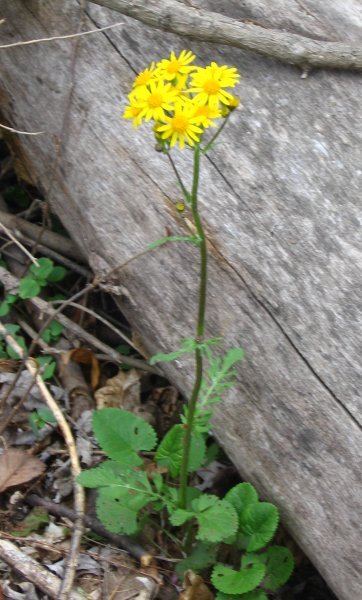
This Golden Ragwort was near the boardwalk in the wooded swamp. Ragworts are part of the aster family, which includes daisies, goldenrod, and similar species.
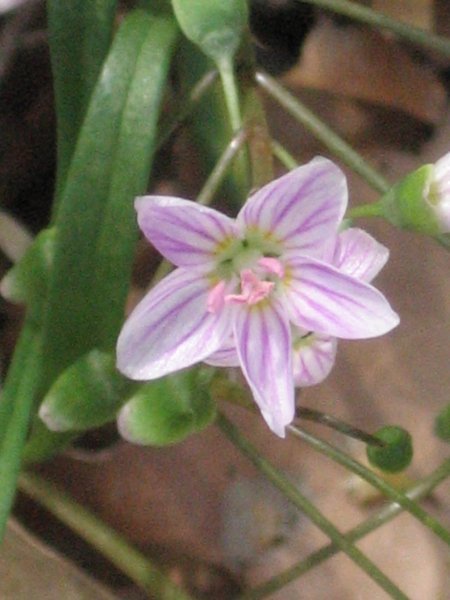
A small patch of Spring Beauties was on the western side of the island. This photograph does not quite show how delicate these flowers are. The stems are so thin that it is a wonder that they can hold up the flowers at their tips. Indeed, a lot of them were slumped over. What first caught my attention about this flower were the thin purple veins on the petals.

A robin led me to this flower. I noticed a robin digging in the vegetation at the side of the trail. After the robin scurried off, I went over to see what it was doing, and I found a small patch of these flowers. This is a Trout Lily, also known as a Dogtooth Violet or Yellow Adder's Tongue. I suspect the name Trout Lily is derived from the brown and white mottling on the leaves.

Loose Feathers #38

News and links about birds, birding, and the environment.

  • Coturnix has linked a group of articles on penguins and global warming. Breaking ice is making it more difficult for penguins to travel to and from their breeding grounds, and it is also narrowing their window for successful reproduction.
  • Grrlscientist has been following the story of a pair of red-shouldered hawks shot for defending their nest on a Florida golf course. See the posts here and here.
  • Here are a few figures on migratory birds, based on data from banding and radio tagging.
  • There is a strange story in China of a young woman committing to live in a cage with 300 birds for a week.

Non-birds
  • If you have not seen them yet, take a look at Kevin Ambrose's photographs from Monday's thunderstorm. (Ambrose is the photographer for CapitalWeather.com.)
Tags:

Roosevelt Island

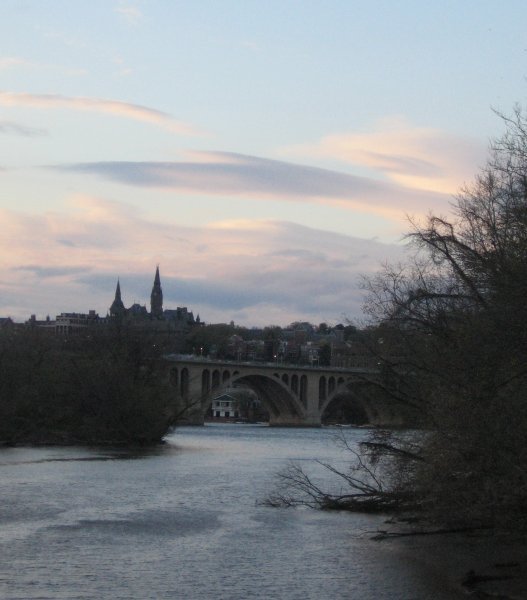
Roosevelt Island occupies a special place in the Washington birding itinerary. It does not quite ranking with the big sites like Rock Creek Park, Kenilworth, or the Arboretum. But it has a wildness about it not seen in most other small D.C. parks, and it combines an array of habitats within a very small space. One can pass through tidal marsh, bottomland forest, and upland forest all within an hour's walk.

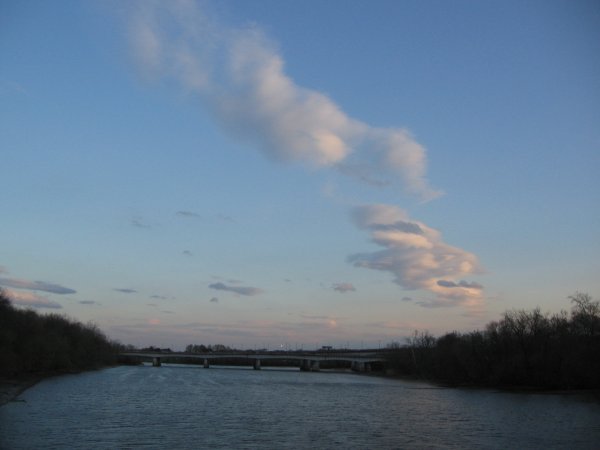
The first thing that impressed me about the island this evening was its dryness. At left I have placed a photograph of a muddy patch this evening. That muddy patch is usually covered with standing water. The trail I followed to take that picture is usually impassable because of muddy conditions; today it was bone-dry.

At the end of the island and in the marsh, there were swarms of swallows. Almost all of these were northern rough-winged swallows, a species I had not seen since last July. They darted back and forth across the water in the typical swallow fashion, flying swiftly, then suddenly reversing course. At times, they seemed to stop in midair before changing direction. Among them were a few slightly smaller swallows with more deeply notched tails, white throats, and brown neck bands; these were bank swallows.

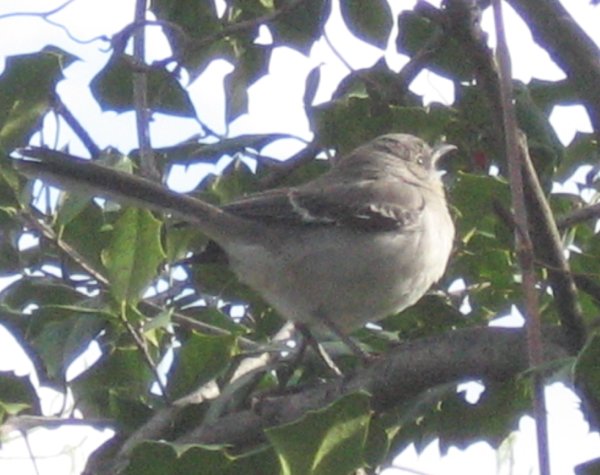
A few killdeer were in the marsh. While these are not entirely unexpected at Roosevelt Island, I usually do not see shorebirds (killdeer or otherwise) at this location. Wood ducks, both on the riverbank and in the marsh, were another pleasing sighting. Several hermit thrushes flocked around the Roosevelt Memorial near the entrance.

At right: blurry footage of a large, crested woodpecker.

Along my walk, I found a red-shouldered hawk nest. Or, perhaps it is better to say that the nesting red-shouldered hawk found me. As I passed by the nest, the proud parent starting calling vociferously. I stood off a bit where I was less conspicuous and watched through my binoculars as it shook its feathers and shifted position on the eggs. I will have to check back there to see if they hatch.

The pair that is nesting at Roosevelt Island is one of several breeding pairs in the District. Other pairs of breeding red-shouldered hawks have territories in Rock Creek Park, Kenilworth, and the National Arboretum. There may be another pair in the Catholic University area, and possibly another along the canal. While the species may be declining overall, it seems to be thriving in D.C.

SPECIES SEEN: 31

Double-crested Cormorant
Great Blue Heron
Canada Goose
Wood Duck
Mallard
American Black Duck
Red-shouldered Hawk
Killdeer
Rock Pigeon
Mourning Dove
Red-bellied Woodpecker
Downy Woodpecker
Northern Flicker
Pileated Woodpecker
Northern Rough-winged Swallow
Bank Swallow
Golden-crowned Kinglet
Carolina Wren
Northern Mockingbird
Hermit Thrush
American Robin
Carolina Chickadee
American Crow
European Starling
Song Sparrow
Swamp Sparrow
White-throated Sparrow
Dark-eyed Junco
Northern Cardinal
Red-winged Blackbird
Common Grackle

Wednesday, April 05, 2006

Climate Research and the Bush Administration

Several climate scientists who work for NOAA and the USGS claim that their work has been hidden from the public. In particular, political appointees have blocked media requests and rewritten press releases to prevent the agencies' researchers from speaking publicly about climate change.

These scientists -- working nationwide in research centers in such places as Princeton, N.J., and Boulder, Colo. -- say they are required to clear all media requests with administration officials, something they did not have to do until the summer of 2004. Before then, point climate researchers -- unlike staff members in the Justice or State departments, which have long-standing policies restricting access to reporters -- were relatively free to discuss their findings without strict agency oversight.

"There has been a change in how we're expected to interact with the press," said Pieter Tans, who measures greenhouse gases linked to global warming and has worked at NOAA's Earth System Research Laboratory in Boulder for two decades. He added that although he often "ignores the rules" the administration has instituted, when it comes to his colleagues, "some people feel intimidated -- I see that."

Christopher Milly, a hydrologist at the U.S. Geological Survey, said he had problems twice while drafting news releases on scientific papers describing how climate change would affect the nation's water supply.

Once in 2002, Milly said, Interior officials declined to issue a news release on grounds that it would cause "great problems with the department." In November 2005, they agreed to issue a release on a different climate-related paper, Milly said, but "purged key words from the releases, including 'global warming,' 'warming climate' and 'climate change.' "

The incidents reported in this article are but the latest in a series of actions in which the administration has attempted to hide essential information from the public. Whether it is in foreign policy, public health, or environmental threats, the American people need accurate information.

One interesting point is that the funding for climate research has actually increased in the last two years. Maybe someday we will learn what the researchers are finding.

Bird ID Games

In the last few weeks, I have heard a profusion of birdsong, more than I had heard since the end of spring last year. More and more birds will be passing through over the next three months, and each species will have its own songs and identification challenges. Luckily, there are resources online to help birders practice sorting out these challenges before heading out to go birding.

The Virtual Birder has been around for a long time, longer, in fact, than I have been birding. I remember playing the games there and thinking "why don't I see birds like that?" The games there helped make my transition into actual birding easier, because some of the knowledge was already in my head. Some useful parts include:

  • On Location: Full tours of top birding sites around North America. This service requires a fee to activate the binoculars. Each stop includes an extensive FREE "Backgrounder."
  • Birding Breaks: Shorter versions of the On Location trips, and FREE. Visit Mount Auburn Cemetery to bone up on spring warblers.
  • Bird Matcher: Match songs, sonograms, and images. More advanced matching games require a fee, but the basic ones are FREE.
  • Bird Song Matcher: Match songs with images with novice and advanced levels.
Patuxent, the bird research center in suburban Maryland, has a bird quiz with different levels based on photographs, songs, and range maps. If you play this, it is better to reload the quiz page to bring up the next question rather than to click on "next question." The latter seems to be a bit buggy. Note: Photographs and song samples can come from anywhere in North America, not just a focused area.

Whatbird is developing a Flash game for identifying birds based on sounds. Right now it is a very basic game designed for children, but the developer promises more advanced levels for adults in the near future.

There is also a fairly basic song matching game from Ecology Explorers. Drag the bird making the call into a box.

Of course, the best way to learn is to go out to parks and refuges and watch and listen. But if you cannot get out, some online games might be the next best thing.

Tags: