Thursday, February 02, 2006

More Hope for Indian Vultures

In recent decades, the populations of several vulture species in India have crashed due to the use of diclonfenac, a drug used in the cattle industry. Thanks to the availability of an alternative that does not harm vultures, the Indian government is now moving to ban diclonfenac. Despite the coming ban, it will take some time for the vulture population to rebound, as these species are slow breeders. A captive breeding program will be used to boost the population.

Vultures are an important part of any ecosystem as they are among the most efficient scavengers. They break down carcasses of many types of animals, and in doing so help to slow the spread of disease. And with more vultures, there will be fewer undesirable scavengers such as feral dogs or rats.

In India, they also play a ceremonial role as people in certain areas leave their dead out to be eaten by vultures.

Bush and Oil

In his State of the Union Address on Tuesday, George W. Bush proposed new energy policies to reduce American dependence on oil imports. From the speech:

BUSH: Keeping America competitive requires affordable energy. And here we have a serious problem: America is addicted to oil, which is often imported from unstable parts of the world.

The best way to break this addiction is through technology. Since 2001, we have spent nearly $10 billion to develop cleaner, cheaper and more reliable alternative energy sources. And we are on the threshold of incredible advances.

So tonight I announce the Advanced Energy Initiative -- a 22 percent increase in clean-energy research at the Department of Energy to push for breakthroughs in two vital areas. To change how we power our homes and offices, we will invest more in zero-emission coal-fired plants; revolutionary solar and wind technologies; and clean, safe nuclear energy.

BUSH: We must also change how we power our automobiles.

We will increase our research in better batteries for hybrid and electric cars and in pollution-free cars that run on hydrogen.

We will also fund additional research in cutting-edge methods of producing ethanol, not just from corn but from wood chips and stalks or switch grass.

Our goal is to make this new kind of ethanol practical and competitive within six years.

BUSH: Breakthroughs on this and other new technologies will help us reach another great goal: to replace more than 75 percent of our oil imports from the Middle East by 2025.

By applying the talent and technology of America, this country can dramatically improve our environment, move beyond a petroleum- based economy and make our dependence on Middle Eastern oil a thing of the past.

This kind of proposal is long-delayed. We really should have gotten more serious encouragement for alternative fuels at the latest in the year after the World Trade Center attack, and preferably long before then. But we will take what we can get. Unfortunately, the administration is already backing away from Bush's words.

But short of imposing bans or embargoes, the U.S. government can do little to prevent companies from buying oil from any nation they can. White House officials acknowledged yesterday that their plan would not necessarily reduce imports from the Middle East because that determination is made by market conditions and not U.S. directives.

Additionally, the world's oil market is so interdependent that even if the United States ceased buying oil from all Middle Eastern nations, a disruption in the flow of Middle East oil to other countries would affect American prices.

There is also some question about how serious of a proposal this really is, especially since the funding for research is relatively low while the demand for oil continues to increase. More funding might give a better chance of finding a cheap way to produce and sell alternative fuels.

The White House wants to accelerate research into the production of "cellulosic ethanol" from plant fiber, an abundant renewable resource. The president talked about making the fuel from wood chips, stalks and switchgrass, which is commonly found in North America.

The technology exists to produce that type of ethanol today but not at competitive prices, industry specialists said. Most of the ethanol now produced domestically comes from corn. The administration wants to make cellulosic ethanol competitive within six years. Proponents of the idea say that once that happens, automakers would increase production of "flex fuel" vehicles that could run on gasoline or fuels primarily made from ethanol.

The oil provisions are part of a larger Bush vision of increasing funding for alternative energy sources. The White House is calling for more to be spent on research into cleaner-burning coal, solar and wind power.

While the details of this get hashed out, the best solution for the environmentally-conscious is probably to conserve energy where possible.

I and the Bird #16

It is time for yet another edition of I and the Bird, the blog carnival for bird lovers. This week, it is hosted by the always-interesting Dharma Bums, who present us with Birdstock, a day of peace, love, and birds. Visit their site for the best in bird blogging from around the internet and around the world. Amazingly, hosts of I and the Bird continue to find bloggers who have not submitted before; it seems that there has been an explosion of bird and nature blogging over the past year.

Welcome to anyone who may be visiting here for the first time. I hope you like what you find and come back again.

Wednesday, February 01, 2006

Birding at Jamaica Bay

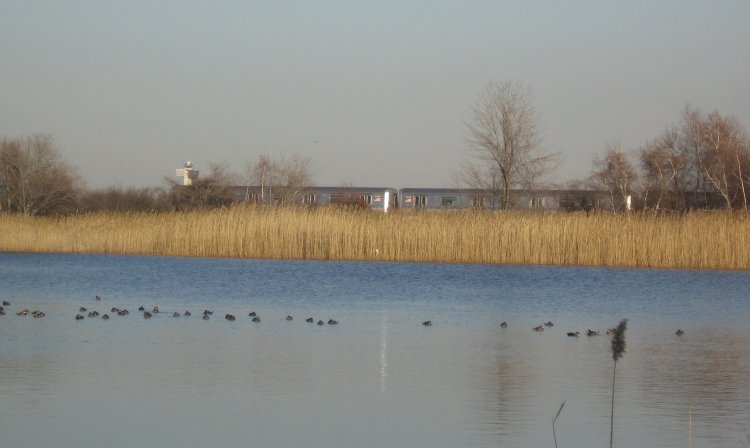
Over the weekend, I made one of my regular trips to New York to see my girlfriend. Now she is not a birder but enjoys being outside on a beautiful day, as last Saturday definitely was. The two of us paid a visit to Jamaica Bay National Wildlife Refuge, a small refuge tucked under the flight path of JFK Airport. The refuge is reachable by subway; the A train crosses the bay and stops a few blocks from the refuge entrance. Like other urban birding sites, Jamaica Bay is a mix of the wild and the developed. Along with the sights, sounds, and smells of a coastal salt marsh, one can see the distant Manhattan skyline and hear the rumble of passing airplanes and subway trains.

Because the ride out was long, we arrived there rather late in the day, for birding purposes. After a quick lunch we proceeded to walk around the West Pond, the smaller of the two main ponds. Several rafts of waterfowl were too far away for identifying any species with binoculars. Other flocks were more obliging. One of the first sightings was a flock of several hundred snow geese that flew up from the flats, veered over the trail and then back out to the mudflats. We saw mute swans and tundra swans at several points along the pond. (Check back here on Friday for pictures of the swans.) Gadwall and northern shovelers were all over the West Pond, with plenty of American wigeons and mergansers mixed in. At one of the last viewing spots on the West Pond, there were a few redheads - an uncommon species - as well as a northern pintail.

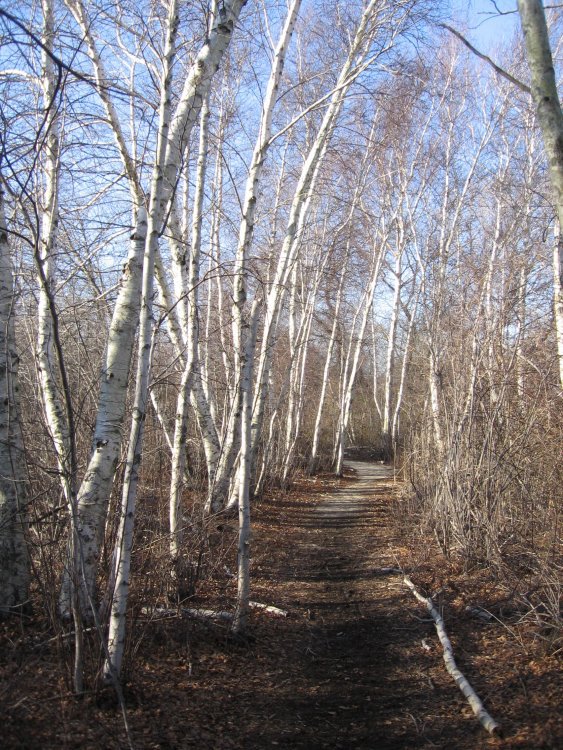
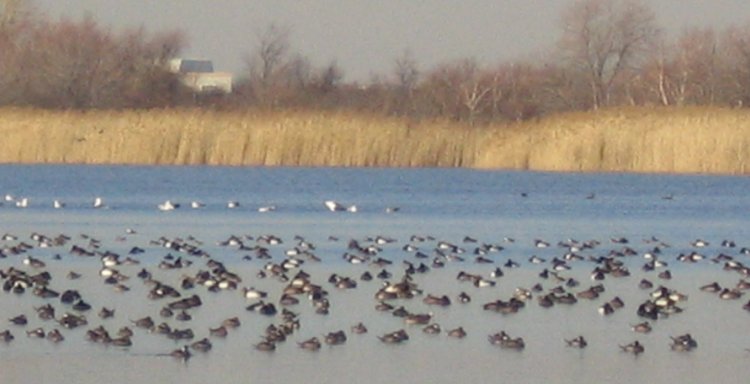
The trail to the viewing areas for the East Pond first passed through a beautiful stand of birches and then along a boardwalk lined with phragmites. When we reached the edge of the East Pond we were greeted with a large raft of waterfowl - over a thousand birds - dominated by ruddy ducks. Scaup of both species mingled with the ruddies. Also impressive were the black ducks, which flew up and down the length of the pond in groups of three or four at a time. Seen from a distance, the black ducks appeared as black darts, more in keeping with their name than their close-up brownish color.

The little birds were not very active while we were there. Perhaps it was the wrong time of day, or perhaps we just hit the wrong spots. There was one out-of-season gray catbird, a very good bird for January. This was not all that disappointing, because the little birds are not the main attraction at Jamaica Bay in any case. The water birds are, and they provided more than enough viewing pleasure to make this a magnificent trip.


SPECIES SEEN: 35

Double-crested Cormorant
Mute Swan
Tundra Swan
Snow Goose
Canada Goose
Brant
American Wigeon
Gadwall
Mallard
American Black Duck
Northern Pintail
Northern Shoveler
Redhead
Greater Scaup
Lesser Scaup
Bufflehead
Hooded Merganser
Red-breasted Merganser
Ruddy Duck
American Coot
Ring-billed Gull
Great Black-backed Gull
American Herring Gull
Rock Pigeon
Downy Woodpecker
Northern Flicker
Gray Catbird
Northern Mockingbird
Black-capped Chickadee
American Crow
European Starling
House Sparrow
Song Sparrow
White-throated Sparrow
Northern Cardinal

Technorati Tag:
Powered By Qumana

Gas Guzzling