Saturday, June 05, 2010

Pelicans in BP's Oil Spill

A cap is on what remains of the riser pipe and appears to be containing some of the leaking oil. Whether it will work in the short term remains to be seen. The Oil Drum has a good explanation of how the cap works, as well as screen shots from BP's live feed. Meanwhile tar balls are starting to wash up on beaches in the Florida panhandle. Onshore winds are expected to move more oil in that direction this weekend.

I cannot quite get my head around the images of the oiled birds that I linked to in yesterday's post. It seems that others feel the same way, and I have seen one argument for a Pulitzer for the AP photographer who shot that set of photos.

The New York Times looks at one of the primary avian victims of the oil spill so far, the Brown Pelican.

In 1968, Louisiana took birds from a surviving Florida colony and reintroduced them along the state’s southern coast in three spots. One was Queen Bess Island, which had been the site of one of the last breeding pairs before extinction, said Kerry St. Pé, program director of the nearby Barataria-Terrebonne National Estuary Program.

Still, the birds struggled, threatened this time by the loss of their habitat. The local wetlands, hurt by levees in the Mississippi that blocked sediment from flowing downstream and by canals cut by oil companies looking to lay pipe, were sinking into the gulf at an astonishing rate. Queen Bess was going under as well until 1990, when a coastal restoration project financed a rock barrier around the island, which stabilized it. The pelican colony began to flourish and the birds’ offspring helped repopulate the coastline, Mr. St. Pé said.

Last year, the birds were officially taken off the endangered species list. But the oil spill, experts said, could change that. Like all birds, pelicans are very sensitive to oil, said Melanie Driscoll, director of bird conservation for the National Audubon Society’s Louisiana Coastal Initiative. It prevents them from regulating their body temperature when it gets on their feathers, she said, and in Louisiana the pelicans are subject to overheating. The oil can also poison the fish the pelicans feed on and seep through the shells of pelican eggs, killing the embryos.
On Thursday alone, a rescue center received 29 oiled pelicans, and more are expected.
The birds at the rehabilitation center, said Sharon Taylor, a veterinarian here, represent a lucky few — far more are certain to die in the wild....

Still, she worried that because there are so many large rookeries nearby, far more pelicans would soon be headed to the center.

“Tomorrow or tonight we could get a hundred pelicans, we could get a thousand pelicans,” Ms. Taylor said.
To provide workers with the information they need, Cornell opened access to the full Birds of North America accounts for the 15 bird species threatened by the spill. As far as I know, anyone can read them, so if you want to read up on any of these species, now is the time to do it.

Friday, June 04, 2010

Loose Feathers #241

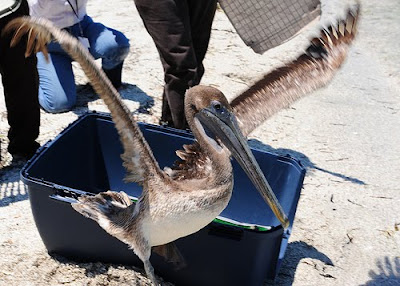
Brown Pelican being released at Egmont Key NWR after being rescued and cleaned / U.S. Coast Guard photo by Petty Officer 3rd Class Nick Ameen

Birds and birding news
Birds in the blogosphere
Environment and biodiversity
Carnivals

Thursday, June 03, 2010

Birds of Haiti iPhone App to Benefit Disaster Relief

There is a new iPhone app for the Birds of Haiti and the Dominican Republic, and its sales will benefit continuing disaster relief efforts in Haiti.
100% of the app sales will go immediately to relief efforts in Haiti led by Partners in Health and Habitat for Humanity. The funds will directly support on-the-ground efforts to provide medical care and critical supplies to those affected by the earthquake, as well as to long term strategies to rebuild stronger and more sustainable communities in Haiti.
Partners in Health and Habitat for Humanity were chosen because they have been doing humanitarian work in Haiti for several decades.

The app features 58 birds that are endemic on the island of Hispaniola. Some birds, like Yellow Warbler, will look familiar to North American birders but occur on the island as endemic subspecies. One, Bicknell's Thrush, is not endemic, but the island is its primary winter range. Most are Caribbean specialties, such as the Hispaniolan Crossbill pictured at left. The app reproduces text and illustrations from a recently-published field guide, Birds of the Dominican Republic and Haiti. In addition, there are audio samples for the songs and calls of each species.

 This is not a complete field guide for Haiti and the Dominican Republic since the omits species that the island shares with the rest of the West Indies or that occur as migrants. However, it provides an interesting look at the birds that live there.

Wednesday, June 02, 2010

Why You Should Record All Species and Bird Outside Hotspots

Accurate species distribution data is necessary to address biodiversity challenges. To save endangered species, conservationists need to know which species populations are contracting or expanding. Restoring an ecosystem requires an accurate picture of how the ecosystem existed historically. Unfortunately, existing global data collections such as the Global Biodiversity Information Facility and IUCN Red List underrepresent some geographic areas, especially in the tropics, and may not show accurate distribution or trends for many species that live there. A further problem with newer datasets is that conservation organizations have focused largely on endangered species and nature reserves and lack the broad baseline data that may be necessary for future conservation problems.

A new study measures how well existing data compilations cover the Galliformes, an order that is well-studied and contains many threatened species. The datasets surveyed included museum collections, scientific articles, banding records, bird atlases, and birders' trip reports (archived on sites such as travellingbirder.com). Museum collections are the most significant source of historical distribution data, and scientific literature has gained importance over time. Birding reports are a relatively new phenomenon and still account for relatively few records, with most of those coming from birding hotspots.

Geographic coverage of different data sources: A) museums, B) literature, C) banding, D) atlases, and E) website trip reports

The data sources vary in how much geographic area they cover. Museum collections are the most comprehensive as a whole, though individual collections may be more localized. Scientific literature covers western Europe, China, and southern Asia well, but not as many studies are available for other regions. Banding data and atlases were largely confined to western Europe. Birding trip reports provide broader coverage than banding or atlases but are concentrated in well-known hotspots and easily accessible locations. Because active specimen collecting has declined, contemporary data sources are less geographically comprehensive than older ones (see maps below).

Records for all galliform species across the Indian Subcontinent from A) pre-1930 and B) 1990–2006

The authors offer three suggestions for improving the geographic coverage and usability of biodiversity data:
  1. Museum collections and sightings data from scientific literature should be catalogued in electronic databases to make historical data more accessible.*
  2. Observation records should include a date and location, preferably with geographic coordinates, and be incorporated into a central database to avoid fragmentation.
  3. Observers should report all species rather than just rare or threatened ones and should look outside of known biodiversity hotspots.
They see a role for citizen science projects to monitor biodiversity and cite eBird specifically as an example of how a citizen science project should collect data from users. From their perspective, its principal strengths include requiring users to enter a date and geotagged location, flagging unusual records for review by regional editors, and encouraging participants to submit checklists from areas with few observations. Unfortunately eBird has so far been limited to the Americas (though it will expand coverage soon) and only records bird observations. The authors hope, however, that eBird's model can be expanded to other taxa, even less charismatic ones.

* Though the authors do not cite it specifically, the North American Bird Phenology Program still needs volunteers to scan and transcribe thousands of historical observations.


ResearchBlogging.orgBoakes, E., McGowan, P., Fuller, R., Chang-qing, D., Clark, N., O'Connor, K., & Mace, G. (2010). Distorted Views of Biodiversity: Spatial and Temporal Bias in Species Occurrence Data PLoS Biology, 8 (6) DOI: 10.1371/journal.pbio.1000385

Tuesday, June 01, 2010

Red Knot Population Holding Steady But Not Growing Yet

In the last two decades, the Red Knot population has steadily decreased. The primary cause seems to be overharvesting of horseshoe crabs, used in medical research and as bait for catching other shellfish. Red Knots and other shorebirds migrating along the Atlantic coast rely on horseshoe crab eggs for food, to the extent that these shorebirds time their arrival to coincide with the peak of horseshoe crab spawning. Recent regulations have tried to stabilize the situation, from a complete moratorium on horseshoe crab harvests in New Jersey to harvest limits in other states.

According to this year's shorebird census, the numbers of horseshoe crabs and Red Knots have not improved yet.
Each year, scientists from as far away as Australia and England take over two rental houses on Reed’s Beach and study Red Knot/Horseshoe crab numbers at the peak of the phenomenon, a full moon in late May or early June. The crabs come out of the bay in the highest numbers under the full moon.

“The crab spawning is happening at the right time in relation to the bird stopover,” said Humphrey Sitters, a scientist from the University of Exeter in England with the International Wader Study Group....

In 2009 and this year, the birds and crabs have arrived at the same time. He said there is some evidence this year at least part of the Red Knot population was delayed in early May in Patagonia, the southernmost portion of South America in Argentina.

Horseshoe Crab numbers reached a peak in 2006-2007 and have since declined, according to Virginia Tech data. Overharvesting by commercial fishermen who cut up the crabs for bait to catch conch and eels has reduced the crab population greatly since 1990.

“If anything, the adult crabs have declined over the last three years (2006-2009) but on the other hand, there seems to be an increase in immature crabs,” said Sitter.

The scientists conduct counts of the number of Red Knots along the bay. Last year, the count increased to about 25,000 birds. He said this year he believed the peak count would be around 17,000 Red Knots.

The population has dropped from a count of 50,000 birds in 1998.
I would not expect the harvest limits to produce a rebound right away since horseshoe crabs take several years to reach maturity and the horseshoe crab population needs to stabilize before the Red Knot population can grow significantly. With that in mind, the increase in immature crabs is encouraging. It is also encouraging that the Red Knots arrived at the same time as the horseshoe crab spawn this year, as that should allow them to gain the weight they need to make it to the Arctic and breed.

According to another article, some of the banders are using geolocators to track where the shorebirds go.
Burger helped to band shorebirds this week with geo-locaters that measure the sun's rays. Red knots nest in pairs far from others of their kind, making them notoriously difficult to find in their arctic breeding grounds. But scientists who capture tagged knots can use the tag's information about sunrise and sunset to pinpoint exactly where they went. So far the scientists have recaptured four red knots they banded with geo-locaters in past seasons.
There are photos from one banding session at the CMBO's blog.

In a related story, a truck full of lobsters and horseshoe crabs overturned on the Parkway at mile 0.7. I assume that the horseshoe crabs were harvested in another state.