Showing posts with label Red Knot. Show all posts

Wednesday, May 23, 2012

Red Knots Return North

Red Knots / Photo by Gregory Breese (USFWS)
Once again, scientists are documenting the status of Red Knots as they migrate through the Delaware Bay region. Here is one interesting tidbit that echoes comments I heard from scientists last spring:
The great unknown is the plight of juvenile red knots between the time they leave the Canadian Arctic and when they return to Delaware Bay two years later, Kalasz said.

Last summer’s breeding season produced high numbers of juvenile birds, Kalasz said.

The concern is whether something happens to these birds – food supplies, hunting, habitat loss – in South America before they reach maturity and make their first breeding trip north through Delaware Bay, he said.

Scientists aren’t detecting any increases in the red knot population even though the numbers of juveniles in Canada – at least last year – was good.
Stopping the horseshoe crab harvests in Delaware Bay was clearly the most important means of protecting Red Knots and rebuilding their population. Having a ready supply of horseshoe crab eggs in the Delaware Bay area during spring migration is vital to the species's breeding success. However, there are other pieces of the puzzle, on their breeding grounds, on their wintering grounds, and on their fall migration routes. Finding what the remaining problems are and their solutions will be important for the Red Knot's long-term survival.

Wednesday, December 07, 2011

Delaware Bayshore Is an Important Bird Area

New Jersey's Delaware Bayshore has now been designated as a Globally Significant Important Bird Area.
To achieve the “Globally Significant” label, [New Jersey Audubon] and National Audubon submitted years of annual shorebird and waterfowl survey data to a panel of nationally and internationally recognized experts. The panel found that four species were present in numbers that met or exceeded the quota required to trigger the “Globally Significant” designation: The Bayshore is a crucial stopover site for migrating Red Knots and Ruddy Turnstones, and provides critical winter habitat for large concentrations of Snow Geese and American Black Ducks. The survey data was collected in annual surveys by wildlife biologists from the New Jersey Department of Environmental Protection (NJDEP).

Stretching along approximately 50 miles of coastline, from Fairfield Township in Cumberland County to Cape May Point in Cape May County, the Delaware Bayshore IBA includes about 50,000 acres, much of which is protected conservation land, including 13 state Wildlife Management Areas and the Cape May National Wildlife Refuge....

Awareness of the Delaware Bayshore’s importance began to grow in 1982, when staff at the New Jersey Audubon Society began the first aerial shorebird surveys to quantify the number and species of shorebirds using the Bayshore. These aerial surveys were later assumed by the state Division of Fish and Wildlife, which has performed them annually since 1986. The state also performs the annual winter waterfowl surveys that led to the inclusion of American Black Ducks and Snow Geese in the “Globally Significant” designation....

Of the four species named in the Globally Significant announcement, the plight of the Red Knot and Ruddy Turnstone is the best known and lends a bittersweet note to the designation. While recent surveys show significant numbers of birds refueling at the Bayshore during spring migration (12,000 to 16,000 Red Knots and 17,000 to 37,000 Ruddy Turnstones), they are lower than numbers of 95,000 Red Knots and 80,000 Turnstones recorded in the early aerial surveys. A precipitous decline in these populations began in the mid-1980s, when horseshoe crab harvesting rose dramatically for use as bait. The horseshoe crabs’ eggs are essential food that allows these long-distance migrants to make it to their summer arctic nesting grounds to breed.
I am actually surprised that this area was not designated as an Important Bird Area sooner since the importance of the area for migratory shorebirds (especially Red Knots) has been known for some time. Much of the area is already protected, so I am not sure whether this designation will lead to further conservation measures.

Saturday, July 16, 2011

Red Knots Expedited for ESA Listing

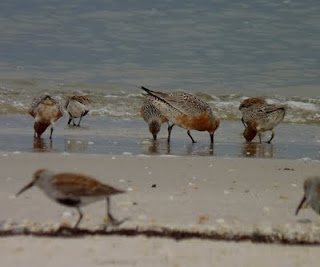
Red Knots and Dunlin feed together at Reeds Beach
I mentioned this in yesterday's Loose Feathers round-up, but I thought the news deserved its own post. It seems very likely that Red Knots will soon be listed under the Endangered Species Act. Such listing has been overdue for some time now, and several petitions have been filed with the U.S. Fish & Wildlife Service. So far it has lingered among the over 250 species on the candidate list. A plan to expedite review and listing of the candidate species was developed as a result of a lawsuit brought by WildEarth Guardians and the Center for Biological Diversity. From what I have read, the Red Knot will be near the front of the list, though formal listing might not come for a year or two.

What additional protections result from a listing remain to be seen, but conservationists have some suggestions:
Advocates say the listing would help not only the red knot, but many other shorebird species that migrate through Delaware Bay and are in a similar, although less dire, decline. These would include the ruddy turnstone, semi-palmated sandpiper and sanderling....

During the 1980s and '90s, peak Delaware Bay counts of the red knot reached 95,000.  Since 2004, they ahve been consistently below 16,000.  Likewise, in their wintering area at the tip of South America, peak counts have dropped from 75,000 to 16,260 in 2010.  At the winter count earlier this year, the number had declined to less than 10,000.

Meanwhile, a recent study by New Jersey biologist Larry Niles, who has followed the bird to the ends of the earth in a decade or more of study, and others has confirmed the key role that horseshoe crab eggs play.

"Right now, we need to see more adult crabs breeding, and we're not," Niles said. Fisheries officials that govern the crab harvest keep saying to give it more time, he said. "That would be fine, except we were promised signs of recovery six years ago."

He suspects further restrictions in the harvest are needed. Or the problem now may lie elsewhere. The illegal harvet may be greater than estimated. The blood of the crab is used as an indicator for contamination in medical devices, and the crabs are caught, partially bled and then returned to the wild. But a recent study suggested that mortality from this may be higher than estimated.
I wrote about the study connecting Red Knots to Delaware Bay stopover habitat last week.

Habitat protections might also result, though a lot of the Red Knot's habitat falls outside of the U.S. – in Canada for breeding and in southern South America for wintering. Either way, it is a positive step forward, and I hope it results in a stronger Red Knot population.

Wednesday, July 06, 2011

Study Confirms Importance of Red Knot Migratory Stopovers

As many readers know, Red Knots (Calidris canutus rufa) are in serious trouble.* Though they were once an abundant shorebird during spring migration on the Atlantic Coast, their population crashed in the 1990s. This winter, Red Knots suffered another setback, when a third of their current known population disappeared from the wintering grounds for reasons that are not entirely clear. The major crash in the 1990s has long been linked to food availability at migratory stopover sites.

During spring migration, Red Knots time their arrival in the Mid-Atlantic to coincide with the spawning of horseshoe crabs. Red Knots (and other shorebird species) eat the freshly-laid eggs to gain weight for the final leg of their journey, from the Mid-Atlantic to the Arctic, where the birds need to find mates and breed within a fairly short window of time. A major increase in the harvest of horseshoe crabs, due to their increasing use as bait for whelk fishing, reduced the availability of horseshoe crab eggs. While some shorebird populations remained stable or suffered small decreases, the Red Knot population crashed.

ResearchBlogging.orgA new study, published in the open access journal Ecosphere, confirms the importance of stopover habitats – and the food sources they provide – for migratory shorebirds. The study uses data collected during a multiyear banding project of shorebirds around Delaware Bay. (As readers may remember, I participated in one such banding session earlier this year.) The study used two types of data from the project: captured or recaptured birds with known identities and known weights and resighted birds with known identities but unknown weights. The project has been banding Red Knots and other shorebirds with metal bands since 1997; in 2003, it started tagging Red Knots with colored bands bearing alphanumeric codes that can be read with binoculars or a spotting scope.

The study used mathematical models to determine the relationships between spawning by horseshoe crabs and weight gain by Red Knots and between Red Knots' mass at departure and future survival. (You can read the study's methods section for a technical description of the models.) The results showed that how much weight Red Knots gain depends not so much on the overall horseshoe crab abundance but on the timing of horseshoe crabs are spawning. If horseshoe crabs spawn later than usual, Red Knots are not able to gain as much weight as they normally would because not enough eggs will be available before they have to depart for the Arctic. Weight gain at stopover sites is crucial since Red Knots with a light weight at departure were unlikely to be recaptured or resighted in subsequent years.

While the model found a correlation between weight gain and subsequent survival, it found a stronger relationship between survival and snow depth on the Red Knots' breeding grounds. Red Knots were more likely to survive from one year to the next if there was deeper snow on the ground when they arrived in the Arctic. The scientists offer several possible explanations. One is that greater snow depth means greater overall moisture, which increases the amount of invertebrate prey available for the Red Knots. Another is that lemming populations tend to crash in years with low snow depth, so in those years predators that normally eat lemmings might turn to shorebirds instead. Determining whether those or other hypotheses are correct will require further research in the Arctic.

The study reinforces the link between horseshoe crabs and Red Knots and the importance of Delaware Bay as a spring stopover site. All necessary efforts should be taken to ensure that the bay continues to provide adequate habitat and food for these long-distance migrants. Such efforts should include further restriction of horseshoe crab harvests, particularly in Delaware, which has continued to allow harvesting even though New Jersey has imposed an indefinite moratorium.


Cited study:
McGowan, Conor P., James E. Hines, James D. Nichols, James E. Lyons, David R. Smith, Kevin S. Kalasz, Lawrence J. Niles, Amanda D. Dey, Nigel A. Clark, Philip W. Atkinson, Clive D. T. Minton, and William Kendall. (2011). Demographic consequences of migratory stopover: linking red knot survival to horseshoe crab spawning abundance. Ecosphere, 2 (art69) : 10.1890/ES11-00106.1

* For international readers, the IUCN ranks Red Knot as a species of least concern; the discrepancy is that there are multiple subspecies, and many of them are secure. However, the western Atlantic subspecies – the one that breeds in the North American Arctic, migrates along the Atlantic Coast of North America, and winters in Tierra del Fuego – is in serious danger of extinction.

Tuesday, May 24, 2011

Some Red Knot News

Last week, I had the privilege of helping with Red Knot banding in Cape May. A reporter from my local newspaper spent some time with the shorebird banding crew recently and filed a story on the current status of Red Knots. Things are still looking dire, despite some New Jersey's moratorium on the horseshoe crab harvest.
Now the federal government might make a decisive move. The red knot is a priority in a new plan by the U.S. Fish and Wildlife Service to deal with a backlog of 250 animal and plant species proposed to be covered by the Endangered Species Act....

But meanwhile, horseshoe crab harvests in other states might be increased when the Atlantic States Marine Fisheries Commission meets later this year, she added. And scientists are concerned because a key crab survey by Virginia Tech lost its federal funding this year and is just halfway toward raising the $200,000 cost.

Delaware Bay is the big stopover for red knots’ flying north to breeding grounds in Canada, because their migration coincides with the horseshoe crab breeding season that leaves bay beaches littered with nourishing crab eggs. That fattens the birds and gives them energy to push on north and lay eggs, said Niles, chief scientist for the Conserve Wildlife Foundation of New Jersey....

New Jersey shut down its commercial fishery for horseshoe crabs in 2006, culminating years of cutbacks after the take of crabs for fishing bait was blamed for the red knots’ decline. But after 6,000 birds went missing from their South America wintering grounds, researchers think the problem may be down south, Niles said.

Researchers in Argentina reported toxic red tide algae blooms may have killed some birds before they reached their winter quarters, at the southern tip of the continent at Tierra Del Fuego. The drop in the winter count, to 10,000 birds from 16,000, may show growing dangers to the birds all along the western Atlantic and Caribbean shores, said Niles, a former chief of New Jersey’s endangered wildlife program.
Banded shorebirds now carry small flags that can be read with a spotted or from a photographic image. These flags, along with any codes they bear, should be reported at bandedbirds.org. Here is some background information on the website: 
“If you are the first one to see the re-sighting, we know the bird is still in the flyway,” said Jeannie Parvin, who manages the website www.bandedbirds.org. “Just that information is very important. It’s not just for red knots, it’s for all the shorebirds.”
The website supports the Delaware Bay Shorebird Project, a 15-year effort that has built perhaps the world’s biggest database on migrating shorebirds within a flyway. Like a highway for people, a flyway is a track that birds follow between their southern winter homes and summer nesting grounds in the high Arctic of Canada.

Bandedbirds.org offers pages explaining shorebird research, how to read tags on birds and estimate bird counts. After a one-time registration, contributors can send in sightings that go immediately into a database for researchers to use, Parvin said.
Finally, there has been some research into the feasibility of raising horseshoe crabs from eggs in captivity and releasing them once they are better able to survive predation.
Woodruff works at the university's aquaculture facility in Lower Township, where the staff cultivates oysters. But they are looking to expand their scope to raise horseshoe crabs from eggs for release back into the wild to give the creatures a head-start against hungry predators.

"Everything eats them. Basically, we want to farm them - take their eggs and raise them until they are big enough to survive on their own," Woodruff said.

Such human intervention could solve a conflict between local fishermen and conservationists. New Jersey's ban on crab harvesting remains in place in a bid to build up the number of spawning crabs and their bounty of eggs, which are critical for feeding rare shorebirds such as red knots that gather on the bay to fatten up during their epic migrations from the Arctic to South America.

Daniel Hernandez, an assistant professor at The Richard Stockton College of New Jersey, counts crab eggs on the beach each year for his ongoing research. The Stone Harbor resident said egg counts have dropped precipitously from their historic levels....

A 2009 study in the journal BioScience, which Hernandez took part in, said that in 1990 more than 100,000 crab eggs per square meter were found on Delaware Bay beaches.

"Now they have 5,000," he said.
I hope that works to rebuild their numbers because the number of horseshoe crabs eggs is critically low to support Red Knots and the other shorebirds that depend on them. The same news article mentions that there will be horseshoe crab tagging sessions open to the public at 8:30 pm on May 31 and June 2 at Kimbles Beach in Cape May NWR. If you're in the area, it might be worth checking out.

Thursday, May 19, 2011

Some More Shorebird Photos

These are a few additional photos that I took on Saturday, but that did not fit into my post on shorebird banding yesterday. Up above, a group of Dunlin pause in the surf, with a Semipalmated Sandpiper standing by.

A Dunlin forages in the foreground while Red Knots stand in the surf.

A familiar trio from Reed's Beach: Red Knot, Laughing Gull, and Dunlin.

A Semipalmated Sandpiper picks through beach litter for morsels.

A Laughing Gull stands in the surf.

Speaking of Laughing Gulls, this is what Reed's Beach looked liked on Sunday morning. Cape May County has one of the largest Laughing Gull breeding areas in the world in its back bay marshes along the eastern side of the peninsula. Apparently a lot of those nests got flooded out in the last week because of recent high tides, made higher than normal by their proximity to the full moon on Tuesday. As a result, a lot of those gulls were hanging out in the horseshoe crab spawning areas along the Delaware Bay instead of tending to their nests in the marshes.

Wednesday, May 18, 2011

Shorebird Banding in Cape May

As many readers are aware, conservation of shorebirds that use the Delaware Bay as a migratory stopover is a pressing issue. Many species, such as Red Knots and Ruddy Turnstones, time their migration to arrive at the bay just as horseshoe crabs are laying their eggs on the beaches. Shorebirds feed on those eggs to regain the weight they lost during their flights from wintering grounds in South America and prepare for another long flight to their Arctic breeding grounds. For a long time this arrangement worked well, but in the 1990s, overharvesting of horseshoe crabs (used for fishing bait and medical research) caused a crash in the Red Knot population. States have taken some steps to limit the horseshoe crab harvest (including New Jersey's legislative moratorium), but the Red Knot's survival remains tenuous. The population has fallen enough to earn the Red Knot a place on the USFWS's candidate list but so far it has not been listed as threatened or endangered by the federal government.

An international effort is underway to monitor the remaining population and push for conservation of the habitats and resources the Red Knots need. Part of that is an ongoing banding program to study how birds use stopover sites and what migration routes they use. My friend Mary (whom I met through DC Audubon) knows some of the banders from her time in Australia, so she got invitations for the two of us to participate in a banding session this past weekend. Because of weather and tides, it turned out that Saturday was our best chance to participate, so we made sure to be at Reed's Beach early in the morning, even though we both arrived in Cape May rather late the previous night.

You can see how shorebirds are banded in a video I linked on this blog a few years ago. That shows a different set of banders in a different location, but the methods for capture and processing are essentially the same. The banding team prepares a net and disguises it as carefully as possible. Once enough shorebirds are in front of the net, the team fires cannons that propel the net over the birds. Some birds will escape, but many will be caught under the net. The banding team hurries to extract the birds from under the net as quickly as possible, so as to avoid unnecessary stress or injuries to the birds. Once all the birds are out of the net and into shaded containers, the banders can sit down and process them.

On Saturday, the captured birds went through several steps before their release. First they were banded and marked with coded tags to make it easier to recognize individuals in the field without recapturing them;* then a series of measurements were taken: weight, wing chord, and bill and head length; finally, feather samples were taken for lab analysis. One person recorded all of the codes and measurements for each bird. I was last in line, so I held each bird while another person snipped some feathers (one wing covert and two breast feathers), and then I released it. I think I probably handled a few dozen Red Knots in the course of the morning, though I was not keeping count.
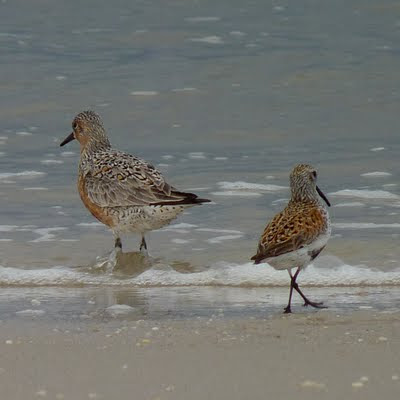
It was really cool to hold the Red Knots and see them up close. One thing I had not realized when I looked at them through binoculars was just how intricate the patterns on their backs are. Their scapulars in particular have dark brown lines dividing each feather into sixths; the middle part of the feather is tinged with rufous while the tip is white. Meanwhile, their rumps are etched with fine barring, and their undertail coverts are speckled. The Red Knots were also smaller than I expected; I guess they look larger to me through binoculars than they do in the hand. A lot of these birds were recent arrivals, though, so it is possible I would get a different impression once they had time to gorge themselves on horseshoe crab eggs.

As I mentioned in yesterday's post, Mary and I went to Heislerville in the afternoon and evening to find a Curlew Sandpiper. Once we had found it, we helped with another banding project that is monitoring some of the species using the impoundments. That project is mainly concerned with Semipalmated Sandpipers, but it also bands Short-billed Dowitchers, Dunlin, and other shorebird species that happen to get tangled in the nets.  Mary helped extract shorebirds from the nets, while I ferried birds from the nets to the banders or held nets so that they would not blow on a bird during the extraction process. Once again I was impressed by the birds' small size; the Semipalmated Sandpipers were especially tiny.

I really enjoyed my experience with shorebird banding this weekend, and I hope to do more of it when I have the chance.

* If you happen to see a Red Knot (or other shorebird) with color markings or a colored flag with an alphanumeric code on it, please report it to bandedbirds.org.

Tuesday, March 08, 2011

Red Knot to be Listed as Endangered in NJ

New Jersey's Department of Environmental Protection is proposing to change the state's listing of Red Knot from threatened to endangered. The proposal is based on a few years of studying their population trends, but it was made more urgent by recent reports from South America:
In late February, biologists returned with sobering news from their annual trip to the bird's wintering grounds in Tierra del Fuego, Chile.

Immense flocks of red knots once swooped over the vast tidal mudflats, rich in tiny organisms that were a nonstop banquet. In recent years the number declined to 16,000, but remained stable.

Now, the count showed the population dropping again, to between 10,000 and 11,000.

"We're dismayed," said Larry Niles, former chief of the DEP endangered-species program, now a wildlife consultant. He has led red knot research for more than a decade.

The crew of more than a dozen international researchers had hoped for an uptick because conditions on Delaware Bay last spring were so favorable. The weather held, the crabs laid their eggs, the birds feasted.

Data from netted birds showed that nearly 80 percent were at or near ideal body weight, prime for breeding.
An online version of the state's proposal is here, for anyone who wants to read and comment on it. Comments must be received by March 19. It looks like comments have to be submitted by mail even though NJDEP asks for an electronic copy.

Tuesday, October 12, 2010

The Amazing Flights of the Red Knot

Scientists have been able to trace the annual journeys of individual Red Knots using tracking devices attached to the birds' legs. (I linked to an article on this in my last Loose Feathers edition, but I think it deserves its own post so that it does not get lost among the other articles.) Prior to this study using geolocators, the general outline of the birds' migration was already known: most Red Knots winter in Tierra del Fuego, make migratory stopovers along the Atlantic coast (especially Delaware Bay), and breed in Arctic Canada.

The geolocator study added some detail to the general picture and emphasized just how important horseshoe crabs are for Red Knots' survival. The bird whose data is presented in the graphic at right (click to see a larger version) made several nonstop long-distance flights, including one over 2,000 miles, another over 3,000 miles, and a third of almost 5,000 miles. The last of those flights crossed the Amazon, the Caribbean, and part of the Atlantic before it terminated in Ocracoke, North Carolina, right around the time that horseshoe crabs would be spawning. At that point, the bird would be tired, starving, and in need of some quick nutrition in the form of fresh horseshoe crab eggs.

The study was funded by the U.S. Bureau of Ocean Energy Management, Regulation and Enforcement, which wanted better data on how offshore wind energy projects might affect Red Knots, Piping Plovers, and Roseate Terns – three vulnerable species that migrate or breed along the U.S. Atlantic coast. Several wind farms are already planned in the vicinity of Delaware Bay.

Here is a bit more about the technology behind the study:

Basically, the geolocators determine location by measuring daylight. The length of a day shows the bird's latitude, and the time of local "noon" - when the sun is at its highest - shows longitude....

Far better devices exist than even the geolocators, but only for larger birds. Several years ago, Pennsylvania officials outfitted a peregrine falcon with a solar-powered backpack that transmitted fixed GPS locations to a land-based receiver - allowing scientists to fly along virtually via a laptop.

The geolocators were developed by the British Antarctic Survey in England. Every year, they are able to tweak the technology to get a smaller instrument, said James Fox, an electronics engineer with the Survey.

The problem is that the devices for the red knots need to be so small that it's impossible to add the capability to transmit. To get the data, the scientists have to find the birds and recapture them.
The scientists capture and tag the birds at Delaware Bay since so many Red Knots gather there during the spring and then recapture them at the same site the following year. So far 47 Red Knots have been tagged with geolocators and three have been recaptured. When (if?) the other birds are recaptured, there will probably be more interesting tales in the data.

The full article is well worth a read.

Tuesday, June 01, 2010

Red Knot Population Holding Steady But Not Growing Yet

In the last two decades, the Red Knot population has steadily decreased. The primary cause seems to be overharvesting of horseshoe crabs, used in medical research and as bait for catching other shellfish. Red Knots and other shorebirds migrating along the Atlantic coast rely on horseshoe crab eggs for food, to the extent that these shorebirds time their arrival to coincide with the peak of horseshoe crab spawning. Recent regulations have tried to stabilize the situation, from a complete moratorium on horseshoe crab harvests in New Jersey to harvest limits in other states.

According to this year's shorebird census, the numbers of horseshoe crabs and Red Knots have not improved yet.
Each year, scientists from as far away as Australia and England take over two rental houses on Reed’s Beach and study Red Knot/Horseshoe crab numbers at the peak of the phenomenon, a full moon in late May or early June. The crabs come out of the bay in the highest numbers under the full moon.

“The crab spawning is happening at the right time in relation to the bird stopover,” said Humphrey Sitters, a scientist from the University of Exeter in England with the International Wader Study Group....

In 2009 and this year, the birds and crabs have arrived at the same time. He said there is some evidence this year at least part of the Red Knot population was delayed in early May in Patagonia, the southernmost portion of South America in Argentina.

Horseshoe Crab numbers reached a peak in 2006-2007 and have since declined, according to Virginia Tech data. Overharvesting by commercial fishermen who cut up the crabs for bait to catch conch and eels has reduced the crab population greatly since 1990.

“If anything, the adult crabs have declined over the last three years (2006-2009) but on the other hand, there seems to be an increase in immature crabs,” said Sitter.

The scientists conduct counts of the number of Red Knots along the bay. Last year, the count increased to about 25,000 birds. He said this year he believed the peak count would be around 17,000 Red Knots.

The population has dropped from a count of 50,000 birds in 1998.
I would not expect the harvest limits to produce a rebound right away since horseshoe crabs take several years to reach maturity and the horseshoe crab population needs to stabilize before the Red Knot population can grow significantly. With that in mind, the increase in immature crabs is encouraging. It is also encouraging that the Red Knots arrived at the same time as the horseshoe crab spawn this year, as that should allow them to gain the weight they need to make it to the Arctic and breed.

According to another article, some of the banders are using geolocators to track where the shorebirds go.
Burger helped to band shorebirds this week with geo-locaters that measure the sun's rays. Red knots nest in pairs far from others of their kind, making them notoriously difficult to find in their arctic breeding grounds. But scientists who capture tagged knots can use the tag's information about sunrise and sunset to pinpoint exactly where they went. So far the scientists have recaptured four red knots they banded with geo-locaters in past seasons.
There are photos from one banding session at the CMBO's blog.

In a related story, a truck full of lobsters and horseshoe crabs overturned on the Parkway at mile 0.7. I assume that the horseshoe crabs were harvested in another state.

Saturday, May 30, 2009

Red Knots Gaining More Weight in 2009

Red Knot, originally uploaded by Birdfreak

This report from the APP suggests that the Red Knot situation may be stabilizing.
At less than a quarter-pound, each sanderling could easily fit in a coffee cup. But for these shorebirds, it's good to be overweight; their May feast on Delaware Bay gave them enough fuel for the last leg of their annual, hemispheric flight.

"Hitting over 100 grams is very good. Some of these birds can barely fly. So they're in great condition," scientist Larry Niles told Rutgers University students Wednesday, after they helped weigh and tag one of the biggest captures this spring by the Delaware Bay Shorebird Project.

For the first time in a decade, red knots and other migrating shorebirds appear to be finding enough horseshoe crab eggs in Delaware to achieve critical weight gain, Niles said.

"We're extraordinarily pleased with what's happened," said Larry Niles, a biologist with the Conserve Wildlife Foundation of New Jersey and the former chief of New Jersey's endangered species program. "We've had unusually settled weather the last couple of weeks, low onshore winds. So it was a soup of crabs."

The birds have gained weight so fast that researchers anticipate they will lift off this week to head for their summer breeding grounds in the Canadian Arctic, said Amanda Dey, who heads the shorebird effort for the state Department of Environmental Protection.
Weight gain is critical for shorebirds since they will need to excess fat for a nonstop flight to their Arctic breeding grounds. Without that fat, they may not be able to complete the journey or they may arrive too exhausted and famished to breed. The brevity of Arctic summer means that shorebirds must follow an even stricter schedule than other bird species. Those that cannot breed right away may not breed at all.

So this is very good news:
The birds have had a good time on their Delaware Bay stopover, according to weighing data compiled by the team. In past years many birds failed to reach what researchers considered minimum safe weights to survive the flight north.

But graphs showing this year's weights show many more birds hitting the optimums. Observers have seen much less activity at Stone Harbor on the ocean side of Cape May County, where large numbers of shorebirds congregated in recent springs, and researchers believed they were feeding on mussels to make up for shortfalls in crab eggs.
Of course, Red Knots are not out of the woods yet. One good spring eating season just gives them a better chance at preventing further losses. There is certainly a long way to go to recovery. But given the dire outlook for these birds just a few years ago, it is a hopeful sign that conservation measures are starting to have effect.

Reported any banded or color-tagged shorebirds to www.bandedbirds.org. The banding studies help scientists to understand more about the birds' movements and habitat needs.

Sunday, May 24, 2009

Counting Knots

According to a post on the Delaware birding list (from May 22), recent counts have estimated that there are about 12,000 Red Knots around Delaware Bay.

I've been spending a lot of time down with the shorebird research team and thought everyone might like to know how things are going. The birds really started coming in about May 14, which is a bit later than usual. They have been building rapidly since then. The last bay-wide aerial survey was yesterday and the count was roughly 12,000 Knot and 16,000 Turnstones. This week and next week should be the peak weeks for the shorebirds. After about the 30th I would anticipate that some would start leaving and almost all should be gone by June 6 or so (keep in mind each year is different and this is my best educated guess). For those of you following the knot closely, 12,000 is not necessarily the high number for the year. A mathematical model is typically used to calculate the population size since all of the knot are probably not in the bay at any one time.
She further suggests that Mispillion Harbor is currently the best place for viewing Red Knots; last week the harbor featured 3,000-7,000 knots daily. Of course, there are plenty of other reliable spots, in both Delaware and New Jersey.

A count of 12,000 seems to be more or less in line with counts from the past few years (e.g.). Whether or not that is a sign of stabilization remains to be seen. There is probably more that can be gleaned this year's banding studies. If you find a color-marked shorebird, make sure to report it through bandedbirds.org.

Sunday, May 17, 2009

In the Wind

While the fast-disappearing Red Knots were the stars of a visit to Reed's Beach last week, they were not the only birds present. There were the other expected shorebirds like Sanderling and Ruddy Turnstones, as well as some lingering Brant. And, of course, there were gulls, mostly Laughing Gulls, but also Herring and Great Black-backed Gulls.

What was interesting about the gulls is not that they were present, but that they, like the shorebirds, all faced in the same direction. This turns out to be a fairly common tactic among birds in windy conditions. Indeed the beach was very windy last Thursday; local weather reported 25-35 mph, and several gusts felt a good bit stronger than that. Since birds are built for flight, they are used to dealing with a headwind. Their feathers are sleeked back to provide maximum protection when the wind is in front; a wind from behind would ruffle the feathers and defeat their insulating capabilities. Presumably facing the wind also gives them somewhat better control in the event that they need to take off suddenly, as birds on a beach often do.

Unfortunately I do not have photos of the Red Knots; they were too far out on the jetty for my camera. But here are some photos of Laughing Gulls instead to illustrate the point. The wind in these photos is blowing from left to right.


Sunday, May 03, 2009

List the Red Knot

An op-ed in today's Home News Tribune argues for a quick listing of the Red Knot (Calidris canutus rufa) under the Endangered Species Act.

Quick and emphatic action is needed, none more so than the immediate federal listing of the red knot as an endangered species. Regretably and unbelievably, that hasn't happened, despite overwhelming evidence that the red knot might otherwise disappear from this side of North America.

What are federal officials waiting for? Washington's listing would deliver the urgently needed protections and resources required to help the red knot recover and survive. Anything less invites disaster, is careless, unthinking and backward science.

A big part of the answer resides in the antiquated and stingy policies of the Bush administration. Though the Endangered Species Act was a bipartisan initiative, created in 1973 under President Richard Nixon, the Bush White House removed all funding for its implementation, neutering the law for a full eight years. What resulted isn't surprising: today there exists a logjam of troubled species that desperately need federal aid and attention.
Unfortunately there are currently 252 candidate species for listing under the Endangered Species List – a massive backlog by any measure. These are all species that the Interior Department has acknowledged are in need of assistance but has not listed due to lack of funds. So the Red Knot will continue to wait in line for the near future.

Wednesday, March 18, 2009

Maryland Announces New Horseshoe Crab Policy

Some conservation groups are praising Maryland's new horseshoe crab policy. Maryland, like other mid-Atlantic states, has been trying to rebuild the populations of horseshoe crabs and the shorebirds that depend on their eggs while maintaining a profitable commercial fishing industry. Horseshoe crabs come ashore along the Atlantic coast to spawn in late spring, and many shorebird species time their migrations to arrive in our area when fresh horseshoe crab eggs are most abundant. Red Knots were hit particularly hard by the sudden spike in horseshoe crab harvests in the 1990s and remain on the brink of extinction as a result. Other shorebirds like Semipalmated Sandpipers are also threatened by the reduced food supply.

It is not clear to me that this new policy is significantly better than the default option offered by the Atlantic States Marine Fisheries Committee. The ASMFC has set a harvest quota of 170,000 crabs in Maryland for the past two years. All the Maryland policy appears to add to the commission's policy is a 2:1 male-to-female harvest ratio. So crabs will continue to be removed from beaches at the same rate as last year, but there may be more females to lay eggs.

By most accounts, it will take some time before the Red Knot population can recover. First, horseshoe crabs need to recover sufficiently to provide a large mass of eggs on Atlantic coast beaches. Since horseshoe crabs take nine years to mature and spawn, that could take a decade or more. Red Knots presumably will need even more time for their population to reach stable levels. So over all that time, there will be a continual need to have harvest restrictions in place.

If government agencies continue to push male-only harvests or 2:1 male-to-female ratios in order to sidestep the issue of whether the overall limit is low enough, then over time we may see the development of an unnatural imbalance in the numbers of male and female horseshoe crabs. For the present that may not be too much of a concern, since the sex ratio is presumably close enough to natural. In the future, it could have unintended effects if pushed too far, such as making it more difficult for females to find enough mates or reducing genetic diversity among younger crabs. It is an issue that bears watching, and I hope that our regulatory agencies have taken it into account in their planning.

Thursday, February 05, 2009

Semipalmated Sandpiper in Decline

Semipalmated Sandpiper / Photo by Tim Bowman (USFWS)

Birders and conservationists have known of a link between declining numbers of Red Knots and overharvesting of horseshoe crabs in the Delaware Bay region for at least a decade. Now it appears that Semipalmated Sandpipers are having similar troubles, according to surveys conducted on the species's wintering grounds.
In the 1980s, about 2 million semipalmated were counted by researchers on the 4,000-mile coastline of Suriname and neighboring French Guiana, where scientists say 85 percent of the world's population of the bird winters annually. Last month, only 400,000 of the birds were found in aerial surveys by the New Jersey Audubon expedition.

"We had already found a 50 percent decline over 15 years by 2006. Now, this is a 70 to 80 percent decline since the survey in the 1980s. I think it's alarming," said David Mizrahi, the team leader....

"About 80 percent of the world's population of red knots go through the Delaware Bay on their return north. About 60 percent of the world's population of semipalmated sandpipers come through at the same time," Mizrahi said.

"There just doesn't seem to be a major change down in the wintering areas of either the red knot or the semipalmated sandpiper to explain a decline in either species. The Arctic breeding grounds of the red knot also have not changed ... But what we do know is that there have been changes in the stopover area both birds share in North America," he said.
The research team sees the decline in Semipalmated Sandpipers as further confirmation that overharvesting of horseshoe crabs is at fault in the Red Knot population crash.
"The semipalmated sandpipers cement the underpinning that something more is in play here than just a problem isolated to the red knots," said Eric Stiles of the New Jersey Audubon expedition. "The semipalmated sandpipers don't winter in the same area as the red knot or breed in the same areas. They only share this one stopover area, the Delaware Bay, and they, too, are in decline."

The research team spent three weeks capturing 2,500 semipalmated sandpipers, taking blood and tissue samples and fitting them with identifying legbands. The data will be used in monitoring the semipalmated this spring as they return to the Delaware Bay.

"But in order to nail this all down, we must ultimately get to the breeding grounds as well to confirm that the problem is in the North American stopover," Mizrahi said. "We're following the model our colleagues in Canada and the New Jersey Division of Fish and Wildlife have already used on the red knots."
I am not at all surprised that a bird species other than Red Knot has been affected by the horseshoe crab situation in the Delaware Bay and elsewhere. In fact, it would not surprise me if other species like Ruddy Turnstone were having some trouble as well. The good news is that New Jersey's moratorium and restrictions in other states are in place before the reduction in horseshoe crab numbers became an existential threat to Semipalmated Sandpipers. Provided that those restrictions stay in place, the horseshoe crab population should rebound and the sandpiper population should stabilize.

Unfortunately, the same cannot be said of the Red Knot, whose status is much more dire and will probably remain that way for at least the near future.

Sunday, January 18, 2009

Horseshoe Crab Update

Cape May hosted a panel on red knot and horseshoe crab managment last week.

Roy Miller, fisheries administrator with the Delaware Division of Fish and Wildlife, Department of Natural Resources and Environmental Control, said since 1989, his agency has used a 30-foot bottom trawl in Delaware Bay on a monthly basis to monitor the adult and juvenile horseshoe crab population. Horseshoe crabs are tagged and their migration studied.

Beginning in 1998 when management of horseshoe crabs began, Delaware’s harvest quota was 482,000 crabs. It was subsequently been lowered to 362,000, 150,000 and 100,000 horseshoe crabs, said Miller.

He said there was a considerable build up of crabs in their trawl survey in 2004 and then a decrease in 2006 and 2007. There was a considerable decline in population from 1990 to mid 1990’s.

A trawl survey by Virginia Tech, which works the ocean area just outside Delaware Bay, found a positive trend in the horseshoe crab population.

Miller said red knots declined through 2003 with some recent stabilization of the population at a relatively low level in the 12,000 to 15,000 range from both sides of Delaware Bay.

In Delaware, a harvest of just male horseshoes crabs is permitted only after June 8 of the year to allow shorebirds undisturbed access to crab eggs. Female horseshoe crabs cannot be harvested at any time, said Miller.
The maximum harvest in Delaware is 100,000 crabs per year, he said.
The conference website is here.

It is hard to say what all that means at this point. Even if it has stabilized (and I hope it has!), the red knot population is still very small and thus extremely vulnerable. I hope that the positive reports are not premature.

Wednesday, July 16, 2008

Horseshoe Crab Limits on the Atlantic Seaboard

The Atlantic States Marine Fisheries Commission (ASMFC) is in the process of deciding whether to adopt a limit or moratorium on horseshoe crab harvests in along the Atlantic Seaboard. The last time they took up this issue, they decided to issue a harvest limit of 100,000 male crabs per state. New Jersey decided to go a step further and place a moratorium on horseshoe crab harvests within state borders, but other critical states, such as Delaware, have stuck to the ASMFC standard.

Red knots depend for food on these ancient creatures during migration; in recent years, they have not been able to get enough to survive as a species. A moratorium is the surest way to regrow the horseshoe crab population sufficiently for red knots to survive. Encourage ASMFC to approve a moratorium.

Wednesday, June 11, 2008

Red Knots Not Eating Enough

As a follow-up to last night's post, this year's banding sessions have found that red knots are not gaining as much weight as usual. I suspect that part of the problem was that a large storm swept through the bay right as horseshoe crabs started spawning. However, a strong weather event would not have such an impact in the situation were not already dire.

Biologists have determined that the knots need a density of about 50,000 pearlescent crab eggs per square meter of beach to feed efficiently.

But this year, a May storm swept the eggs from the beaches. Afterward, the crab spawn, exquisitely timed to the arrival of the birds, slowed.

Counts showed an average density of fewer than 500 eggs per square meter.

In 1997, about 80 percent of the birds leaving the bay had bulked up to a needed weight of about 180 grams, or six ounces.

This year, based on data obtained from birds that were captured in nets, only 15 percent - the lowest proportion biologists have yet seen - gained sufficient weight.
Next winter's surveys in South America will tell what effects this will have on the red knot population. I fear that this will bring the bird closer to the extinction – and very soon.

Tuesday, June 10, 2008

Red Knot Banding

American Road Journal visited Delaware Bay last year for red knot migration. This video shows the stages of the red knot banding process – from netting to release.

(Via JerseyBirds)