Saturday, February 25, 2012
Killdeer
Thursday, October 27, 2011
American Oystercatcher Banding
![]() |
| Banded shorebirds at Cedar Key, Florida |
The oystercatcher is an especially easy bird to survey during fall migration due to its distinct features. Not only do they stand apart from other shorebird species with their unique orange bill and striking coloration, but color bands help us determine individuals as well. Banding efforts have been underway in New Jersey since 2004 in order to give insight to researchers regarding theOystercatchers banded in each state covered by the project are given a different color band. If you happen to spot a color-banded oystercatcher, you can report the observation to the American Oystercatcher Working Group.
oystercatcher’s breeding habits, pair behavior, and migration patterns. About 300 oystercatchers have been banded in New Jersey to date, including a significant percentage of the state’s estimated 400 breeding pairs.
Adult oystercatchers are captured every year during their breeding season using a trap called a noose carpet. This flat trap, which is covered in noose knots, is partially buried under the sand near the oystercatcher’s nest. A wooden decoy is placed in the middle of the trap. When the breeding pair catches sight of the decoy imposter, they approach it to defend their territory and get caught in the trap. Once trapped, researchers place two orange bands with a two letter/digit code, denoting that they were caught in New Jersey, and one silver U.S. Fish and Wildlife Service band on their legs. They also take a variety of body measurements and obtain a DNA sample from a feather for further research. Chicks are also banded a few weeks after hatching and before they are able to fly.
The process of banding oystercatchers, while time consuming, has taught us many important things. Among many other findings, banded birds have helped us confirm that oystercatchers are long living, and exhibit strong site fidelity and pair bonds. Individual color bands have also shown us their migration route, as well as how long they stay at their migration stopover sites and wintering grounds.
Wednesday, September 14, 2011
Whimbrel Navigates a Storm but Gets Killed Anyway
| Machi being fitted with satellite transmitter in August, 2009. Image credit: Barton Paxton |
Scientists at the Center for Conservation Biology learned today that a whimbrel that they had been tracking via satellite for 2 years as part of a migration study had been shot by a hunting party this morning on the Caribbean island of Guadeloupe (French West Indies). The bird named “Machi” had just flown through Tropical Storm Maria and made landfall on Montserrat before flying to Guadeloupe. Machi had been tracked for over 27,000 miles (44,000 km) back and forth between breeding grounds in the Hudson Bay Lowlands of Canada to wintering grounds on the coast of Brazil. The bird was tracked on 7 nonstop flights of more than 2,000 miles. During the spring of 2010, Machi flew more than 3,400 miles directly from Brazil to South Carolina. Machi serves as an example of birds that interact with many landscapes and cultures throughout the year and a reminder of how international cooperation is required for their continued existence.The center argues that this is a persistent conservation problem on Caribbean islands since many are not subject to the Migratory Bird Treaty Act, which governs the treatment of birds crossing international boundaries in North America.
Guadeloupe, Martinique and Barbados continue to operate “shooting swamps” some of which are artificial wetlands created to attract migrant shorebirds for sport shooting during fall migration. It is estimated that tens of thousands of shorebirds continue to be taken annually by hunting clubs on just these three islands. This practice is a throwback to more than a century ago when gunners hunted shorebirds throughout the Americas. The Migratory Bird Treaty Act was passed, in part, to protect dwindling numbers of birds that migrate across country borders. Operated as a French overseas department, both Guadeloupe and Martinique are part of the European Union and are not party to the Treaty. Barbados, once a British colony is now an independent state and also not party to the Treaty. The last Eskimo Curlew known to science was shot on Barbados in 1963. Shorebird hunting within these areas continues to be unregulated to the present time. Conservation organizations continue to work toward some compromise that will reduce pressures on declining species.This comes from the press release about the incident, which may be downloaded here.
Worldwide, many shorebird populations are experiencing dramatic declines. Most of the migratory shorebird species breeding in eastern North America and the Arctic pass over the Caribbean region during the late summer and early fall on their way to wintering grounds. When they encounter severe storms the birds use the islands as refuges before moving on to their final destinations. Hunting clubs take advantage of these events and shoot large numbers of downed birds following the passage of these storms. During the 2009 and 2010 fall migrations, Machi did not stop on any of the islands but flew directly from Virginia to Paramaribo, Suriname before moving on to winter near Sao Luis, Brazil. It appears that the encounter with Tropical Storm Maria caused the bird to stop on Guadeloupe.
![]() |
| Tracking map of Machi (2009-2011). Image credit: The Center for Conservation Biology. |
Saturday, September 03, 2011
Local Shorebirding
While Hurricane Irene did not bring me any tropical birds, it has created some good opportunities for local birding. The Raritan River flooded on Sunday and remained flooded on Monday, with the waters gradually decreasing since then. At this point, the flooding here is finished, but the river's level remains very high, so that areas that are normally exposed at low tide are still submerged. This leaves waders that depend on tidal mudflats looking for new locations for foraging and loafing. Meanwhile, with the river still high and the ground still saturated, a lot of fields have big wet areas.
Lesser Yellowlegs is probably the yellowlegs I see less frequently in New Jersey. I'm not sure if this reflects an actual distribution pattern or if it is just an impression.
Solitary Sandpiper is actually one of the more reliable sandpipers at Donaldson Park. Least Sandpiper is the sandpiper that one is most likely to see there. After that would come Spotted Sandpiper and Solitary Sandpiper. The Solitary Sandpipers that visit Donaldson Park seem to prefer the wet fields to the edges of the river, unlike the Spotted Sandpipers, which I usually see along the riverbank. This wet area was one that both could agree on. Contrary to its name, this Solitary Sandpiper was not solitary, as one or two others were nearby.
The floodwaters have receded, but there is still evidence of the torrents all over the place, with a few trees down, fences covered with debris, and even one bent fence.
Sunday, August 21, 2011
Birding the Middlesex Coast
Elsewhere in the Garden State, birders were delighting in a rare sighting of a Brown Booby in Jarvis Sound near Cape May. The booby was seen by the naturalists aboard The Osprey, a pontoon boat that runs daily birding excursions during the warmer months. I have taken several trips on that boat, and none of them turned up any birds that exciting!
| Great Egret in a tree |
| Yellow-crowned Night Heron |
| Semipalmated Sandpiper |
| Semipalmated Sandpipers |
Saturday, August 06, 2011
Migrating Shorebirds on Raritan Bay
Yesterday morning I was out on Middlesex County's Raritan Bay coastline to see what sorts of waterbirds might be moving through. Even though it was not as hot as a few weeks ago, the heat affected me more than I expected, so that I felt a little sick at times. As a result, I did not spend as much time on the beaches as I otherwise might have and probably saw fewer bird species.
The second stop was Pirate's Cove in Cliffwood Beach. I was no sooner in the parking lot than I saw a stocky heron fly up out of the near side of the creek, over the road, and land on the other side. Immediately sensing what it was, I crossed the road and found the bird standing on the west side of the creek – a juvenile Yellow-crowned Night-Heron, my second county bird for the day.
The beach itself had a similar assortment of species as the South Amboy mudflats. One new species for the day was Boat-tailed Grackle; a few were out on one of the sandbars. Pirate's Cove provided a better viewing distance of Common Terns and Willets than South Amboy did. Flocks of terns right now show a mixture of adults and juveniles. One juvenile yesterday was begging nonstop, letting anyone who would listen know about how hungry it was. Most of the terns around it just kept preening or resting. Its parents were out catching fish and brought back an occasional morsel to feed it.
Wednesday, July 06, 2011
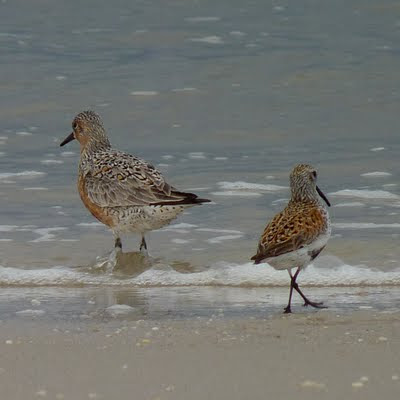
Study Confirms Importance of Red Knot Migratory Stopovers
During spring migration, Red Knots time their arrival in the Mid-Atlantic to coincide with the spawning of horseshoe crabs. Red Knots (and other shorebird species) eat the freshly-laid eggs to gain weight for the final leg of their journey, from the Mid-Atlantic to the Arctic, where the birds need to find mates and breed within a fairly short window of time. A major increase in the harvest of horseshoe crabs, due to their increasing use as bait for whelk fishing, reduced the availability of horseshoe crab eggs. While some shorebird populations remained stable or suffered small decreases, the Red Knot population crashed.
The study used mathematical models to determine the relationships between spawning by horseshoe crabs and weight gain by Red Knots and between Red Knots' mass at departure and future survival. (You can read the study's methods section for a technical description of the models.) The results showed that how much weight Red Knots gain depends not so much on the overall horseshoe crab abundance but on the timing of horseshoe crabs are spawning. If horseshoe crabs spawn later than usual, Red Knots are not able to gain as much weight as they normally would because not enough eggs will be available before they have to depart for the Arctic. Weight gain at stopover sites is crucial since Red Knots with a light weight at departure were unlikely to be recaptured or resighted in subsequent years.
While the model found a correlation between weight gain and subsequent survival, it found a stronger relationship between survival and snow depth on the Red Knots' breeding grounds. Red Knots were more likely to survive from one year to the next if there was deeper snow on the ground when they arrived in the Arctic. The scientists offer several possible explanations. One is that greater snow depth means greater overall moisture, which increases the amount of invertebrate prey available for the Red Knots. Another is that lemming populations tend to crash in years with low snow depth, so in those years predators that normally eat lemmings might turn to shorebirds instead. Determining whether those or other hypotheses are correct will require further research in the Arctic.
The study reinforces the link between horseshoe crabs and Red Knots and the importance of Delaware Bay as a spring stopover site. All necessary efforts should be taken to ensure that the bay continues to provide adequate habitat and food for these long-distance migrants. Such efforts should include further restriction of horseshoe crab harvests, particularly in Delaware, which has continued to allow harvesting even though New Jersey has imposed an indefinite moratorium.
Cited study:
McGowan, Conor P., James E. Hines, James D. Nichols, James E. Lyons, David R. Smith, Kevin S. Kalasz, Lawrence J. Niles, Amanda D. Dey, Nigel A. Clark, Philip W. Atkinson, Clive D. T. Minton, and William Kendall. (2011). Demographic consequences of migratory stopover: linking red knot survival to horseshoe crab spawning abundance. Ecosphere, 2 (art69) : 10.1890/ES11-00106.1
* For international readers, the IUCN ranks Red Knot as a species of least concern; the discrepancy is that there are multiple subspecies, and many of them are secure. However, the western Atlantic subspecies – the one that breeds in the North American Arctic, migrates along the Atlantic Coast of North America, and winters in Tierra del Fuego – is in serious danger of extinction.
Thursday, May 19, 2011
Some More Shorebird Photos
A Dunlin forages in the foreground while Red Knots stand in the surf.
A familiar trio from Reed's Beach: Red Knot, Laughing Gull, and Dunlin.
A Semipalmated Sandpiper picks through beach litter for morsels.
A Laughing Gull stands in the surf.
Speaking of Laughing Gulls, this is what Reed's Beach looked liked on Sunday morning. Cape May County has one of the largest Laughing Gull breeding areas in the world in its back bay marshes along the eastern side of the peninsula. Apparently a lot of those nests got flooded out in the last week because of recent high tides, made higher than normal by their proximity to the full moon on Tuesday. As a result, a lot of those gulls were hanging out in the horseshoe crab spawning areas along the Delaware Bay instead of tending to their nests in the marshes.
Wednesday, May 18, 2011
Shorebird Banding in Cape May
An international effort is underway to monitor the remaining population and push for conservation of the habitats and resources the Red Knots need. Part of that is an ongoing banding program to study how birds use stopover sites and what migration routes they use. My friend Mary (whom I met through DC Audubon) knows some of the banders from her time in Australia, so she got invitations for the two of us to participate in a banding session this past weekend. Because of weather and tides, it turned out that Saturday was our best chance to participate, so we made sure to be at Reed's Beach early in the morning, even though we both arrived in Cape May rather late the previous night.
You can see how shorebirds are banded in a video I linked on this blog a few years ago. That shows a different set of banders in a different location, but the methods for capture and processing are essentially the same. The banding team prepares a net and disguises it as carefully as possible. Once enough shorebirds are in front of the net, the team fires cannons that propel the net over the birds. Some birds will escape, but many will be caught under the net. The banding team hurries to extract the birds from under the net as quickly as possible, so as to avoid unnecessary stress or injuries to the birds. Once all the birds are out of the net and into shaded containers, the banders can sit down and process them.
On Saturday, the captured birds went through several steps before their release. First they were banded and marked with coded tags to make it easier to recognize individuals in the field without recapturing them;* then a series of measurements were taken: weight, wing chord, and bill and head length; finally, feather samples were taken for lab analysis. One person recorded all of the codes and measurements for each bird. I was last in line, so I held each bird while another person snipped some feathers (one wing covert and two breast feathers), and then I released it. I think I probably handled a few dozen Red Knots in the course of the morning, though I was not keeping count.
It was really cool to hold the Red Knots and see them up close. One thing I had not realized when I looked at them through binoculars was just how intricate the patterns on their backs are. Their scapulars in particular have dark brown lines dividing each feather into sixths; the middle part of the feather is tinged with rufous while the tip is white. Meanwhile, their rumps are etched with fine barring, and their undertail coverts are speckled. The Red Knots were also smaller than I expected; I guess they look larger to me through binoculars than they do in the hand. A lot of these birds were recent arrivals, though, so it is possible I would get a different impression once they had time to gorge themselves on horseshoe crab eggs.
As I mentioned in yesterday's post, Mary and I went to Heislerville in the afternoon and evening to find a Curlew Sandpiper. Once we had found it, we helped with another banding project that is monitoring some of the species using the impoundments. That project is mainly concerned with Semipalmated Sandpipers, but it also bands Short-billed Dowitchers, Dunlin, and other shorebird species that happen to get tangled in the nets. Mary helped extract shorebirds from the nets, while I ferried birds from the nets to the banders or held nets so that they would not blow on a bird during the extraction process. Once again I was impressed by the birds' small size; the Semipalmated Sandpipers were especially tiny.
I really enjoyed my experience with shorebird banding this weekend, and I hope to do more of it when I have the chance.
* If you happen to see a Red Knot (or other shorebird) with color markings or a colored flag with an alphanumeric code on it, please report it to bandedbirds.org.
Tuesday, May 17, 2011
Seeing a Curlew Sandpiper
This past weekend I was in Cape May, primarily to participate in shorebird banding, but also to see any rare birds that might be around. I was especially eager to see one of the several Curlew Sandpipers that have been frequenting the impoundments at Heislerville. This is a species I have missed on past visits to Heislerville. Plus, who can resist a sandpiper with a long, down-curved bill and a bright red breast? Not me!
One other species of interest in the main impoundment was Red Knot. A group of about ten was among the thousands of other shorebirds. One of the group was banded and wore a light green flag with the code 3CP. By entering the code at bandedbirds.org, I found out that this bird was banded at Mispillion Harbor in Delaware in 2009 and was recaptured at Kimble's Beach in New Jersey in 2010. That means that this individual has made it back to Delaware Bay three years in a row as part of its annual round trip from southern South America to the Arctic and back.
Sunday, March 27, 2011
Robins and a Snipe
Besides the robins, there were three American Kestrels, two Northern Harriers, and a Red-tailed Hawk patrolling the fields. A few Eastern Bluebirds seem to be setting up breeding territories in the fields. Beyond that, the preserve is still waiting for the influx of spring migrants and summer residents.
On Thursday, another birder found a Wilson's Snipe in Johnson Park, with further reports of the bird on Friday. So yesterday I went over to follow up since it would be a county bird for me. Sure enough, the snipe turned out to be easy to find, as it was hanging around the same drainage ditch where it was reported for the previous two days.
A couple of Mallards hanging around nearby provided a nice size comparison for the snipe.
Wednesday, January 26, 2011
Dunlin at Barnegat Light
I estimated that there were about 180 spread over the top and sides of the jetty. This is a small portion of the flock. This group did not want to move when I approached to pass, whether because they are used to foot traffic or because they did not want to give up their sheltered roosting places.
Meanwhile, other Dunlin were feeding among the mussels attached to the rocks.
The many mussel beds along the sides of the jetty made it easy to understand why so many waterfowl and shorebirds were gathered in the location.
Here are some of the Dunlin with a Purple Sandpiper in their midst.
Monday, January 17, 2011
Ruddy Turnstones at Barnegat Light
I saw relatively few Purple Sandpipers (normally a highlight at Barnegat Light) or Ruddy Turnstones on my last visit there, but both were on the jetty. In winter, Ruddy Turnstones lose the ruddiness that gives them their name, but they retain the distinctive bib and moustache. Ruddy Turnstones are one of the northerly breeders among shorebirds, with their breeding range covering parts of Nunavut and Greenland, as well as the northern coasts of Alaska and Siberia. Their winter range extends along the Atlantic and Pacific coasts of North and South America.
Here is a Ruddy Turnstone with a Purple Sandpiper. It is easy to see why shorebirds winter here, with a convenient mussel buffet. Turnstones switch from eating flies and other insects to a more varied diet in winter. Crustaceans and mollusks are their main prey items, but they also will scavenge animals killed by other birds and refuse left by humans. Speaking of refuse, the gray item in the lower right of this photo appears to be a fishing weight.
Saturday, November 20, 2010
Sandpipers on the Rocks
The Purple Sandpipers were feeding in some of the pools that formed after a wave hit the jetty. I am not sure exactly what they were finding to eat there, or if they were finding anything in the pools. Perhaps the waves carried some small animals onto the rocks.
Others were working the edges of the jetty, but they had to run for cover whenever one of the larger waves crashed.
The were also Ruddy Turnstones, like the one above. These moved faster than the Purple Sandpipers, so they were harder to photograph, even though sometimes they ran right past my feet.
Most of the Sanderling were on the beach, but one ran up on the jetty.
Thursday, November 18, 2010
Avocets at Brigantine
This small flock has been lingering at Forsythe NWR (a.k.a. "Brigantine"). Sightings of this species in colder months are somewhat unusual, so these birds may not stick around much longer. When I first saw them, they were wading into deep water – so deep that it came up to their chests. They almost appeared to be swimming.