


 Posts
All Comments
Posts
All Comments


Recently I started participating in the Dragonfly Pond Watch Project run by the Migratory Dragonfly Partnership. I hear about a lot of projects like this through insect bloggers; in this case I heard about it through the Xerces Society's newsletter. This particular project tracks the migratory movements of two very common dragonflies, the Common Green Darner (Anax junius) and Black Saddlebags (Tramea lacerata). It involves periodically counting dragonflies at the same pond over the course of the fall migration period. This works well for me since an artificial pond is part of my normal walking route through my local patch, and I can just add 15 or 20 minutes to my normal route to count dragonflies there.




 |
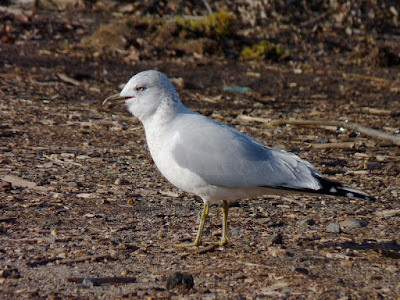
| Not a bird. |
 |
| Daffodils? In January?? |


While Hurricane Irene did not bring me any tropical birds, it has created some good opportunities for local birding. The Raritan River flooded on Sunday and remained flooded on Monday, with the waters gradually decreasing since then. At this point, the flooding here is finished, but the river's level remains very high, so that areas that are normally exposed at low tide are still submerged. This leaves waders that depend on tidal mudflats looking for new locations for foraging and loafing. Meanwhile, with the river still high and the ground still saturated, a lot of fields have big wet areas.


The worst parts of Hurricane Irene passed through New Jersey in the early morning hours. The eye made landfall in the state around 6 am near Little Egg Inlet, the waterway between Atlantic City and Long Beach Island, very close to the Brigantine portion of Forsythe NWR. It was only the third storm to make landfall in New Jersey as a hurricane and the first since the Vagabond Hurricane of 1903. It continued up the coast and degraded into a tropical storm as it reached New York City.
 |
| Donaldson Park was flooded by the surging Raritan |


Yesterday morning, I walked through my local patch, Donaldson Park, in the hope of seeing some unusual birds before the storm arrived. Most of the birds I saw were the usual ones, highlighted by a flock of several dozen Brown-headed Cowbirds. One Spotted Sandpiper joined the usual Killdeer on the mudflats along the Raritan. I stood for a while and watched for bird activity at the east end of the park, which has an unobstructed view of the river down to the US 1 bridge. A few Double-crested Cormorants flew past, along with a few Laughing Gulls. The latter is a common coastal bird, but I rarely see it at that particular location. Maybe the easterly winds carried a few in from Raritan Bay.


