Showing posts with label Weather. Show all posts

Wednesday, November 21, 2012

How Soon Can Refuges Recover from Sandy?

Damage at Forsythe NWR / USFWS Photo
The Washington Post covers some of the damage that Sandy wrought at national wildlife refuges in the Mid-Atlantic region:
The wreckage at Forsythe and other Northeast coastal refuges was yet another testament to the destructive power of Sandy, the superstorm that ripped up the New Jersey shore and flooded Manhattan. And it drew attention to the costly plans being considered by the federal agency to protect wildlife refuges from the impact of climate change and sea-level rise.

Sandy’s winds rammed a dirt and gravel dike at Forsythe with seawater, causing it to burst. Bay salt water rushed into a shallow freshwater pond created for birds such as the American black duck and Atlantic brant. The usual foot of water in which the birds dip their heads got saltier, rose to five feet and washed out vegetation, so the birds could no longer reach underwater seeds or pick bugs from leaves.

Dozens of refuges between Maine and Virginia were pummeled. Four were damaged severely, including Forsythe, where about 130 boats in the Atlantic City area were blown into marshes, Kahan said.

At Chincoteague National Wildlife Refuge in Virginia, part of the public beach and two parking lots were washed away on Assateague Island. At Prime Hook National Wildlife Refuge in Delaware, a 1,500-foot breach in a dune sent salt water from the Delaware Bay into a freshwater pond where waterfowl eat, nest and give birth, and flooded homes on an island near the refuge. And at the Long Island National Wildlife Refuge Complex in New York, fallen trees blocked the entrance.

Sandy created sea surge powerful enough to reshape portions of the coasts of North Carolina, Delaware and Maryland, and Virginia’s portion of the Delmarva Peninsula, which includes Chincoteague, said the U.S. Geological Survey.

Thirty-five of the region’s 72 refuges were closed after the storm. Six million people per year — many from the District, Virginia and Maryland — visit the refuges, which cover 535,000 acres, and managers acted to protect visitors from “widow-makers,” damaged trees that crash down after storms, a Fish and Wildlife spokeswoman said.

Forsythe still has not reopened. In addition to the busted dike and ruined pond, the wrecked boats appear to be leaking fuel, Kahan said.

Saturday, November 03, 2012

Brigantine after Sandy

It looks unlikely that birders will be driving around the wildlife drive at Brigantine in the near future.

Those cormorants are swimming through what used to by the road along the south dike. Other parts of the road are eroded as well.


It looks like the refuge will be closed indefinitely, but the status will be updated on the Forsythe NWR website.

Update: Some aerial views of the south dike:


All photos are courtesy of the US Fish and Wildlife Service.

Thursday, November 01, 2012

My Sandy Experience

Hurricane Sandy / Image credit: NASA GOES Project
Hurricane Sandy made landfall in New Jersey around 8 pm on October 29. Up until that point, things had been going as well as could be expected, with a lot of rain and wind, but not much damage. Around the time Sandy made landfall, trouble started with the electricity. First the lights started flickering, and then there were two or three momentary power drops — the lights would go off, my desk fan (to cool my laptop) would stop, and I'd lose my internet connection. Each time, the power was restored after about a minute. Then around 8:30 pm, the power went off for good. It was off until about 6 pm last night. A lot of nearby towns are still without power.

The good news is that I survived the storm with no injuries. So did my parents and sisters and everyone else I know that I've been able to contact so far. My house is still intact, and the water never got cut off. It also isn't 90°F, so life without electricity was a lot more bearable. I am so glad that the stove and hot water heater are both powered by natural gas and not electricity. There was surprisingly little flooding for a storm of this magnitude, at least in Central New Jersey. Low-lying areas were wet, and a few roads were flooded, but the main roads seemed to be open. The flooding was nothing like that during Irene and Floyd.

While there was little flooding, the wind was ferocious on October 29. It was the worst wind storm I can remember. Many trees and branches are down. I saw at least one car with a Silver Maple on top of it. Bradford Pears were massacred. One Gingko had its top ripped off and tossed on the ground beside it. Other trees took power lines with them, and some crashed through houses. Many trees in my birding patch were uprooted. The Norway Maples along the back fence of my yard lost a lot of limbs, including a big one that crushed the fence.

I feel very lucky because this could easily have been a lot worse, and there are still a lot of people that have no power or water or even homes in some cases.

I did a little bit of post-hurricane birding on Tuesday morning, once I had an idea of what the storm had caused. There was nothing rare at Donaldson Park, my one stop. The Chipping Sparrows I had seen on October 28 were still there, though reduced in number. There were hundreds of gulls, including 119 Laughing Gulls. These are almost certainly storm-blown birds since they rarely visit the site except during unusual weather patterns. I also saw a Peregrine Falcon and a Northern Harrier. The latter might be a storm-displaced bird, though it is hard to be certain. I have only seen one other harrier at the site as far as I can remember, and that was several years ago. The Peregrine, of course, is a local breeder.

Saturday, January 28, 2012

Early Invertebrate

This has been an unusual winter in several ways, not least of which has been the persistently warm weather. A cold snap has rarely lasted longer than a day or two, and the first snow of the winter did not arrive until last weekend. One consequence of this is that the normal spring processes are running ahead of schedule. Daffodils have been sprouting over the past few weeks. Yesterday afternoon, it was warm enough for a slug to be out and active.


Tuesday, November 01, 2011

Leaves in the Snow

Some snow remains from Saturday's snowstorm. The piles of snow here and there create the unusual sight of bright fall foliage on or under snow. Here are a few leaves from a flowering dogwood in the snow.


Sunday, October 30, 2011

Snow in October?

Yesterday, New Jersey had a highly unusual October snowstorm, the first since 2008. Usually the state gets its first significant snowfall in mid-December. With a wet snow and leaves still on the trees, there were a lot of reports of limbs breaking (though I did not see any limbs down myself). Some of the trees, like the dogwood above, looked extra colorful with the combination of red or orange leaves with a white frosting of snow.


Thursday, September 08, 2011

Rain and Asters

The New England Asters are starting to bloom. Meanwhile, we seem to be stuck in a pattern of cool rainy weather, which I actually like (especially compared to the extremes we experienced in July), but it slows down birding and tends to suppress insect activity. So I will leave you with these waterlogged asters.


Tuesday, August 30, 2011

Vagrant Birds from Hurricane Irene

Hurricane Irene Reaches New York City / Credit: NASA/NOAA GOES Project
Tropical cyclones like Hurricane Irene are well-known among birders for carrying numerous birds far from their normal ranges. Aerial waterbirds – those that earn their living on the wing over open ocean – are particularly prone to displacement. The prospect of seeing storm-blown birds, especially ones that one would normally need to travel or take a pelagic trip to see, lures birders to coastal areas or inland spots with open water even before a storm has completely subsided. I made some mostly unsuccessful attempts to find unusual birds at my usual spots. Other birders had much better luck, and it turns out that Irene's track was particularly conducive to sighting entrained birds from land in this area.

Here are a few of the sightings that have been reported so far:
Finally, the Hurricane Irene 2011 blog has been collecting sightings from throughout the areas affected by the storm. The Philadelphia Inquirer has an article on hurricane birding in the Philadelphia area. If you live in or near the storm's path, did you see any unusual birds this weekend?

Monday, August 29, 2011

Birding after the Storm

The worst parts of Hurricane Irene passed through New Jersey in the early morning hours. The eye made landfall in the state around 6 am near Little Egg Inlet, the waterway between Atlantic City and Long Beach Island, very close to the Brigantine portion of Forsythe NWR. It was only the third storm to make landfall in New Jersey as a hurricane and the first since the Vagabond Hurricane of 1903. It continued up the coast and degraded into a tropical storm as it reached New York City.

Donaldson Park was flooded by the surging Raritan
As the eye was passing Central New Jersey, I took a walk down to Donaldson Park, my local patch, to see if any unusual birds were around. As I expected, the park was completely flooded. There were about 150 Laughing Gulls, as well as flocks of swallows (mostly Tree Swallows), taking advantage of the newly flooded fields. As I mentioned in yesterday's post, that many Laughing Gulls is very unusual for the site. I looked for terns but saw none. Even something common like a Forster's Tern would have been a nice sighting for the location.

There was not too much damage in my neighborhood, just some limbs down and one fallen tree, as far as I could see. The carpenter bee above was apparently killed by the storm, either by drowning or by being slammed into the ground by a gust of wind. A baby squirrel must have been knocked out of its nest by the wind.

In the afternoon, I went out again, this time across the Albany Street Bridge into New Brunswick. The bridge is closed because of flooding on the New Brunswick end, and Route 18 is closed because of flooding in multiple places. The river is very high right now, and it is expected to get worse before it gets better. The Delaware and Raritan Canal, its towpath, and Boyd Park have disappeared under the flood waters.

As I walked across the bridge and along Route 18's deserted northbound lanes, I kept an eye out for interesting birds. There were a lot of swallows around; I identified both Barn Swallows and Tree Swallows, but not any others. About 100 Laughing Gulls were in the air. Beyond that, I did not see anything out of the ordinary.

Sunday, August 28, 2011

Riding out Irene

Yesterday morning, I walked through my local patch, Donaldson Park, in the hope of seeing some unusual birds before the storm arrived. Most of the birds I saw were the usual ones, highlighted by a flock of several dozen Brown-headed Cowbirds. One Spotted Sandpiper joined the usual Killdeer on the mudflats along the Raritan. I stood for a while and watched for bird activity at the east end of the park, which has an unobstructed view of the river down to the US 1 bridge. A few Double-crested Cormorants flew past, along with a few Laughing Gulls. The latter is a common coastal bird, but I rarely see it at that particular location. Maybe the easterly winds carried a few in from Raritan Bay.

Here are a couple photos from later in the day.


Thursday, July 21, 2011

Sparrows in Hotter Climates Have Larger Bills

On a hot day, you need to do whatever you can to keep cool, especially if you have to be out in the sun. Humans, at least, have the ability to sweat: the skin produces moisture, and the heat makes it evaporate, cooling the skin. (At least that is how it usually works; if the humidity is sufficiently high, that moisture will not evaporate easily.) Birds cannot sweat, so they have to find other ways to cool down. One way is by panting: they open their bills to let heat escape through their mouths.

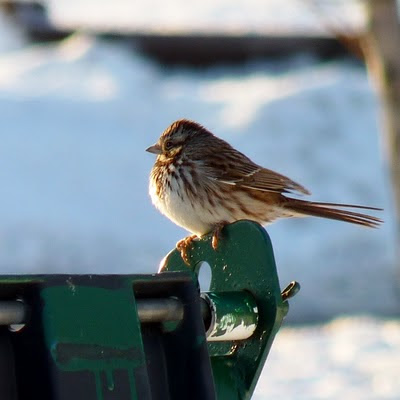
Song Sparrow / Cephas
For some birds, the bill itself presents a way to regulate temperature. That seems to be the case for coastal sparrows:
Scientists at the Smithsonian Migratory Bird Center at the Smithsonian's Conservation Biology Institute and colleagues examined five species of sparrow that inhabit salt marshes on the East, West and Gulf coasts of North America. While these marshes are very similar in makeup and structure, the main difference among them is summer temperatures. Focusing on 10 species and subspecies of tidal salt marsh sparrow, the team measured 1,380 specimens and found that the variation in the sparrows' bill size was strongly related to the variation in the daily high summer temperatures of their salt marsh breeding habitats—the higher the average summer temperature, the larger the bill. Birds pump blood into tissue inside the bill at high temperatures and the body's heat is released into the air. Because larger bills have a greater surface area than smaller bills, they serve as more effective thermoregulatory organs under hot conditions. On average, the study found the bills of sparrows in marshes with high summer temperatures to be up to 90 percent larger than those of the same species in cooler marshes....

The scientific theory known as Allen's Rule states that warm-blooded species from colder climates usually have shorter limbs or appendages than the equivalent animals from warmer climates. The team's new findings are a new example of Allen's Rule that confirms the importance of physiological constraints on the evolution of vertebrate morphologies, even in bird bills.
The full paper from Ecography is online via the Smithsonian site (pdf) if you want to read it. I was surprised that the press release did not mention which bird species were involved in the study since that is one of the first things I wanted to know. From the paper, I can see that they used four subspecies of Song Sparrow (Melospiza melodia atlantica, M. m. pusillula, M. m. samuelis, and M. m. maxillaries), two subspecies of Savannah Sparrow (Passerculus sandwichensis rostratus and P. s. beldingi), one subspecies of Nelson's Sparrow (Ammodramus nelson subvirgatus), Saltmarsh Sparrow (Ammodramus caudacutus), and two subspecies of Seaside Sparrow (Ammodramus maritmus maritimus and A. m. fisheri). Some breed along the Atlantic Coast, some along the Gulf Coast, and others on the Pacific Coast.

Saturday, February 26, 2011

Storm Clouds

Yesterday brought wind and rain, in some cases very heavy, to my area. It also brought some dramatically textured clouds and changing light conditions. These two photos are an attempt to capture how this looked in the afternoon.


Wednesday, January 19, 2011

Yesterday's Ice Storm

A storm dropped snow and freezing rain on New Jersey yesterday. It left bushes and trees covered in a thin coat of ice. One thing I found interesting about the ice was that its surface was not smooth, but instead had fissures and ripples running over it.


This dogwood branch is covered in ice, but you can still see the shape of its flower bud.

The azalea bushes, which still have some leaves, were also coated.

Saturday, January 08, 2011

More Snow in New Jersey

Yesterday and today we have been getting more snow. It is not nearly as much as the last storm, but it is enough for some photo opportunities.


Wednesday, December 29, 2010

Sparrows in the Snow

Deep snow still covers most of the ground in my town. However, there are some bare spots – places where people have shoveled or plowed, places sheltered from the snow, or places where snow has been trampled or melted a little. After not seeing many birds for most of my walk through my patch yesterday, I found a cluster of sparrows in one such bare spot. The sparrows were gathered under a tree, which must have reduced the amount of snow that fell in that area.

The sparrows were all Song Sparrows and Dark-eyed Juncos, with juncos making up about two-thirds of the total. A couple robins also dropped down to feed in the same area. There was a park road nearby with sloped snow embankments. It was amusing to watch some juncos skidding down the embankment as if they were sledding or skiing. They did not seem any worse off for it.

One junco seemed to have some snow and grass stuck to its wing. I assume that it got the snow off eventually as no junco appears that way in subsequent photos.


Tuesday, December 28, 2010

A Post-Christmas Blizzard

There is a traditional Christmas carol that starts, "Good King Wenceslas looked out, on the feast of Stephen, when the snow lay round about, deep and crisp and even." "Feast of Stephen" refers to the day honoring St. Stephen the first martyr, which falls on December 26. That came to mind on Sunday as I watched snow fall and pile up. In less than 18 hours we got 23 inches (58 cm) of snow in central New Jersey – in other words, sufficient to be deep and crisp. Nearby towns had about the same amount while areas to the north and west got a lot less.

The result was very pretty but also a lot of work to shovel. It also makes me wonder how lingering snow will affect next weekend's Christmas Bird Counts. I am planning to do the Long Branch count with Patrick on Saturday; then thanks to its postponement, I will be doing the Raritan Estuary count on Sunday. Will the important parts of our count sectors be accessible? Will the predicted rain on Sunday turn the local parks into a slushy, muddy mess? Hopefully the answers will be yes to the first and no to the second.

In the meantime, here are some photos of the snow. A photographer in Belmar (about 35 miles from me) made a time-lapse video of the snowstorm. NASA's GOES-13 satellite took a pretty cool photo as the storm was passing over New England yesterday. If you expand the image to its original size (and scroll to the right and down), you can see the snow lying on the ground in the mid-Atlantic states and the Carolinas. One part of New Jersey that does not appear white is the Pine Barrens; I am not sure exactly why it is dark.


Weather Underground, as usual, has informative coverage of the blizzard in yesterday's and today's blog posts.

Wednesday, July 07, 2010

Ice-covered Rocks

On a day like today, a scene like this feels a lot more inviting.

Monday, March 29, 2010

Harsh Winter Changes the U.K.'s Bird Population

Fieldfare / Photo by Matt HB

This year Western Europe had one of its coldest winters in recent memory. As one might expect, this changed bird distribution. The numbers are in from the RSPB's Big Garden Birdwatch, and many species are down compared to last year's results. The Guardian has a summary of the changes.
The survey saw 530,000 people take part and their records showed the average number of birds per garden for already rare goldcrests were down 75% on January 2009, being seen in only about 5,300 gardens. Long-tailed tits were down 27% to an average of one bird per garden, and coal tits down 20%. The long-tailed tithad been thriving due to a succession of mild winters and was one of last year's big success stories.

This winter's bitter weather had a greater impact because the cold spell was national Kelly explained. Most previous drops in small bird populations caused by cold weather - such as the death of all the Cetti's warblers in Kent after two successive cold winters in the mid-1980s - were only regional.
It is not clear from the article what happened to these missing birds. The cold may have pushed them elsewhere, perhaps further south in Europe. They could also have died of cold-related causes, whether hypothermia or starvation. Or perhaps a bit of both. If this count is based solely in the U.K., it would not be possible to answer the question from this count's data alone. (This is one advantage of the Great Backyard Bird Count – it is easier to see movements over a continent-wide scale.) Relocation seems more likely, in my opinion, since the Big Garden Birdwatch showed evidence of a different set of species moving into people's gardens:
The snowy winter also led to a huge rise in sightings of countryside birds such as thrushes and finches in the UK's gardens. The number of fieldfares was up 73% on last year, redwings up 185% and song thrushes up 51%, though their numbers are still relatively low compared to garden stalwarts such as blue tits and chaffinches....

Another species apparently doing well was the blackcap, which was up 47% against 2009 levels. The RSPB believes many may have been migrants sheltering from even harsher weather in mainland Europe, though it also speculates that the increased sightings may simply be a result of the blackcaps getting used to eating from bird feeders and becoming more visible.
If you would like to look at the data yourself, it is available online, including in a Google spreadsheet.

Monday, March 15, 2010

Flooding on the Raritan

There is a saying that March comes in like a lion and goes out like a lamb. This year March saved the lion part for the middle of the month. Over the weekend, we had a major winter storm with heavy wind and about four inches of rain in 48 hours (some places got more than that). As result the river flooded any low-lying areas, such as my local park.


Someone flooded the bathrooms.


Of course, the local Canada Geese took full advantage of the expanded waters.


For the sake of comparison, the view from the top of the hill should look something like this (in summer).  The benches in the top photo are these ones.

Some towns fared far worse; in Bound Brook, where the river crested at 31.45 feet, the police had to patrol the streets on jetskis and rubber dinghys to evacuate residents. In Highland Park, the water only reached about 15 feet, which is not sufficient to flood the town. Even so, this was the highest I have seen the river in a long time. Newspaper accounts compared it to the aftermath of Hurricane Floyd.