


 Posts
All Comments
Posts
All Comments


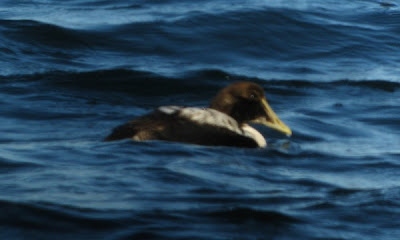
The only records that we have were made by the Audubon Association wardens stationed at the Point. A female or immature male was seen by William Rusling on the ocean off Cape May Point near the jetties in front of the Villa Maria. It remained there from October 10 to 14, 1935, and he watched it several times a day for four days having it in good view, once within twenty-five feet. When caught by the tide and carried out from shore it immediately swam back to the jetties. He identified it as an American Eider.Turning to King Eider, Stone notes that most of the specimens are young birds and that there had been no recent sightings in Cape May County, but that specimens had been shot in 1928 (in Great Bay) and 1900 (on the lower Delaware). He continues:
Three were seen off the end of the jetty at the entrance to the Harbor, on November 3, 1936, by James Tanner.
In the Barnegat Bay region several of these ducks have been seen. Charles Urner sends me the following list: One on November 3, 1930 (Harry Ridgway); a drake, January 11, 1931; one on December 27, 1931 (Lester Walsh and Charles Nichols); two on December 17, 1932 (Oscar Eyre); one drake, on December 26, 1932 (Urner and others); one young drake, February 18, 1934 (Urner).
Charles Urner sends me the following list of individuals observed in the Barnegat Bay region by him or his associates: One December 15, 1924, (Watson); one March 3, 1929 (Jacques); two November 9, 1930; one January 14, 1934; two February 4, 1934; four February 18, 1934. The 1934 birds were seen immediately following the extremely cold weather of that winter which was undoubtedly the cause of their southward wandering.The impression I get from Stone is that neither species was common but that both made regular appearances along New Jersey's southern coast, either singly or in groups. I do not know of a similar resource for more recent decades, though one could probably piece it together by going through back issues of New Jersey Birds and its predecessors. As an alternative, I turned to archived Christmas Bird Counts. Using historical CBC data presents problems since participation and coverage have changed over time and count circles have gone in and out of existence. However, using birds per party hour controls somewhat for effort and New Jersey has some long-running counts along the coast. Here is graph for New Jersey since the winter of 1940-41, roughly Stone's time to ours.


A New Jersey birder recently visited the Barnegat Lighthouse and, while he was walking out to see the Harlequin Ducks, fell head-first into the jetty. The tide was coming in, but fortunately he was able to summon help by calling 911. You can read more and see pictures of the incident at his website.
 As I mentioned in my last post, I have been visiting family in New Jersey for the holidays. Today several of us were down at Barnegat Light, a nineteenth-century lighthouse and state park. Barnegat Light is an important historic site for its longtime role in ship navigation along the New Jersey coast, and it is a beautifully scenic location. Visitors may climb the steps to the top of the lighthouse for a view with a thirty-mile radius on a clear day. The site is also a great birding spot, particularly for seabirds and waterfowl.
 Harlequin ducks have visited the lighthouse regularly for the past several years. They and a large flock of common eiders can be found at the far end of the jetty, either on the inlet side or the ocean side. I must say that today I had my best-ever looks at harlequin ducks, up close and in full sunlight. This was much better than picking out a single bird in the snow, as was the case last February. On the jetty itself, there were several purple sandpipers, a ruddy turnstone, and a snow bunting. All were seen at close range. Many of these birds were life birds for my mother and sister, though I had seen them before at one time or another.
 On the walk back to the lighthouse for lunch, we spotted a peregrine falcon land on the lighthouse roof. Later, another birder reported seeing this falcon plucking the feathers from some hapless bird for its lunch. After our own lunch, our dad joined us for a climb to the top of the lighthouse tower for views of Barnegat Bay and its barrier islands. The image at left shows the jetties along Barnegat Inlet; the harlequin ducks stick close to the inlet side of the south jetty, near where the sand ends and the ocean begins. Today the common eiders were on the ocean side of the south jetty, though sometimes they can be found in the inlet. The image below is looking north towards Island Beach State Park, on the southern end of the long peninsula that extends north to the top of Barnegat Bay and Point Pleasant. Island Beach State Park is another good birding spot in all seasons.
 For a final stop, we walked the beach along High Bar, a spit of land that is part of the Edwin B. Forsythe NWR. Along the beach we spotted American oystercatchers (always a favorite), dunlin, red-breasted mergansers, and brant. A northern harrier was working the dunes. The real treat was a chorus of vocalizing long-tailed ducks. Each bird gave a call that sounded a bit like an oboe or clarinet. I enjoy hearing birds as much as seeing them, and I was not aware of how beautiful these birds sound.
 Species List: 30 species seen
Brant
Canada Goose
American Black Duck
Common Eider
Harlequin Duck
Long-tailed Duck
Red-breasted Merganser
Red-throated Loon
Common Loon
Double-crested Cormorant
Great Blue Heron
Turkey Vulture
Northern Harrier
Peregrine Falcon
American Oystercatcher
Ruddy Turnstone
Purple Sandpiper
Dunlin
American Herring Gull
Great Black-backed Gull
Rock Pigeon
Mourning Dove
Fish Crow
Northern Mockingbird
Yellow-rumped Warbler
Snow Bunting
Northern Cardinal
House Finch
American Goldfinch
House Sparrow

