Showing posts with label Cape May. Show all posts

Wednesday, March 14, 2012

Broad-tailed Hummingbird in Cape May

The Press of Atlantic City has an interesting article on the Broad-tailed Hummingbird (a first state record) currently visiting a feeder in Cape May County. The has been there through the winter, but its identity was not recognized until recently because of its similarity to Rufous Hummingbirds.

A broad-tailed hummingbird is spending the winter in Lower Township, just a couple miles away from some of the world’s top birders at the Cape May Bird Observatory. These experts knew about this particular bird and some had even seen it with their own eyes, but they gave it scant attention because they thought it was a different, more common species.

Now they are feeling sheepish about their mistake.

Cape May birder and ecotourism guide Michael O’Brien was the first to realize the error when he took new photographs March 1 after the tiny creature had molted telltale spring plumage.

He immediately tweeted his colleagues his pictures captioned only with the expletive: “Oh, s***.”

Finding a bird never before seen in New Jersey is rare in a state that is so vigilant about such things. New Jersey has documented 465 bird species. Ignoring a new species that for months has had habits as predictable as the tides is simply embarrassing.

“We were going to pose for a photo with some scrambled egg on our faces,” observatory Director Mike Crewe said.
This story is a good reminder not to make assumptions about a bird's identity based on incomplete information. Most of the time, the danger is trying to turn a common bird into a rarer one based on a partial view or a momentary glimpse. Now and then, though, it might make us miss a true rarity while thinking, "Oh, that's just a [fill-in-the-blank]." This incident also serves as a reminder that even the experts can be wrong, and it is worth evaluating rare sightings for yourself.

Wednesday, December 07, 2011

Delaware Bayshore Is an Important Bird Area

New Jersey's Delaware Bayshore has now been designated as a Globally Significant Important Bird Area.
To achieve the “Globally Significant” label, [New Jersey Audubon] and National Audubon submitted years of annual shorebird and waterfowl survey data to a panel of nationally and internationally recognized experts. The panel found that four species were present in numbers that met or exceeded the quota required to trigger the “Globally Significant” designation: The Bayshore is a crucial stopover site for migrating Red Knots and Ruddy Turnstones, and provides critical winter habitat for large concentrations of Snow Geese and American Black Ducks. The survey data was collected in annual surveys by wildlife biologists from the New Jersey Department of Environmental Protection (NJDEP).

Stretching along approximately 50 miles of coastline, from Fairfield Township in Cumberland County to Cape May Point in Cape May County, the Delaware Bayshore IBA includes about 50,000 acres, much of which is protected conservation land, including 13 state Wildlife Management Areas and the Cape May National Wildlife Refuge....

Awareness of the Delaware Bayshore’s importance began to grow in 1982, when staff at the New Jersey Audubon Society began the first aerial shorebird surveys to quantify the number and species of shorebirds using the Bayshore. These aerial surveys were later assumed by the state Division of Fish and Wildlife, which has performed them annually since 1986. The state also performs the annual winter waterfowl surveys that led to the inclusion of American Black Ducks and Snow Geese in the “Globally Significant” designation....

Of the four species named in the Globally Significant announcement, the plight of the Red Knot and Ruddy Turnstone is the best known and lends a bittersweet note to the designation. While recent surveys show significant numbers of birds refueling at the Bayshore during spring migration (12,000 to 16,000 Red Knots and 17,000 to 37,000 Ruddy Turnstones), they are lower than numbers of 95,000 Red Knots and 80,000 Turnstones recorded in the early aerial surveys. A precipitous decline in these populations began in the mid-1980s, when horseshoe crab harvesting rose dramatically for use as bait. The horseshoe crabs’ eggs are essential food that allows these long-distance migrants to make it to their summer arctic nesting grounds to breed.
I am actually surprised that this area was not designated as an Important Bird Area sooner since the importance of the area for migratory shorebirds (especially Red Knots) has been known for some time. Much of the area is already protected, so I am not sure whether this designation will lead to further conservation measures.

Monday, August 15, 2011

Eurasian Collared-Dove at Cape May Point

While I was down at the shore last week, I managed to see a Eurasian Collared-Dove that has been hanging around in Cape May Point for the last several weeks. Apparently there is also a second bird, which I did not see. This was a life bird for me, and it brought my life list up to 350 species. It was larger than I expected, built more like a Rock Pigeon than a Mourning Dove.

Eurasian Collared-Doves originated in southern Asia and gradually spread west and north into Europe. In the 1970s, some were released on Bermuda, and their population quickly grew and spread into North America from there. Their current range covers the Deep South, with pockets of breeding birds in the southern Great Plains and southern California. It would not surprise me to see their population spread further north, especially as the climate warms and becomes more hospitable to them. Their rapid spread has led to concerns about their invasive potential, though what effect they may have on native species like the Mourning Dove remains unknown.

Wednesday, April 20, 2011

Perhaps Not Missing After All

Yesterday morning I did a little birding around Cape May Point before returning home in the afternoon. A dawn seawatch at the dune crossing near St. Peter's produced a lot of seabirds. Most striking were the Northern Gannets. Dozens of them were flying close to shore, in and out of Delaware Bay. Double-crested Cormorants were most numerous, with over 1,000 cormorants passing the point and heading north in the hour I watched from the platform. A few Common Loons flying overhead were a treat; I usually do not get to see them in their breeding plumage. Several Willets passed the point and flew up the bay. Meanwhile, a few dozen Black and Surf Scoters remain around the point.

At the next stop, Cape May Point State Park, I hoped to see some newly-arrived warblers since there had been a good flight into New Jersey the previous night. It ended up being quieter than I had hoped, with only a handful of the same species I had seen the previous day, along with my first Common Yellowthroat of the year. However, just as I was preparing to finish the loop and move on to the next place, there was a flurry of activity around the junction of the red and yellow trails. First, I saw a Swamp Sparrow on the ground. Then, I looked up to find the source of an odd Yellow-rumped Warbler song I was hearing. When I finally saw it, a yellow throat made clear that it was not an expected Myrtle, but instead the Audubon's Yellow-rumped Warbler that I had missed the day before. It was extremely cooperative, sitting out in the open and singing for several minutes. Other birders saw and reported it later, so it stuck around the same area at least through the morning. If it is the same individual, I find it interesting that it stuck around Cape May Point and managed to elude so many birders for a day and a half after its initial discovery on Sunday morning.

A stop at the Nature Conservancy's preserve (a.k.a. the Meadows) turned up a mix of waterbirds and landbirds. Even though they were few in number, the Willets made their presence obvious by flying around, calling, and sometimes perching on the tops of poles to call and look around. Along with the Willets, I saw my first Greater Yellowlegs of the year. I counted nine singing male Common Yellowthroats around the preserve's loop. A few other warblers were migrating through. One treat was a bright male Yellow Warbler, my first of the year. Some ducks and American Coots are still at the refuge, though in fewer numbers than their late winter peak. Gadwall are most numerous, with smaller numbers of Green-winged Teal, American Black Ducks, and Northern Shovelers.

Unfortunately, I was so excited by the Audubon's Warbler sighting that I forgot to take photos. (You can see ones by other birders here, here, and here.) In the meantime, enjoy this photo of a Snowy Egret from the Meadows.

Tuesday, April 19, 2011

Missing Life Birds

Yesterday I made an attempt to see the Painted Bunting that had been appearing at a feeder in Absecon, NJ. I waited in front of the feeder for about an hour and a half. In that time plenty of birds passed by the yard – resident House Sparrows, Northern Cardinals, and House Finches; a Red-bellied Woodpecker; singing Carolina Chickadees; an Osprey; and a flock of Double-crested Cormorants flying overhead. However, there was no sign of the bunting. From what I understand, the bird was last seen on Thursday. The bunting would have been a life bird, and it becomes one of several that I have missed this spring. After a glut of life birds at the Superbowl of Birding, my life list building has slowed considerably.

In the afternoon, I tried to find an Audubon's Yellow-rumped Warbler that had been spotted the previous morning at Lake Lily in Cape May Point. I walked all around the lake, checking every warbler and warbler-like flying object. There were plenty of Myrtles, but no sign of the Audubon's. For those unfamiliar with the terms, Myrtle is the subspecies of Yellow-rumped Warbler normally found in eastern North America, while Audubon's dwells in the west. These forms were previously considered separate species and may one day be split again.

Even though I missed the potential future armchair-lifer, the trip around the lake was not a waste. The Myrtles were nice to see and hear, especially in their bright spring plumage. I saw several year birds. These included Blue-gray Gnatcatcher, Great-crested Flycatcher, and Prairie Warbler. Even better, there was a very cooperative Yellow-throated Warbler in front of one of the houses bordering the lake. My only previous sighting of this species was a singing bird at the top of a tall pine tree in Virginia. The look was good enough to recognize it, but it was not very satisfying. This view was much better, as the warbler crept along a rooftop gutter like a nuthatch and then flitted through nearby trees and shrubs, usually no more than 10 feet off the ground.

I do not have a photograph of the Painted Bunting or Yellow-throated Warbler, so take a look at this Mute Swan instead.

Wednesday, March 23, 2011

Frogs Chorusing in Cape May

Along with the warmer temperatures, spring revives sounds, the songs of animals calling to establish breeding territories and attract mates. Birds, of course, do this; my first sign of spring is usually when the House Finches start to sing in earnest again in February. Insects sing, too, though we will not get the full effect of those nightly choruses for a while yet. Right now, the nights around wetland areas are full of the sounds of amphibians.


Several species of frogs were calling in Cape May Point State Park one night last week. I took these videos at various points along the boardwalks, as the evening got darker and the choruses got louder. The video above, taken early in the evening, records the sound of Northern Spring Peepers. Other sounds in the video include waves on the beaches and footsteps on the boardwalk.


This video has mostly Wood Frogs, as well as a New Jersey Chorus Frog.


This video has four species: Northern Spring Peepers, Northern Cricket Frogs, Wood Frogs, and Pickerel Frogs.


This video, my last of the evening, has the same set of species as the previous one.

New Jersey's fish & wildlife agency produced a guide to the state's amphibians. There is a pdf summary of the frogs and a website with links to factsheets about each of the state's reptiles and amphibians.

Saturday, March 19, 2011

Cape May Light at Dawn

<
I took these photos this week from the dune crossing observation platform at St. Peter's in Cape May Point.


Wednesday, March 16, 2011

Hermit Crab

A hermit crab in a snail shell at Two Mile Beach near Wildwood Crest.

Monday, February 14, 2011

Cape May Weekend

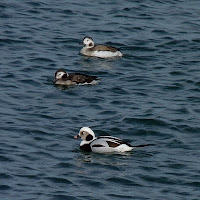
This weekend I was down at Cape May. With slightly warmer temperatures in the last two weeks, this weekend offered a chance to check out some of the places that were frozen when I visited earlier in the season. The peninsula has been unusually quiet over the past two months or so, with very few reports of rarities. This weekend was no different. The first stop on Saturday was at Avalon, where an Eared Grebe had been reported from the seawatch location. There was no sign of that, or any other grebe, but there were Long-tailed Ducks fairly close to shore and a mixed raft of Surf and Black Scoters farther out.

Saturday ended with a trip up to Jakes Landing to watch for owls. I did not see the reported Rough-legged Hawk, but I did see a first-winter Bald Eagle, which flew overhead just above treetop level. A few other birds flew around: American Black Ducks, a Great Blue Heron, an American Bittern, a few Northern Harriers, and a Red-tailed Hawk. An American Coot swam up to one of the boat ramps and started walking up. Finally, a little after the sun had dipped below the horizon, three Short-eared Owls finally emerged and started coursing over the marsh. Occasionally, two of the owls would get too close to each other for comfort, which would result in a brief aerial scuffle before they continued on their way.

Yesterday morning, the first stop was the Beanery. It seemed more quiet than usual, without the mixed flocks of sparrows and other songbirds that are usually all around the perimeter of the back field. One flock of Rusty Blackbirds flew overhead near the entrance, and other blackbirds were flying around. A Wilson's Snipe flushed and then flushed again, showing its distinctive russet rump as it flew away. One American Tree Sparrow was along the back field's fence line, and in one of the bushes, there was a flock of 18 Savannah Sparrows. The pond near the farm buildings held some ducks, including a Gadwall and 7 Ring-necked Ducks. A stop at the Meadows produced more waterfowl, which included a half dozen Northern Shovelers, a lot of Gadwall, a dozen Green-winged Teal, and some American Wigeons.

An afternoon stop at Cape May Point State Park produced more of the same. There were 8 Hooded Mergansers on Bunker Pond in addition to the American Wigeons and Gadwall. One sighting I did not expect, mainly because it has not been reported for a while on the blogs or listserves. Three Tundra Swans (one adult and two immatures) were present along with some Mute Swans on the first plover pond. They moved around more than the Mute Swans, and they were less tolerant of human activity on the trail along the pond. The adult looked especially white under the afternoon sun. Click the photo at right to see more photos of the swans.

Wednesday, December 01, 2010

Birds on South Jersey Jetties

A nature writer for Rochester's Democrat and Chronicle recently visited some jetties in southern New Jersey and described the experience of watching shorebirds there.
It was comical to watch.
A big ocean swell would surge toward the 8th Street jetty at Avalon, N.J., and then crash against the boulders, sending spray into the air.
And birds would come hurtling up from the side of the jetty to land out of harm’s way.
Purple Sandpipers and Sanderlings and Ruddy Turnstones.
When the water receded, these agile shorebirds would scramble back down the sides of the boulders until the next wave came crashing in, and again the birds would come flying through the air.
The post has some good photographs of the jetties and shorebirds, so it is worth a visit.

Tuesday, November 16, 2010

Birds in the Fog

The fog was as thick as I have ever seen it as we arrived at Avalon's 8th Street jetty yesterday morning. The fog was so thick that it was impossible to see the end of the jetty from land, or land from the end of the jetty. It also foiled any chance of watching seabirds, except for handfuls of Black Scoters and Common Eiders that passed close to the jetty. A few Purple Sandpipers, Sanderling, and Ruddy Turnstones were foraging on the jetty's rocks. I will post photos of those later in the week. The story was much the same at Stone Harbor Point. Fog obscured any birds that were not standing on the public portion of the beach, which were mostly gulls and Sanderling. A pool near the observation platform held Brant, Dunlin, and Greater Yellowlegs.

The fog lifted for a time in the afternoon, which made a visit to Cape May Point State Park more productive than the morning stops. Once again, I missed the Ash-throated Flycatcher that has been reported there. Instead, I got great views of the Red-breasted Nuthatch at left, which was foraging in the pines along the boardwalk loop near Lighthouse Pond. The park's ponds held an assortment of waterfowl, pretty much the same species combination as yesterday, including the Eurasian Wigeon. There were also two Purple Finches (and possibly more) along the yellow trail. Eventually the fog rolled back in – so thick that the lighthouse was invisible from most of the park. A short stop at the Meadows produced great views of an American Bittern. It flew several times, from one feeding location to another.

Monday, November 15, 2010

Kiteless

In late October, a White-tailed Kite – possibly the same one that spent the summer in Connecticut – showed up in a small part of Forsythe NWR in Barnegat, New Jersey. This was only the second state record for the species, and a lot of the state's birders eagerly rushed to see it. Yesterday was my first chance to look for the kite, so I headed down with my mother and sister. We arrived at the Barnegat Municipal Dock and scanned the far shoreline for about 40 minutes with no sign of the kite. Another birder told us that he had been there for about an hour before we arrived, also with no luck. Moving on, we stopped at two vantage points for the Forsythe impoundments, one at the public beach and the other at a small observation platform. Neither had any sign of a White-tailed Kite, though we did see some waterfowl and a Belted Kingfisher. After checking the first location once more, we moved on.

We stopped at Cape May Point State Park in the late afternoon. I had hoped to see the Ash-throated Flycatcher that has been hanging around there; unfortunately it must have turned in for the evening by the time we were walking the trails. Instead, there were lots of waterfowl to look at, including a Eurasian Wigeon among the hundreds of American Wigeon. Other ducks included Ring-necked Duck, Ruddy Duck, Northern Shoveler, Northern Pintail, Gadwall, and Green-winged Teal. I noticed two male Green-winged Teal swimming close by each other, one of which had a much more prominent vertical white bar than the other one. I am not sure if this is simply normal variation or marks a difference in populations. Sibley has an illustration of a Green-winged X Common Teal hybrid that has a similarly narrow vertical bar; however, that hybrid should have a more prominent white line where the wings rest against the body than this bird does.

As the sun set and dusk rolled in, we had two memorable sightings. First, as we were watching the waterfowl, a Merlin popped over the far treeline, flew out over the lake, grabbed a songbird in midair, and flew off with the bird in its talons. It is with good reason that raptor banders call the hour before sunset the "magical Merlin hour"! Second, as we were listening to some Brown Thrashers in the twilight, a Woodcock flew over our heads; it landed a short distance in front of us and started feeding. Shortly after that we saw a couple more Woodcock flush and fly past the trail.

Thursday, October 07, 2010

American Wigeons

American Wigeon is one of the characteristic waterfowl of New Jersey's coast during the colder months. These ducks breed in freshwater wetlands of the prairie pothole region in western Canada and the north central U.S. During migration and winter, they move to larger bodies of water that are less likely to freeze, primarily lakes and estuaries with plenty of subaquatic vegetation. A site like Cape May's Lighthouse Pond works very well for them since it is a sheltered spot that only freezes completely during the coldest weather.

Wigeons are smaller ducks than Mallards, but are members of the same genus (Anas). This photo may exaggerate the size difference since the bank slopes down somewhat from the reeds and the camera was on a plane parallel to the two ducks.

Tuesday, September 28, 2010

Monarchs in Cape May

When I was in Cape May last week, the Monarch migration was not quite as spectacular as a week or two earlier, when thousands were counted as they left Cape May Point. Besides an apparent reduction in numbers, the Monarchs had to compete for my attention with the eleventy-billion Common Buckeyes around the state park, as well as numerous other species. Still, there were plenty of Monarchs around Cape May's gardens and natural areas.

This Monarch went deep into a flower to find some nectar.

Monday, September 27, 2010

Other Butterflies from around Cape May

Common Buckeyes certainly lived up to their name when I was in Cape May last week. A lot of other butterfly species were also busy nectaring in the same areas as the buckeyes. Here are a few of them, starting with a Red Admiral photographed at Higbee Beach. In Mariposa Road, Robert Pyle argues for calling this species "Red Admirable" instead of "Red Admiral" to avoid confusion with the true admirals, a separate group of butterfly species from genus Vanessa. Under either name, the species is beautiful and certainly admirable.

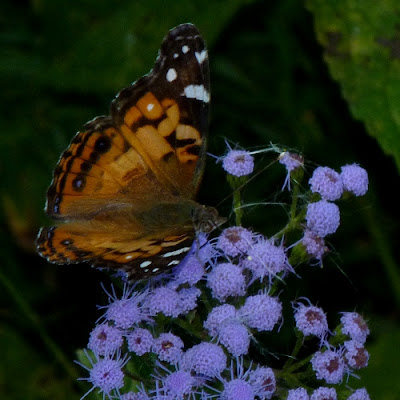
Another Vanessa butterfly, American Lady, was also active in good numbers. This one was photographed at the state park.

I saw a few Mourning Cloaks at the state park. The day after I photographed this one, I saw a Mourning Cloak around the same group of plants. I am not sure if it was the same individual.

The skipper I saw most frequently was the Fiery Skipper. This species has a few variations. While most are bright orange, some can be very dark, as in the photo below. The undersides of Fiery Skipper wings are spotted, almost as if they have a pox.


I also saw a few Gray Hairstreaks around Cape May. This individual was photographed at Brigantine, but I saw a few in the state park as well.

Sunday, September 26, 2010

Snowy Egrets Around Cape May

Snowy Egrets are a constant presence along New Jersey's coast. I have seen them in every month from March through November, and eBird's database says that they have been recorded in the state during December through February by others. It is a good thing to have them around for so long because Snowy Egrets are very charismatic birds.


The feathers on their heads and backs sometimes stand up, giving the bird a ruffled appearance.

Larger herons like Great Egret and Great Blue Heron use a hunting strategy that involves standing still and patiently waiting for prey to come within striking distance. Unlike them, Snowy Egrets forage actively. They stir up mud as they walk in the hope of flushing any prey that might be hiding there.


The contrasting black legs and yellow feet are a reliable field mark for this species. Watch a Snowy Egret in action, and you will see plenty of those yellow feet. Immature birds, though, might not show quite as much contrast as adults since the backs of their legs are often yellow.

All of these photos were taken on an evening at Cape May Meadows with the exception of the last two, which were taken during the birding by boat cruise and at Brigantine, respectively.

Saturday, September 25, 2010

Common Buckeyes in Cape May

I was in Cape May for a few days this week. There were a few potential life birds that I was hoping to see; of those I saw one, a King Eider that has been hanging around the Concrete Ship. The weather conditions were less favorable for migration than I had hoped, so there was not a lot of warbler activity. What were active in big numbers were butterflies. I expected a lot Monarchs, since I have experienced Monarch migration there in the past and people have been talking about them. What came as a surprise was the number of Common Buckeyes. I have never seen so many at once, even in Cape May. Here are a few photos of them.


Bonset was especially popular as a nectar plant. A few times I saw about a dozen Common Buckeyes clustered on the same plant.

A few had chunks missing from their wings. The missing pieces tended to be around the eye spots, which could be a result of birds being confused about where the butterfly's head is.


Thursday, May 27, 2010

Cape May Notes

Last week I was in Cape May for a few days to see the late stages of spring migration and to track down some potential life birds. Even without potential lifers as bait, mid-May is a great time to visit Cape May because of the abundance of northbound migrants and vocal breeding birds. As usual I traveled with my mother and sister, both of whom are also birders.

For several days, Brigantine hosted a Bar-tailed Godwit and a Scissor-tailed Flycatcher had been reported, both of which would have been life birds for me. However, neither were visible from the wildlife drive on the day I was there. So I had to make do with looking at thousands of other shorebirds, and herons, and the handful of breeding Osprey pairs, and the breeding Peregrine pair, and the occasional moth. A few Bank Swallows joined the more common Barn Swallows and Tree Swallows at the Gull Pond.

A Scissor-tailed Flycatcher had also been reported in the South Cape May Meadows, but it was not present there on Thursday night. By the next morning, it had relocated to the second plover pond in Cape May Point State Park. We watched it there as it swooped for insects in all its glory. In addition to the flycatcher, the state park produced a nice crop of warblers, including a Canada Warbler and many Blackpolls.

In the evening we visited Turkey Point in Cumberland County to listen for night birds. When we arrived, Clapper Rails and Virginia Rails were already vocalizing. They were joined by a chorus of Marsh Wrens and Seaside Sparrows. Night Herons were already active; most were Black-crowned, but a Yellow-crowned flew past as well. As the sun set, a Great Horned Owl started hooting somewhere in the distance. Shortly after that, we could hear a Whippoorwill repeating its three-note song. The Whippoorwill was my second life bird of the trip. Even better than the life bird, however, was the experience of standing and listening in a place that is about as dark and quiet as one can find in New Jersey.

A birding by boat trip on The Osprey produced many more shorebirds. (This is a great tour if you are in Cape May during the summer months.) We saw at least a thousand Dunlin, and many Whimbrels, Willets, Ruddy Turnstones, Short-billed Dowitchers, and other species. The tour runs past a heron rookery, which featured a lone Cattle Egret in addition to the expected Snowy and Great Egrets. The boat's captain also spotted an otter near one of the fishing docks. I only got a brief glimpse of its head before the otter disappeared. Terrapins were active near one of the islands.


Reed's Beach, as one might expect, was packed with shorebirds, gulls, and birdwatchers. Red Knots were the prime attractions. I estimated a flock of 500 when we were present, but there may have been more. Several waves of a hundred or more knots and Ruddy Turnstones flew over our heads as we watched the birds from the jetty. An evening visit to Stipson Island Road in western Cape May County produced more of the rails and songbirds we had heard at Turkey Point the night before. As we were leaving, my sister spotted a White-faced Ibis among a small group of Glossy Ibises. This was my third life bird of the trip. Jakes Landing had the same set of birds we had observed at Turkey Point, but without the owl or nightjars.

Sunday, January 17, 2010

Brigantine, Cape May, and Cumberland

Over the past few days, I was visiting some birding sites around Cape May and Cumberland Counties with my parents and sister. This was my first time birding in South Jersey since early November. It felt good to be back at its salt marshes and beaches.

On Thursday we stopped at Brigantine, where the highlight was an exceptionally close Bald Eagle at the gull pond tower. The eagle glided in from a long distance away and landed on the ice, at most 100 yards in front of us. This was about as close a view as one can expect to have an eagle aside from one in the hand. Elsewhere in the refuge, the breeding Peregrine Falcons were perched together on their nest platform. Even though much of the water was frozen, the impoundments hosted many of the usual waterfowl. The Black Duck flocks alone were impressive, numbering in the thousands. Adding to their number were smaller flocks of Gadwall, Northern Shovelers, Northern Pintails, Bufflehead, and Hooded Mergansers. There were also a few hundred Dunlin foraging in the shallower parts of the impoundments. Along the way I added two new species to my Atlantic County list: a Wilson's Snipe near the gull pond tower and a Swamp Sparrow along the Leeds Eco-Trail.

We stopped at a few birding spots in Cape May on Friday. Our first priority was to see the Eurasian Wigeons that have been hanging around in the state park since the fall. This was not a life bird for me, but it felt like one since this was the best view I have had of this species so far – two colorful breeding-plumaged males, at relatively close range on Lighthouse Pond, in good lighting conditions. (There was also a female on Bunker Pond.) The wigeons associated with a mixed flock of waterbirds, including American Wigeons, Gadwall, a single male Redhead, Ring-necked Ducks, Hooded Mergansers, and American Coots. A few Brown Thrashers, a couple Hermit Thrushes, and a Gray Catbird were present along the parks trails, along with dozens of Yellow-rumped Warblers. Along the dunes I saw two Savannah Sparrows and a Horned Lark. One bird that I left unidentified was a very large accipiter that was dashing around the trees near the parking lot. Normally I was count a bird like this as a Cooper's Hawk except.......... that a Goshawk was reported in this park and elsewhere in Cape May within the past few weeks. Given that possibility, I cannot assume it was a Cooper's without a better look.

In the afternoon we walked through the Nature Conservancy's Cape May Meadows. I saw an Orange-crowned Warbler halfway up the west path. As with the wigeons, this was not a lifer, but it was the best view I have had of a member of the species. The bird was very yellow (for an Orange-crowned), so it may be an adult male. Other interesting birds from the Meadows included small numbers of Green-winged and Blue-winged Teal, a flock of Snow Geese (a new Cape May County bird for me), and a very noisy Red-shouldered Hawk. Like in the state park, the shrubs at the Meadows were full of Yellow-rumped Warblers.

Yesterday we made a tour of birding spots in Cumberland County. East Point Lighthouse, our first stop, had a nice raft of Greater Scaup mixed with a few Lesser Scaup. Many Bufflehead were swimming in the Maurice River. There were also about 40 Dunlin standing on the floating ice – a sight I have never seen before!

At Bivalve, we saw an adult Bald Eagle perched at the distant treeline, and three Northern Harriers hunting over the marshes. Most of the water was frozen so waterfowl numbers were very low. The species present included small numbers of Black Duck, Bufflehead, and Hooded Merganser, plus about 125 Snow Geese. The shell piles at the seafood processing plants were less fragrant than normal. At Fortescue, where we ate lunch, there were 20 Dunlin on the beach and 80 Snow Geese flying overhead. Not much else was moving around, either on the bay or on land, at this spot.

The best stop was Glades Wildlife Refuge, which we accessed from the Fortescue Road entrance. The woods were fairly quiet, except for a small flock of Cedar Waxwings. The birding improved once we emerged from the woods into the marsh. One subadult Bald Eagle (most likely 3rd winter) was perched near the observation platform, and two adult Bald Eagles were visible at the far treeline near Rt. 553. One Red-tailed Hawk and two Northern Harriers were hunting over in the marsh. As at Bivalve, the water was partially frozen, so waterfowl numbers were lower than I've seen in the past. Species included Black Duck, Bufflehead, Common Merganser, and Hooded Merganser, plus about 80 Snow Geese in flight.

I took the phot at the top of this image near the observation platform. It captures the general appearance of the marshes, but not quite the seemingly limitless expanse of marsh grasses that one encounters at sites like the Glades. It is an experience far removed from the suburban and woodland birding that I normally do.

Monday, November 09, 2009

Mute Swans at Cape May Meadows

Many mute swans are already displaying their characteristic arched wings.


Not all of them were looking quite so festive.