Monday, June 12, 2006

Hawks Fledge in New York

Both Washington, D.C., and New York City have active and skilled communities of birders within and around their borders. But somehow the birds in New York get more press. As a recent example, Pale Male and Lola's use of a perch on Central Park West gained major media coverage.

What goes for that famous pair goes for other red-tailed hawk pairs that nest in New York on a smaller scale. The other pairs may not get major media coverage, but each has a devoted following and gets blog coverage. Two pairs in Brooklyn - at Prospect Park and Greenwood Cemetery - are regularly monitored by the City Birder, who also receives and publishes reports on a pair at Fordham University in the Bronx. Several blogs (Urban Hawks, The Origin of Species, Palemaleirregulars, Marie Winn, and probably others) have reported on a pair of red-tails who nested high on the Cathedral of St. John the Divine in upper Manhattan. Unlike their more famous counterparts in Central Park, the Cathedral pair has successfully fledged at least one chick, with another still in the nest.

Why DC has not had similar coverage of a pair, I am not sure. There must be red-tailed hawk nests somewhere in DC, either on buildings or in other places that allow for careful monitoring by the public. Personally I do not know of any, but I am sure there are some who do know of them, especially since DC has been carefully surveyed for breeding birds over the past four years as part of a larger atlas project. Perhaps it is just a matter of the information not getting out, or perhaps it is a case of not having enough birders who blog. In New York there are at least a dozen bird bloggers, but here in DC I know of only three.

In any case, best of luck to the newly fledged hawks. For a report on the Cathedral fledgling (with pictures), see Urban Hawks. City Birder has the dirt on the Fordham pair. One interesting bit on the Cathedral pair is that the breasts of the hatchlings are bright orange, as opposed to the more usual red-tailed white. I do not have an answer for why that might be, but you can find speculation on it at Marie Winn's blog.

Sunday, June 11, 2006

Birds of the Mid-Atlantic #12: Black-crowned Night-heron

So far in this series I have mostly written about diurnal birds - those that can be seen during the day. Most North American birds are in fact diurnal species, since birds tend to encounter the world through sight and sound, much like humans. But aside from the diurnal species there is a world of crepuscular and nocturnal birds, some of which are rarely encountered, and others that are more often seen than heard.

Two such species are the night-herons - the yellow-crowned night-heron and the black-crowned night-heron. These two species emerge in the evening as shadows lengthen and return to their roosting spots at sunrise, after a full night of hunting fish and invertebrates. Since night-herons are colonial breeders, the best bet for seeing them during the day is to visit a known nesting or roosting site.

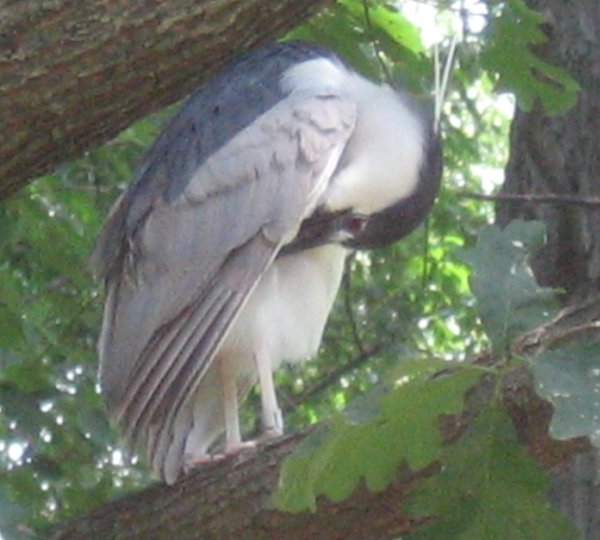
One local spot where seeing black-crowned night-herons is virtually guaranteed (in the proper season) is the National Zoo in Washington, DC. A colony has been nesting over the outdoor flight cages near the bird house for several decades. At this time of year, one can see adults like the above bird perched in the trees around the bird house. Later in the summer, once this year's chicks fledge, immature night-herons will frequently patrol the duck ponds, and do not flee closely-approaching humans. Yes, these are wild birds, despite their nesting location and despite their tameness.

If you enlarge the photograph and look closely, you can see that this individual has been banded. These two photographs show the key identification points for adult black-crowned night-herons. Night-herons have a stocky, hunched appearance, even when not preening, and have a thick, heavy bill. Adult black-crowned night-herons have an obvious black crown, as well as a black back. (Note that the yellow crown of yellow-crowned night-herons is not always apparent.) Like great blue herons, black-crowned night-herons sport long breeding plumes at the backs of their heads.

While black-crowned night-herons are widespread across North America, they are particular about their habitats, and in particular they much prefer the lower elevations of the coastal plain and prairies to mountain ranges.

This entry is crossposted in Blue Ridge Gazette. Images are by the author.

Wind Power Moratorium

Wind turbine projects around the country have been temporarily halted while the Defense Department studies whether the turbines could interfere with military radar.

[Wind farm developers] say their wind turbines are victims of the ongoing dispute between Cape Cod residents and developers of the proposed Cape Wind farm in Nantucket Sound. The Defense Department study was put in the 2006 Defense Authorization Act -- inserted, say wind farm developers, by senators who want to block Cape Wind.

"This legislation was intended to derail Cape Wind, but it had a boomerang effect and affected a lot of projects around the country," said Michael Skelly of Horizon Wind Energy, a Texas company constructing the country's largest wind farm near Bloomington, Ill.

This spring, facilities in the works in North Dakota, South Dakota, Illinois and Wisconsin received "proposed hazard" letters from the Federal Aviation Administration saying the projects must be halted pending the Defense Department study.

FAA spokeswoman Diane Spitaliere said the letters are in keeping with the agency's usual review process, which has been slowed by the quickly increasing number of permit applications for wind turbines nationwide.

While I generally support the development of wind turbines to replace fossil fuels, I do find the following project worrisome.
An offshore wind farm of as many as 170 turbines is planned in the Gulf of Mexico off South Padre Island, Tex. The $2 billion project will generate enough electricity for 125,000 homes.
South Padre Island is along one of the key bird migration corridors for North America. If advocates are wrong, and birds do get caught up in the turbines, this project could devastate North American populations of birds, many of which are already weakened by other human-caused factors. While birds migrate almost everywhere, making a complete moratorium impossible, known concentration points like South Padre Island ought to be off-limits to such development, or at least have to slow or stop turbines during peak migration periods.

Saturday, June 10, 2006

Weird Searches

Here are some recent searches that brought people to A DC Birding Blog.

And now, from the E Street Blog.

First Tropical Depression

The 2006 hurricane season began last week, and now we have our first tropical depression:

The depression, which will be given the name Alberto once its maximum sustained winds reach 39 miles per hour (63 km per hour), was located around 45 miles west-southwest of Cabo San Antonio on the western tip of Cuba at 11 a.m. EDT (1500 GMT).

It was expected to bring heavy rain to the communist-run Caribbean island and also served as a wake-up call to residents of U.S. coastal areas battered by eight hurricanes in the last two years, including Hurricane Katrina -- the most costly natural disaster in U.S. history and one of the deadliest.

The depression was moving north-northwestward, and while the longer-term tracks of storms are always highly uncertain, was expected to make landfall on Monday somewhere between central Florida and the state's westernmost reaches near Alabama, the U.S. National Hurricane Center said.

It looks like this summer and fall will be another bumpy ride.

We have a map:

And it has become Tropical Storm Alberto.

Tags: