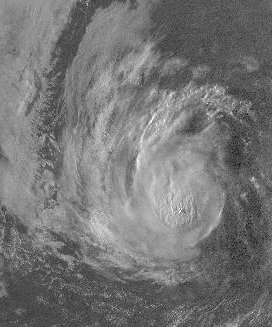
 ... but apparently I am looming over Mexico:
John is a Category 3 hurricane, packing sustained winds of 125 mph (205 kph) and stronger gusts.We are getting one of our own soon, as well.

 Posts
All Comments
Posts
All Comments
... but apparently I am looming over Mexico:
John is a Category 3 hurricane, packing sustained winds of 125 mph (205 kph) and stronger gusts.We are getting one of our own soon, as well.
Some new carnivals are up and ready for reading.
 As a followup to my post on the environmental damage Katrina wrought last summer, I have found some more news from Louisiana. As I noted on Monday, one of the major challenges in rebuilding New Orleans and other damaged communities on the Gulf Coast is that the coastal wetlands that protect those cities have been disappearing. There are a variety of reasons for this phenonmenon. Subsidence from lack of sediment replenishment, erosion from tides from tides and storms, and death of freshwater plants due to saltwater intrusion are a few of the major causes. This article explains the problems nicely.
As early as the mid-1960s, the US Army Corps of Engineers tested the notion that wetlands could provide a buffer against storm surges. It concluded that a storm surge would shrink one foot for every 2.75 miles of wetlands it crossed. The number represented an average taken from several storms. But over the years, it took on a life of its own as the expected return on investments in wetlands, researchers say.The Army Corps of Engineers has proposed a series of measures that they believe will protect the cities better than the current reliance on levees. Rebuilding these vital coastal wetlands is one stage of the project. The goal of such restoration would be encouraging natural replenishment as much as possible to reduce the need for human intervention. Other measures include rebuilding barrier islands and building tall (30-60 ft) armored levees.
After hurricanes Katrina and Rita plowed into the region, LSU researchers Hassan Mashriqui and G. Paul Kemp took a new set of measurements and used them in modeling experiments. They found that when a surge encountered coastal wetlands at least 100 miles long and 25 miles deep, the surge indeed dropped one foot for each three miles inland it traveled. Where dredged channels were present, however, the storm surge traveled up to six miles before it dropped a foot. They also found that when the surge encountered a 100-yard-long phalanx of trees, the waves riding atop the surge lost 95 percent of their energy.
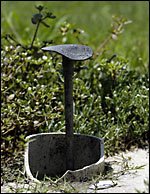 One of the main problems, subsidence, has been blamed on human interventions that prevent the delta from being replenished from sediment in the waters of the Mississippi. The levee system prevents the flood that traditionally dropped sediment into the wetlands. Now that sediment washes into the Gulf of Mexico. An illustration can be seen in the photo at right; the disk at the top of the rod used to be at ground level. Before major restoration work can begin, two questions that need to be answered are how fast the land is sinking and the extent to which human activities contribute.
 This week, I and the Bird comes a day early! Go to migrateblog, where Mariya has summarized each submission in haiku form. Even though we are now up to #31, I still keep finding submissions from blogs that I have not seen before. It makes for some fine reading, and it is good to see the circle of bird bloggers continuing to expand.
Carnival of the Vanities #206 has also been posted today.
Late summer is a time of change for birds. By now, the breeding season has ended for most species, and the young birds are out of the nest. Fledglings are rapidly maturing. Adults are molting their old feathers for fresh ones. Many species have already begun their journey south to their wintering grounds, such as the yellowlegs I covered last week. All this poses special challenges for birdwatchers. In some ways, this may be the most challenging times of the year.
Fledglings
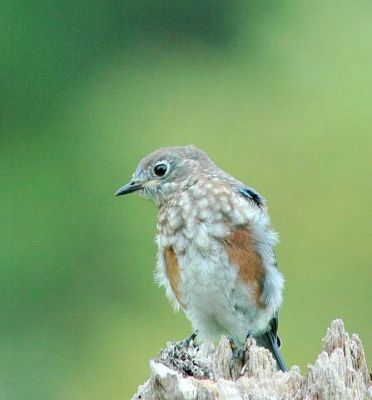
Fledgling plumage may or may not be covered by field guides. Even the big Sibley Guide, for example, shows the fledgling plumage for American Robins, but it illustrates fledgling plumage less frequently for less common species. Fledgling robins themselves are sometimes a cause of confusion because of their spots. Adult robins do not have spots, but sport a solid orange breast. Fledglings, on the other hand, do have spotted breasts, much like other members of the thrush family. See below for an example.
 Baby American Robin / Photo by Sean Varner (USFWS)
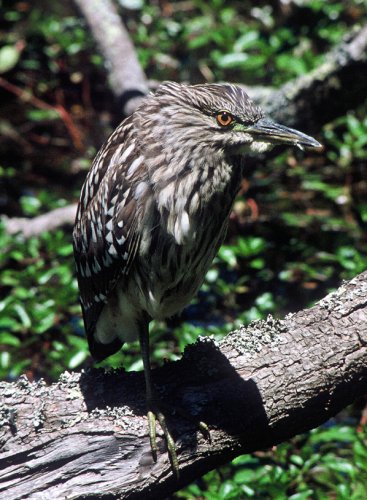 Juvenile Black-crowned Night-Heron / Photo by Lee Karney (USFWS)
 Scarlet Tanager / Photo by Bill Dyer (CLO)