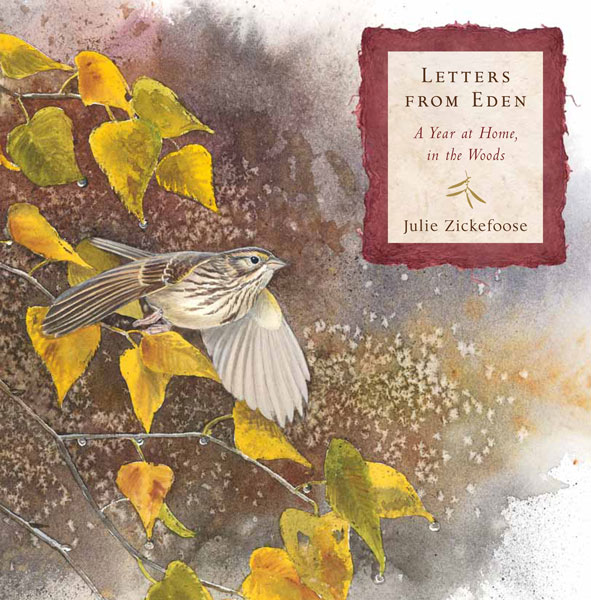
 Last week I reviewed Club George, a book that narrates one season of watching birds in Central Park. This week the seasonal theme continues with Letters from Eden: A Year at Home, in the Woods, by Julie Zickefoose. Unlike Club George, this book is not a birding journal. Letters from Eden consists of 31 essays that were published in Bird Watcher's Digest over an eight-year period in a feature called "Watcher at the Window." Each essay is illustrated with paintings and sketches by the author.
Zickefoose arranged the essays by season, rather than by date of composition. The essays are not equally grouped among the seasons; a third fall under spring. (Spring seems to bring out the best in nature writers.) The arrangment by season causes a bit of dissonance when her children appear to oscillate in age from one essay to the next. Zickefoose's lively writing and attractive illustrations make the distraction minimal.
Reviewing a collection like this is tricky because each chapter was written as a free-standing essay. Each has its own theme or flows from a particular event. As such they defy easy summary. However, several common themes and subjects run through the book, so I discuss them below in loose groupings based on theme.
Essays are set in the context of the property surrounding Zickefoose's residence. Zickefoose and her husband, Bill Thompson III, own an eighty-acre rural property that they manage for wildlife. From what I gather from the essays, part is wooded and part is meadow. Many of essays describe how the changing seasons affect the author's daily walks in the woods and meadows around her home. These essays describe the author's observations, with plenty of detail about what different animal species are doing and why.
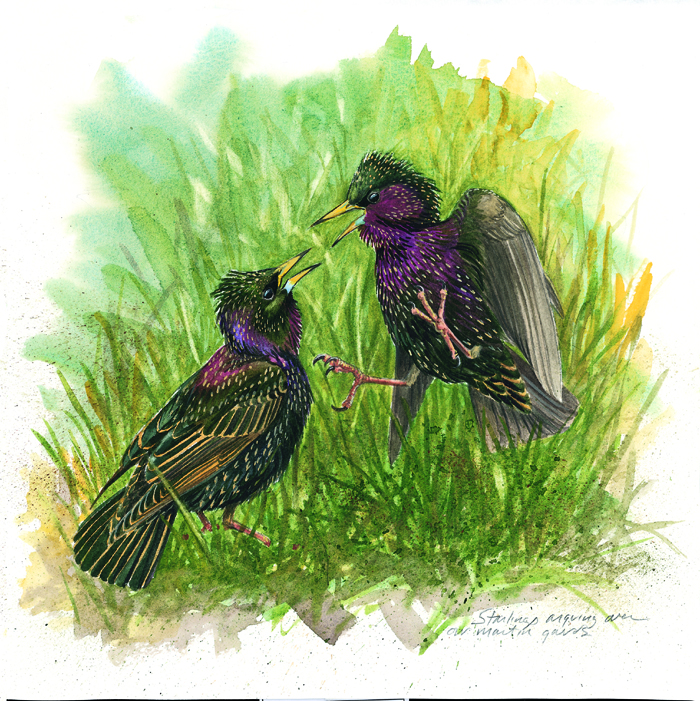
A second large group of essays are about individual species. Many are species that the author holds dear and attempts to attract to her property: Eastern Phoebe, American Robin, Brown Thrasher, Tree Swallow, and Carolina Wren. One is a disliked species: European Starling. Essays on individual species combine the author's personal observations with details about the bird's behavior. The breeding process - from mating displays to nest building to raising chicks - has a prominent place in these essays. These species nest around the author's home.
The author's daily walks on the family property inspire most of the essays in the groups mentioned above. A few essays use the walks as a gateway to discuss issues in managing land specifically for wildlife. Two deal with specifically with management: balancing mowing with the nesting needs of species like woodcock and gardening methods that benefit birds. Two others identify species that become harmful in the wrong context: the invasive multiflora rose that is difficult to control and the bullfrogs that started eating birds around the family's pond. Another warns of the dangers of spreading disease through bird feeders.
Respect for animals and concern for their welfare runs through most of the essays, but a few deal specifically with these issues. In the spectrum of opinion on how much humans should intervene in the lives of animals, Zickefoose would probably fall more towards the interventionist end. She stops her car for turtles and helps baby bird back into their nests, has guarded piping plover nests, smashes animal traps, and once caught a sparrow in a food store to let it loose in the wild. One particularly good essay describes the dangers facing box turtles and what she does to help. Another very good essay discusses birds' intelligence.
The author's family features prominently throughout the essays. Many were written when her children were very young, so they frequently appear as actors. A few essays deal with the challenges of balancing parental responsibilities with her activities as a naturalist. One of the best essays associates evening grosbeaks with memories of her late father.
All essays are fully illustrated with paintings and sketches relevant to each essay's themes. The illustrations were not originally published with her column. Many were selected from the author's archive of paintings and sketch books and bear a note with the date of composition. Others were original illustrations painted for this publication. Full color paintings depict scenes from the essays, such as the fighting starlings shown below. Many of the pencil sketches illustrate a variety of postures and behaviors. Zickefoose depicts birds as birders see them in the field: feeding, gathering nesting materials, incubating and guarding chicks, and keeping watch for threats.
 Letters from Eden was a fun read made better by the lovely illustrations. While the book is clearly not a nature journal, the chapters have the feel of journal entries, and the book as a whole has the feel of a yearly journey. The anecdotal style makes the serious themes raised in several essays approachable.
Images published here are from
Letters from Eden: A Year at Home, in the Woods by Julie Zickefoose.
Copyright (c) 2006 by Julie Zickefoose. Reprinted by permission of Houghton Mifflin Company. All rights reserved.
Full citation:
Julie Zickefoose,
Letters from Eden: A Year at Home, in the Woods. Boston and New York: Houghton Mifflin, 2006. Pp. xvi, 224; color illustrations and index. $26.00 cloth. ISBN: 0618573089.
To purchase:
AmazonAuthor's website:
Julie Zickefoose has her own
blog. On a few occasions, she has taken readers through her painting process.
Here, for example, she completes a commissioned painting of a Carolina Parakeet. She also painted an ivory-billed woodpecker, which was blogged in five parts:
part 1,
part 2,
part 3,
part 4, and
part 5.

 Posts
Posts


 It is time for another edition of I and the Bird, postponed a week for Thanksgiving festivities. Visit Five Wells for I and the Bird #37.