Tuesday, June 14, 2011

Micromoths from Last Week's Mothing Session

Yesterday I showed some of the larger moths that I observed and photographed during last week's mothing session. This morning I would like share some of the micromoths. As the name implies, micromoths are small, sometimes tiny. There are numerous species, and many species are both highly variable and similar in appearance to other related species. In some cases, the taxonomy is still being worked out. Moth and insect field guides tend to focus on macromoths, so the best sources for identifying micromoths are online, and these may have incomplete coverage. All these things make identification difficult, and some individuals are best left unidentified.

Despite the difficulties I try to identify as many of them as I can, anyway, and sometimes I even find the correct identification. Here are a few micromoths that I found and identified. Above is an Oak Leafroller (Argyrotaenia quercifoliana).

I do not yet know the identity of this reddish moth, but it may be in the genus Acleris.

Pseudexentera costomaculana.

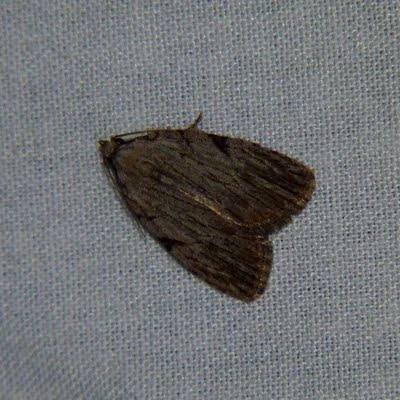
Tinea apicimaculella.

Monday, June 13, 2011

Some June Moths

Last week I did some mothing for the first time since April. I had not meant to wait that long since my last session, but after several futile sessions in March and early April, I wanted to wait for the weather to warm enough to get more moths moving. Then May had some prolonged stretches of rainy weather, which made it difficult to find good nights to put the light out. Last week, though, I got started again and set up the black light and sheet for three hours. And what a night it was! I have not identified all of the moths yet, but I think I photographed about 30 species at the sheet. Here are a few highlights.

This is one of the largest moths I have ever seen, and certainly the largest I have had at home. I think it is an American Dagger Moth (Acronicta americana), a species whose larvae feed on a variety of trees. I was impressed by the intricate pattern, particularly the scalloped lines crossing its wings.

Moths this large look almost as if they should have a personality. Despite its fierce appearance, it was fairly docile and sat still around the sheet for most of the evening.

Speckled Rustic (Caradrina multifera).

Three-lined Balsa Moth (Balsa tristrigella).

Grey Pug (Eupithecia subfuscata). A lot of Eupithecia species look very similar to each other. This species seemed like the best match, but it could easily be something else.

This American Idia (Idia americalis) was my first of its kind, though I have seen its sister species, Common Idia (Idia aemula) numerous times. According to Covell, American Idia feeds on lichens while Common Idia feeds on dead leaves. Since there are more dead leaves than lichens in the yard, that might explain the difference in abundance.

I will post another installment with some of the micromoths soon. Each of the photos above links through to a larger image on Flickr, and I have links to further resources about each species on its photo page there.

Sunday, June 12, 2011

Rainy Birding at Griggstown Grasslands

Yesterday I was at Griggstown Grasslands on a rainy day. The bird activity was somewhat subdued, but it picked up when the rain stopped. I did not see or hear any Grasshopper Sparrows or Bobolinks there. In one of the back fields I heard a Northern Bobwhite call a few times. In the same area, a Willow Flycatcher and a Savannah Sparrow were singing. I had not realized that Savannah Sparrows were present at that site in the breeding season. The rest of the birds were typical old field species, like Field Sparrow, Indigo Bunting, and Blue-winged Warbler. A couple Orchard Orioles and a Baltimore Oriole were scolding pretty loudly along one of the trails. I probably would not have noticed the latter's nest if she had not called my attention to it by scolding.

Very few butterflies were active. One very dark skipper, which I did not managed to photograph, may have been a Common Sootywing. I also saw a Least Skipper (above) and Zabulon Skipper (below).

A few moths were active as well. Most were crambid grass-veneer types, but this Faint-spotted Angle (Digrammia ocellinata) sat in the middle of the path for me.

Saturday, June 11, 2011

Life in a Mugwort Patch

Mugwort (Artemisia vulgaris) is an herb native to Europe, Asia, and Africa that was introduced to North America. It is not particularly eye-catching; instead it appears as a waist-high, gray-green plant.  (See a line drawing for identification.) In its native range, it was traditionally used as a substitute for tea (when tea was extremely expensive) and as a treatment in Asian medicine. In North America, its propensity to grow in dense clumps and spread quickly makes it highly invasive, and it can take over disturbed areas quickly. Once it gets established, it is very difficult to remove.

My patch, unfortunately, has a lot of mugwort, in addition to other native species. Yesterday morning, one particularly bank of mugwort drew my eye for having a lot of insect activity. Most noticeable were the Multicolored Asian Lady Beetles, which were plentiful in all of their life stages. Above are two lady beetles mating; below are a larva and a pupa. Like the mugwort, this is a nonnative species; it was introduced repeatedly in the 20th century as a control measure for agricultural pests.


Aside from the lady beetles, there were a lot of wasps, especially grass-carrying wasps like the one below, which I think is Isodontia apicalis.

Another insect in the mugwort patch was the soldier beetle below, which I think is Podabrus rugosulus.I should caution, though, that the genus Podabrus has a lot of species in it, many of which look very similar.

In a mothing session earlier in the week, I recorded another member of the Podabrus genus that looked very similar to this one, except that its pronotum was entirely orange. So there are at least two species from that genus wandering around the neighborhood. I recorded a lot of moths that night, and I will share some of them here once I get more identified.

Friday, June 10, 2011

Loose Feathers #294

Spectacled Eider / Photo by Laura L. Whitehouse (USFWS)

Birds and birding news
  • British scientists are fitting cuckoos with satellite trackers to record their migration patterns. They hope to gather more data to help determine why the species is declining.
  • As many as 300,000 seabirds are killed each year as a result of longline fishing practices. Seabirds, especially albatrosses, get caught when they dive after bait attached to the lines.
  • The Great Indian Bustard (Ardeotis nigriceps), one of the world's largest birds, is on the brink of extinction according to the 2011 edition of the IUCN Red List. According to this year's list, 1,253 bird species are threatened – about 12% of all species worldwide. (To check on other bird species, see the IUCN Red List here.)
  • Conservationists want to see a halt to horseshoe crab harvests in Maryland and Virginia to protect the food source for migrating Red Knots and other shorebirds. While New Jersey has banned the harvest of horseshoe crabs, those states and Delaware have not, and the annual harvest of horseshoe crabs along the Atlantic coast is still unsustainably high if the shorebirds are to survive.
  • A survey of Canada's Wood Buffalo National Park recorded 75 active Whooping Crane nests, a new record.
  • A Kookaburra that survived a high-speed auto collision and a 400-mile ride stuck to a vehicle's grille has been returned to its home territory and released.
  • An oil refinery in Wyoming will pay a fine for an incident that killed 80 migratory birds in a wastewater pond.
  • Both Yellow-billed and Black-billed Cuckoos like to feast on caterpillars, especially tent caterpillars.
  • NY Times City Room has an image of one of the Washington Square Park nestlings panting because of the heat.
Birds in the blogosphere
Environment and biodiversity