


 Posts
All Comments
Posts
All Comments


Above dark brown, rarely with a trace of forewing spots. Below hindwing yellow-brown with veins slightly paler. In most of its range, few other skippers are so dull.While I do not see much trace of yellow in the hindwings of this individual, the other elements of the description fit.




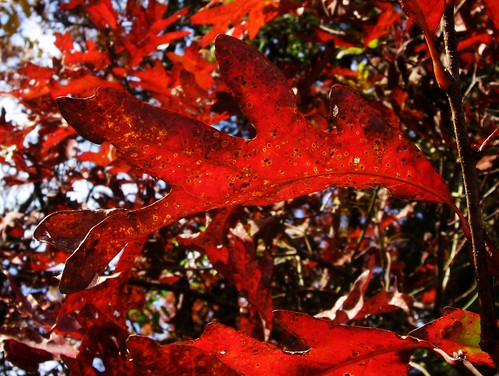
In last week's SkyWatch post, I mentioned that we were in the midst of the early stages of fall. While some maples were at or near peak, most oaks and Norway Maples had barely begun to change. It turns out I spoke to soon. Yesterday at the Griggstown Grasslands Preserve, many of the White Oaks were already changing, and even some Red Oaks and Pin Oaks were showing some fall color. Below is a White Oak.

Large Milkweed Bugs (Oncopeltus fasciatus) on milkweed at Griggstown Grasslands Preserve.

 As a Skywatch offering, I have this photo that I took last Saturday at the Griggstown Grasslands in New Jersey. This is one of my favorite photos to come out of that walk. I took it at the widest angle my camera offers, and I found myself wishing for an even wider view to capture more of the sky and field. But I like the resulting image all the same.
Common milkweed (Asclepias syriaca) is an attractive host plant for insect species. The species most associated with milkweed is probably the Monarch butterfly, which can be found in all stages of its lifecycle around milkweed plants. However, many other insects seek the nectar of milkweed flowers or chew on its leaves and pods. Below are a few insects that I found on milkweed plants at the Griggstown Grassland Preserve. While I saw a few Monarchs fluttering about at the preserve, I did not get a chance to photograph any.
First is a Small Milkweed Bug (Lygaeus kalmii). It bears close resemblance to the Large Milkweed Bug (Oncopeltus fasciatus) and Box Elder Bug (Boisea trivittata). All three species are very common with a wide distribution. Small Milkweed Bugs have a distinctive red 'X' on their backs and other more subtle differences with the other two bugs. I only saw a few Small Milkweed Bugs yesterday. Second, we have a swarm of aphids on a milkweed pod. I think that these are Oleander Aphids (Aphis nerii), which are very common on milkweed plants. According to the Kaufman Guide, these aphids extract toxins from milkweed as they feed to defend against predators.
 Finally, the most numerous insect I saw around milkweed plants yesterday was the Red Milkweed Beetle (Tetraopes tetrophthalmus). The Red Milkweed Beetle is a member of a genus that contains 13 species that specialize in milkweeds. This is the common eastern form.
 Apparently love was in the air for milkweed beetles, as I saw several pairs mating.

At Griggstown this morning the red-tailed hawks were putting on quite a show. The first time I saw one was shortly after arriving; it flew along the edge of a field just under a far treeline. Another was perched on another treeline, and yet one more was soaring on a thermal. Several more appeared during the two-hour walk, including at least one apparent pair. I had a difficult time figuring out how many were around. The most I saw at any one time was four, but there seemed to be others around, and at least one red-tail was a migrant, very high up.
The most active songbird flock was in the grove of spruces on the portion of the preserve closest to Canal Road. Several Carolina chickadees and a house finch were singing. Tufted titmice and white-breasted nuthatches flitted from tree to tree while chattering. They were joined briefly by a lone pine siskin. As much as I looked for them, no white-winged crossbills made an appearance. The spruces there have a moderate cone crop, so they may be worth checking again.
In addition to the other birds there was a flock of eastern bluebirds patrolling the parking lot.
While I was gone over the weekend, there was a massive bird kill in Franklin Township, not far from where I live. Apparently it was the work of the USDA, but both the Department of Agriculture and Franklin Township have been slow in releasing information.
Everything from Avian influenza to West Nile disease, both bird-killing ailments that also affect humans, was feared. But no humans or pets were ever at risk, said the USDA, contending the pesticide, known as DRC-1339, is inert once it is eaten by the birds and becomes metabolized.The starlings were actually poisoned on a farm in Mercer County but dispersed into nearby Franklin Township before dying. So far I have not seen any reports of species other than starling being affected by the kill.
That part of the story is only now reaching residents in Somerset County's Franklin Township, where officials continued efforts today to help citizens find ways to dispose of the bird corpses filling up their lawns.
"Unfortunately, this was also done on a Friday, so the birds died on the weekend when no one was around to respond to calls. I can just imagine it would have been very disconcerting for people to find the birds dead," said Carol Bannerman, a USDA spokeswoman.
State agriculture and wildlife officials were notified two weeks ago, along with Somerset County officials. But Ken Daly, Franklin Township's administrator, said the township was told too little, too late.
"The only notice we got in the municipal building was on Friday, a second-hand phone call from our county health director that somewhere, sometime the USDA would be culling birds. No one knew what that meant. If we had known it was coming, we could have gotten word out to the residents," he said.
This morning was overcast and chilly - in other words, perfect weather for a winter solstice. Unfortunately it is not perfect for identifying birds. When all colors dissolve into gray, shapes and sounds become vital for bird identification.
Birding can still be productive under such circumstances, as it was this morning at the Griggstown Grasslands Preserve. Large flocks of Canada geese and various ducks flew noisily overhead all day; perhaps they were disturbed by the hunters combing through nearby farm fields. One highlight came during an overflight - two tight vees of common mergansers. The fields contained the usual sparrows, plus about a dozen American tree sparrows. As I noted in a previous post, I am really amazed at the number of tree sparrows I have seen so far this fall and winter. I have also come to appreciate the tinkling calls and warm coloration of these "sweet little creatures" (as some might call them). It is a relief amidst the stark gray colors taken by their surroundings. More relief came from the small flocks of eastern bluebirds that inhabit the hedgerows at Griggstown.
A few purple finches were present at Griggstown today. The birds in this group were mostly males, purplish with no sign of brown streaking. One female was with them. Usually females of this species are a bit easier for me to identify, but today it seemed to work in reverse.
Oddly enough, there were no harriers present today, at least none that I saw. It was the first time in at least a month that I did not record one there.
 This morning we returned to the Griggstown Grasslands Preserve in Somerset County. I saw mostly the same bird species as last weekend. One exception was that I do not remember seeing any savannah sparrows this morning, unlike last week when there were dozens. The other exception was a bird I did see - my first American tree sparrow for the year.
Trees and plants occupied my attention more than the birds did this morning. Many of the trees have already lost their leaves, but some are just hitting their autumn peak. Oaks looked particularly vibrant this morning. Many maples are still brightly colored.

 Unfortunately invasive species are still prolific in the hedgerows here, such as this dense tangle of bittersweet and multiflora rose.
 I noticed that some of the taller grasses had some form of gall in the middle of the stem.
 Then there was this curiosity. The small yellow fruit (less than a half inch wide) grew on some short stems in the middle of a field.
 Does anyone recognize it? It appears to be a nightshade, probably Horse Nettle (Solanum carolinense). Thanks to Dave and Jeff for suggestions. I probably would have recognized some other members of that genus, such as S. dulcamara, S. tuberosum, or S. melongena.
This afternoon my mother and sister and I visited the Griggstown Grasslands Preserve in Franklin Township. As with a previous trip, the fields were full of savannah sparrows. The area immediately around the parking lot continues to be a hotspot for this cryptic species. I have noticed that savannah sparrows will flush as I approach, but if I stand still in a place and pish a little, they will pop up and sit at the top of a mullein stalk or other tall plant. Unlike song sparrows, which react similarly, savannah sparrows tend to sit still without much nervous twitching.
Aside from savannah sparrows, the preserve today was notable for the hawks patrolling the fields. A harrier wheeled continuously over the fields. A young sharp-shinned hawk and an adult Cooper's hawk made passes at the flocks of savannah sparrows in the parking lot area. Several red-tailed hawks circled in a kettle for a short time before moving on. My sister was the lone spotter of a juvenile bald eagle. The most interesting to watch were the resident kestrels. These birds could be observed at fairly close range as they used trail sign posts and mullein stalks as hunting perches.
A surprising number of grasshoppers were jumping along the paths. We have had several frosts already, including one last night that froze the water in the bird baths. I wonder how much longer the grasshoppers can stay active.
There were also two red foxes present.
BIRD SPECIES: 26
Black Vulture
Turkey Vulture
Bald Eagle
Northern Harrier
Sharp-shinned Hawk
Cooper's Hawk
Red-tailed Hawk
American Kestrel
Mourning Dove
Red-bellied Woodpecker
Northern Flicker
Northern Mockingbird
Eastern Bluebird
American Robin
Tufted Titmouse
Blue Jay
American Crow
European Starling
House Finch
American Goldfinch
Yellow-rumped Warbler
Savannah Sparrow
Song Sparrow
Dark-eyed Junco
Northern Cardinal
Common Grackle

With last night's heavy rain storm, and generally unfavorable winds for migration the last few days, it was hard to predict how good the birding would be this morning. We headed down to the Griggstown Grasslands to see what would be in the meadows there. As it happens, two groups of birds stood out for their abundance.
The first group were the sparrows, and principally savannah sparrows. There must have been about fifty of these tiny spritely birds clustered into a few fields right around the parking lot. At times there seemed to be one on every dried mullein stalk. These were not the only sparrows. They were accompanied in the meadow by several richly-colored swamp sparrows and many song sparrows. A few field sparrows and a single chipping sparrow rounded out the mix. Other areas of the preserve held more song and white-throated sparrows. Several palm warblers were scattered around the grasslands.
The second large group were the diurnal raptors. These were notable both for diversity and for numbers of individuals. First-year harriers were new arrivals at the grasslands this month. A Cooper's and several sharp-shinned hawks made brief appearances. At one point a group of four red-tailed hawks circled overhead; there may have been more than that, as red-tails were visible at several points on the walk. Kestrel flybys included one male that circled and gave great looks. Several large kettles of vultures - including one of about twenty black vultures - passed through.
Fall foliage season is well underway, though it has not reached its peak yet. The trees along the canal were especially beautiful where they reflected on the water in the morning light. Update (10/21): After seeing a lot of white-crowned sparrows at Sandy Hook, I think that two of the sparrows we saw yesterday were actually immature white-crowned sparrows.
BIRD SPECIES: 35
Canada Goose
Mallard
Black Vulture
Turkey Vulture
Northern Harrier
Sharp-shinned Hawk
Cooper's Hawk
Red-tailed Hawk
American Kestrel
Rock Pigeon
Mourning Dove
Red-bellied Woodpecker
Downy Woodpecker
Northern Flicker
Ruby-crowned Kinglet
Carolina Wren
Northern Mockingbird
Eastern Bluebird
Hermit Thrush
American Robin
Tufted Titmouse
Blue Jay
American Crow
European Starling
Yellow-rumped Warbler
Palm Warbler
Eastern Towhee
Chipping Sparrow
Field Sparrow
Savannah Sparrow
Song Sparrow
Swamp Sparrow
White-throated Sparrow
Common Grackle
American Goldfinch
 I spent the afternoon and evening at two grasslands preserves in Franklin Township. Birds were pretty sparse at Griggstown. The best sightings were a trio of palm warblers and a few savannah sparrows. One of the latter was perched on top of a mullein stalk until it was spooked by a monarch butterfly. There were quite a few hawks and vultures in the air. I am not sure if any were migrants, but a couple Cooper's hawks were soaring so high that they may have been migrating. Also, there were a yellowthroat and a black-and-white warbler in one of the back corners of the preserve.
 The second stop at Negri-Nepote turned up yet more palm warblers, several phoebes, and a small group of chipping sparrows. Kestrels were out hunting tonight. One was hovering over a field, and later a pair was flying together. The last bird, just as the light was disappearing, was a white-throated sparrow settling down for the night.
BIRD SPECIES: 32
Great Blue Heron
Canada Goose
Mallard
Black Vulture
Turkey Vulture
Cooper's Hawk
Red-tailed Hawk
American Kestrel
Rock Pigeon
Mourning Dove
Red-bellied Woodpecker
Downy Woodpecker
Hairy Woodpecker
Northern Flicker
Eastern Phoebe
Gray Catbird
Eastern Bluebird
American Robin
Carolina Chickadee
Tufted Titmouse
White-breasted Nuthatch
Blue Jay
American Crow
American Goldfinch
Palm Warbler
Black-and-white Warbler
Common Yellowthroat
Eastern Towhee
Chipping Sparrow
Savannah Sparrow
White-throated Sparrow
Red-winged Blackbird

This morning I visited some of the open space preserves in Franklin Township with my mother and sister. Our first stop was the Bunker Hill Natural Area. That wooded tract was fairly quiet, with the exception of a few patches of chickadees and white-breasted nuthatches, along with ubiquitous blue jays.
The Griggstown Grasslands Preserve was much more birdy. We found field and savannah sparrows fairly close to the parking lot. The latter seems a bit early too me; I am not quite sure of their timing of their fall appearance in central Jersey. The meadows deeper into the tract were full of butterflies, such as hairstreaks, skippers, and swallowtails. I saw my first common checkered skipper today. Two hedgerows separated by a meadow held small mixed flocks that included three redstarts, a phoebe, and a great-crested flycatcher, as well as the more common species. Finally, there was a small flock of bobolinks near the parking lot. About seven flew over the path and settled on top of some forbs for an easy view.
There will be some hunting in the area during fall and winter for the purpose of deer control. The hunting application (pdf) explains where and when it will occur. BIRD SPECIES: 30
Turkey Vulture
Red-tailed Hawk
Ring-billed Gull
Mourning Dove
Chimney Swift
Red-bellied Woodpecker
Downy Woodpecker
Northern Flicker
Eastern Phoebe
Great Crested Flycatcher
Barn Swallow
House Wren
Gray Catbird Northern Mockingbird
Eastern Bluebird
American Robin
Carolina Chickadee
Tufted Titmouse
White-breasted Nuthatch
Blue Jay
American Crow
European Starling
Red-eyed Vireo
American Goldfinch
American Redstart
Field Sparrow
Savannah Sparrow
Song Sparrow
Bobolink
Common Grackle BUTTERFLY SPECIES: 14
Black Swallowtail
Eastern Tiger Swallowtail
Cabbage White
Clouded Sulphur
Cloudless Sulphur
Gray Hairstreak
Red-banded Hairstreak
Eastern Tailed-Blue
Mourning Cloak
Red Admiral
Monarch
Common Checkered-Skipper
Least Skipper
Zabulon Skipper

