Friday, August 31, 2012

Loose Feathers #358

Palm Warbler / Photo by Keenan Adams (USFWS)
Birds and birding
Nature blogging
Environment and biodiversity

Sunday, August 26, 2012

Grass Diversity

Recently someone asked me questions about particular grasses, and I realized I could not answer them because I knew next to nothing about grasses. I mean, I can recognize certain grasses like the ubiquitous Phragmites australis and a few other wetland grasses like cattails and Spartina. Beyond those, though, my knowledge is very limited. So I have been making an effort to learn more about the grasses I encounter in the types of habitats I bird frequently.

Grasses (family Poaceae) are an incredibly important group. Wheat, oats, barley, rye, corn, and rice are all grasses, as is bamboo. Many species of butterflies and moths, such as skippers and grass-veneers, use grasses as their larval host plants. Some bird species also associate with particular grasses or depend on habitats where grasses predominate. Along with grasses, rushes (family Juncaceae) and sedges (family Cyperaceae) may be found in those sorts of habitats and present similar identification challenges. Grasses, sedges, and rushes are all in the order Poales, along with many other plant families.

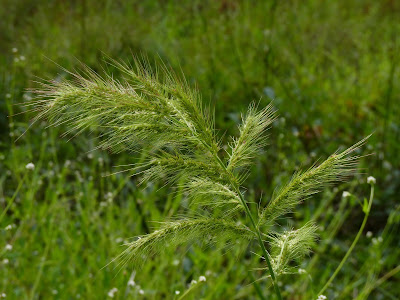
One of the distinctive native grasses is wild rice, a plant of wetland habitats. The wild rice sold commercially is usually Zizania palustris, a species native to the Great Lakes region. In my area, the native wild rice is Zizania aquatica. Wild rice is an important food source for waterfowl and other wetland birds. A distinctive feature of wild rice is that the male and female flowers are on separate branches. The female flowers are on thin branches that stick up from the top of the stem; male flowers droop from horizontal branches below the female flowers. The photo above shows the male flowers on one plant.

Another wetland grass is cockspur (Echinochloa sp.). Plants in this genus are sometimes grown as forage crops for livestock, but otherwise just grow wild. I think this is E. walteri, a grass of both saltwater and freshwater marshes that characteristically long bristles along its spikelets.

Like grasses, rushes have round stems, but their flowers and seeds are structured somewhat differently. On this Soft Rush (Juncus effusus), the flowers burst in a clump from the side of the stem rather than emerging from the top.

Sedges are another group of plants that grow in wetlands and meadows. As a group, sedges are fairly easy to recognize because most of them have obviously triangular stems ("sedges have edges"). Narrowing down to a species, though, can be more difficult. I think the plant above is a Dark Green Bulrush (Scirpus atrovirens), which shows one common sedge structure. The main stem ends in a leafy bract, from which several branches emerge that bear the sedge's flowers. Another plant that shares a similar structure is Yellow Nutsedge.

So far I have been aided in my learning by Grasses: An Identification Guide by Lauren Brown. This guide, published by Houghton Mifflin, uses simplified terminology and emphasizes broad characteristics such as shape and color rather than minute details. (The latter, unfortunately, may still be necessary to confirm a species identification.) The book contains a key followed by descriptions of 135 species from the Midwest and Northeast. I have found it very helpful as an entry point to learning about grasses.

Friday, August 24, 2012

Loose Feathers #357

Puerto Rican Nightjar / Photo by Mike Morel (USFWS)
Birds and birding
Nature blogging
Environment and biodiversity

Sunday, August 19, 2012

Herons at De Korte Park

Yesterday I was at De Korte Park in the Meadowlands. There had been a number of interesting sightings there in the past few weeks, and I was eager to track down a few of them. The first, Least Bittern, was in its usual spot at the start of the Marsh Discovery Trail. Least Bitterns bred here over the summer, and for the past few weeks, the juveniles have been coming out of the reeds and sitting in the open. The bitterns were really hard to see yesterday, perhaps owing to the high water level. One briefly came out of the reeds, and another perched just inside the reeds on the other side of the island. Initially I mistook the second one for a rail, but it turned out to be a second Least Bittern juvenile after further examination. Neither was in a good clear position for me to photograph them. It was delightful to see them, especially since I had not seen one in five years, and it was my first sighting of one in New Jersey.

A second bird I was interested in seeing was a Tricolored Heron. This immature heron was foraging at the far end of the East Shorebird Pool, almost all the way to the NJ Turnpike. There are also quite a lot of Great Egrets and Snowy Egrets patrolling the edges of the pools.

As I mentioned, the water levels are higher than ideal, which means in turn that shorebird numbers are pretty low. However, there are still about 500 Semipalmated Sandpipers in the Shorebird Pools, along with a few dozen yellowlegs. I noted on Short-billed Dowitcher and one Spotted Sandpiper in addition to those birds.

Saturday, August 18, 2012

Donaldson Dragonflies

Recently I started participating in the Dragonfly Pond Watch Project run by the Migratory Dragonfly Partnership. I hear about a lot of projects like this through insect bloggers; in this case I heard about it through the Xerces Society's newsletter. This particular project tracks the migratory movements of two very common dragonflies, the Common Green Darner (Anax junius) and Black Saddlebags (Tramea lacerata). It involves periodically counting dragonflies at the same pond over the course of the fall migration period. This works well for me since an artificial pond is part of my normal walking route through my local patch, and I can just add 15 or 20 minutes to my normal route to count dragonflies there.

So far the results have not been auspicious. My first visit, on August 2, netted exactly one Black Saddlebags and no Common Green Darners. During my second visit to the pond yesterday, I saw neither of the target species during my count period. Most of the odonate activity around the pond consisted of Eastern Amberwings and Familiar Bluets, with an Eastern Forktail thrown in for good measure. One red dragonfly caught my eye, so I photographed it as best I could. After reviewing my dragonfly resources, I think this is a male Needham's Skimmer. The lack of black triangles along the sides of the abdomen rule out most meadowhawks. The closest species in appearance is the Golden-winged Skimmer, which is more uncommon in this state than Needham's Skimmer, especially on the coastal plain. Plus there are hints of a few other features characteristic of Needham's but not Golden-winged.

I mentioned in the previous paragraph that I did not see either of my target species during the count. Of course, when I walked along the river to continue my route, what do I see on the other side of the field? Black Saddlebags. And not just one, but a half-dozen or more. In their company was a Common Green Darner. If I did my watch by the basketball courts instead of at the pond, I would be recording more sightings.