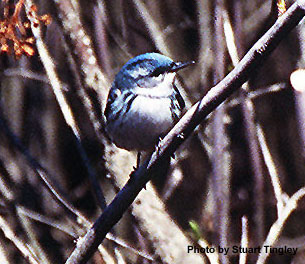
Showing posts with label Cerulean Warbler. Show all posts

Thursday, December 15, 2011

Species Missing Endangered Species Act Protection

Cerulean Warbler / Photo by Lana Hays
It is no secret that the Endangered Species Act gives incomplete protection to vulnerable species in the United States. Not all vulnerable species are listed, and even when a species is listed, a recovery plan may take years to create or lack adequate funding. A new study attempts to quantify just how many species lack Endangered Species Act protections.
A study - now published in Conservation Letters - has compared the ESA list of endangered species with the world's leading threatened species list, the International Union for the Conservation of Nature (IUCN) Red List.

The study has found that of the American species included on the IUCN Red List, 40% of birds, 50% of mammals, and 80-95% of other species such as amphibians, gastropods, crustaceans, and insects, were not recognised by the ESA as threatened.

This amounts to approximately 531 American species on the IUCN Red List that have not made the ESA protection list. These include bird species such as the critically endangered Kittlitz's murrelet (Brachyramphus brevirostris), the endangered ashy storm-petrel (Oceanodroma homochroa), and the vulnerable cerulean warbler (Dendroica cerulea).

"The ESA has protected species since its establishment in 1973, and it may have prevented 227 extinctions. However, the implementation of the ESA by successive US governments has been problematic, including poor coverage of imperilled species, inadequate funding, and political intervention," says study leader Bert Harris, a native of Alabama who is undertaking his PhD with the University of Adelaide's Environment Institute and School of Earth & Environmental Sciences.

"Vague definitions of 'endangered' and 'threatened' and the existence of a 'warranted but precluded' category on the ESA list are also contributing to the gap in species classification," he says.

Sunday, May 01, 2011

Birding Central Park

Yesterday I took the first train of the day into Manhattan so that I could watch spring migration in Central Park. While there had been some interesting sightings in the past week, I did not have any particular target birds on this trip. Instead, I just wanted to experience the sights and sounds of many Neotropical migrants packed into a small wooded area. The birding started off rather slowly when I first entered the park; for a while I only saw common resident species, and when I did see warblers they were almost all Yellow-rumped Warblers. However, things started getting better once I crossed the Bow Bridge into the Ramble. Amidst a big flock of Yellow-rumped Warblers, I started seeing others – a singing Black-throated Green Warbler, Black-and-White Warbler, Common Yellowthroat, and Yellow Warbler. A Black-crowned Night-Heron flew around the Upper Lobe of the Lake. A little up the hill, I spotted a Northern Waterthrush in the Gill and a singing Prairie Warbler nearby.

Shortly after, I saw my first Wood Thrush of the year. It crossed the path and then stopped and froze a few feet off the path. I had just long enough to take two photos. One is above; you can see the other by clicking through the photo. It was one of four (non-robin) thrushes that I saw in the Ramble. The others were Veery, Swainson's Thrush, and Hermit Thrush. All but the Hermit Thrush were firsts for 2011.

As I made my way around the Ramble I continued seeing lots of Yellow-rumped Warblers and various resident birds, such as the Downy Woodpecker pictured above. At the suggestion of another birder, I checked out Maintenance Field but did not find much new. As I walked west from there I saw a crowd of birders and decided to see what they were looking at. I soon heard the rising buzzy song of a Cerulean Warbler. I had to bend over backwards to see it since it was high up in a tree straight overhead. As I continued wandering around the Ramble, I would see it three more times. It moved around the woods in the company of other warblers, which included a Nashville Warblers and a gorgeous singing Blackburnian Warbler. Other warblers in the Ramble included Magnolia Warbler, American Redstart, Northern Parula, Blue-winged Warbler, Ovenbird, Palm Warbler, and Black-throated Blue Warbler.

Along with the warblers, I saw many other species. Orioles made a good showing, with both Orchard and Baltimore Orioles active and singing throughout the Ramble. At least one male Scarlet Tanager showed off its plumage. Vireos included Warbling, Red-eyed, and Blue-headed. I was surprised to see a Red-breasted Nuthatch foraging in the same oak tree where I was watching the Cerulean Warbler and a Nashville Warbler.

It was an excellent day to be out birding. The weather was neither too cold nor too hot, and it provided good lighting for most of the day. Birds were singing and in breeding plumage. Winds must have been favorable to deposit so many birds in such a small area. I ended up seeing 72 species, of which 17 were warblers. I think that is an excellent birding day in any location.

Wednesday, January 13, 2010

Further Evaluation of State Endangered Bird Lists in Pennsylvania and New Jersey


An at-risk but unlisted species, the Cerulean Warbler
Photo by Wikimedia user Mdf, used under a Creative Commons License

Last week, Jeffrey Wells of the Boreal Songbird Initiative published an interesting evaluation of state endangered species lists in PLoS ONE. (I wrote about the article here.) Looking primarily at birds, Wells and his co-authors found that states were effective at protecting species that were globally at-risk and for which they bear high responsibility. However, they also protect many species whose overall populations are secure but happen to be rare in a given state. In other words, resources might be wasted on stable populations when they could be better used on more vulnerable ones.

The Philadelphia Inquirer this week has a closer look how state wildlife agencies in this area handle their endangered and threatened species lists. Like the situation nationally, the local lists have uneven coverage: Pennsylvania lists Great Egret and Blackpoll Warbler, but not Cerulean Warbler; New Jersey lists Savannah Sparrow but not the more vulnerable Saltmarsh Sparrow. State officials argue that their mission is local rather than global biodiversity. Pennsylvania officials had a lot more to say than New Jersey officials, so I will quote them below.
"We have this mandate to maintain the health of Pennsylvania's environment, not the world," says Dan Brauning, wildlife diversity chief with the Pennsylvania Game Commission, which has oversight for bird conservation.

"We're down to one site for black terns," he says. "What are we going to do, ignore it because it's fairly common in North Dakota? No." ...

Even if losing a niche species here wouldn't really destabilize a nationally abundant population, "Pennsylvania is a much better place with them than without them," says Brian J. Byrnes, Important Bird Area Coordinator for Audubon Pennsylvania.
They also argued that the state has programs that go beyond the species on their endangered species list.
In order to qualify for a new source of federal funds, states have had to devise "wildlife action plans" for conservation. "The mantra," Brauning says, is "to keep the species from becoming endangered." These plans, too, have lists; in both Pensylvania and New Jersey, the cerulean warbler is included.

Brauning says Pennsylvania dedicates about $300,000 annually toward nongame bird conservation. But federal funding for the state's wildlife action plan has averaged $1 million. That has allowed the state to actually spend more on the cerulean than it has on the sedge wren, which is listed in the state but is common nationally.

Innovative cerulean research is under way in the Allegheny National Forest, Brauning says, adding that in some cases, listing a bird might actually hamper research efforts. As each individual bird becomes more valuable, it's harder to rationalize, say, capturing a few to extract blood and feather samples to get health data. The risk of their dying is too great.
The State Wildlife Action Plans, by the way, is a good program and an important source of funding for local conservation efforts. (Each state has one, and all are posted at the link.) However, I am not sure that this federal funding program is really a replacement for state endangered species lists. Endangered species lists do play a role in funding priorities, but they are just as much about creating a legal framework for protecting species and their habitats from direct harm. It is great that the federal government is funding innovative Cerulan Warbler research through Pennsylvania's wildlife action plan – and I mean that seriously – but what will the state do when someone wants to clearcut a forest on private land that provides important Cerulean Warbler habitat? What will New Jersey do when more coastal developments impinge on Saltmarsh Sparrow habitat? Similar questions could be raised about numerous other species. To some extent these issues can be addressed through strategic land purchases, but states can only buy so much land, even with help from the federal government and private donors.

As I wrote in my previous post on this subject, protecting globally at-risk species, such as the 192 Critically Endangered birds, is primarily the job of the federal government rather than state governments. The federal government is better positioned to implement conservation measures across state borders and cooperate with neighboring countries. If funding is a constraint to listing and protecting more at-risk species, then the relevant budgets ought to be raised; as it now stands, wildlife conservation is a minuscule portion of the overall federal budget. Meanwhile states need to pick up some of the slack left by the federal government and re-evaluate whether their own species lists represent the best use of state resources.

Tuesday, July 28, 2009

Cerulean Warblers Return to the Same Winter Habitat

Since I adopted the Cerulean Warbler as my blog's mascot, I try to keep abreast of news regarding the species. The tiny warbler has been rapidly declining in recent years thanks partly to the loss of mature forest breeding habitat to mountaintop removal mining and other developments and partly to the loss of 64% of its winter habitat. While the decline has not been sufficient to get it listed under the Endangered Species Act, this warbler has been the focus of intense research on this continent and in its winter range in South America.

Through the Nature Conservancy's blog, I learned of an interesting finding from a research station in Colombia's Andes Mountains: some Cerulean Warblers return to the same wintering grounds year after year.

This research is so exciting that every time I read the reports, I immediately want to head to the field to help out. Gabriel and his team have, since 2003, captured 49 individual Cerulean Warblers. They have used an innovative technique with aerial mist nets suspended on bamboo poles high in the canopy, which is what you have to do to capture this species. Most incredible, the team has recaptured 4 of these birds in different wintering seasons.

This has demonstrated, I believe for the first time, that some individual Cerulean Warblers return to the same wintering area in succeeding years — something we’ve always suspected, but have never proven. So you can meet some of the characters, on the left is a photo of a female Cerulean named Aleja, who was caught and banded in March, 2009. You can see some of the color bands that were placed on her, so she could be followed to study her behavior and diet.
The implications of this finding for conservation will be up to the researchers in the field to determine. However, I would like to suggest a few areas where it might be relevant. First, if individual birds return reliably to the same winter locations, it makes preserving the habitat at those locations all the more important. This is something where U.S. nonprofits can be of some assistance. Second, maintaining (and possibly expanding) these wintering areas will be easier if there is some incentive to keep them forested. One way to do that is through encouraging shade coffee production, which benefits Cerulean Warblers and other species. U.S. consumers (especially birders) can play a role here by providing a market for it. Finally, if warblers return consistently to the same breeding grounds and the same wintering grounds, chances are that they do the same for at least some migration stops. In that light, keeping migrationg stop-overs – even small ones – intact ought to be a major benefit.

(Photos: Top photo by Flickr user Petroglyph; second photo included in the linked blog post.)

Thursday, April 10, 2008

Help Stop Mountaintop Removal Mining

A bill in the House of Representatives, introduced by Frank Pallone and Christopher Shays, would end some of the worst damage from mountaintop removal mining. It already has 129 co-sponsors. Check the list and contact your representative if your representative is not already on it.

Mountaintop removal mining is an environmentally devastating way of extracting fuel for electric power plants. The practice should concern birders because it removes habitat along with the mountains.

Mountaintop removal mining is a type of surface mining found in the Appalachian portions of Kentucky, West Virginia, Virginia, and Tennessee. As its name suggests, mountaintop removal mining involves removing the top of a mountain in order to uncover the coal seams contained near the mountain's surface. Explosives are used to break the mountain's rock, and massive earth-moving equipment (such as "draglines") removes the spoil - the dirt and rock that formerly composed the mountaintop. Federal law normally calls for excess spoil to be placed back in the mined areas, returning the lands to their approximate original contours. However, in mountaintop removal mining, vast quantities of spoil are carried to surrounding valleys and dumped, hence the term mountaintop removal/valley fill. Why not simply replace the fill at the mine site and return the mountain to its former state? The answer is because broken rock occupies more volume than the original mountain, and so there is always spoil left over. Also there are concerns with spoil stability in steep terrain....

One consequence of mountaintop removal mining is that streams flowing through the valleys are buried. Large mines may be surrounded by several valley fills because of the sheer volume of broken rock and spoil created. Depending on the local topography and the profile of those valleys, a single fill may be over 1,000 feet wide and over a mile long. Until recent years, excess spoil from coal mining was generally placed in the extreme headwaters of streams, affecting primarily ephemeral streams that flow intermittently only in direct response to precipitation in the immediate watershed. Because smaller upstream disposal sites are exhausted and because of the increase in mountaintop mining activity, today the volumes of a single stream fill can be as much as 250 million cubic yards. As a result, streams are eliminated, stream chemistry is harmed by pollutants in the mining overburden, and downstream aquatic life is impaired. From 1985 to 2001, an estimated 724 stream miles in West Virginia, Kentucky, and parts of Virginia and Tennessee were covered by valley fills, and 1,200 miles of headwater streams were directly impacted by mountaintop mining activities.
Many of the Appalachian ridges are covered with mature forests; any bird that depends on this type of habitat will be displaced. One of the birds threatened by mountaintop removal mining is this blog's mascot, the Cerulean Warbler, which has declined precipitously in the last 40 years. Old-growth Appalachian forests are prime breeding territory for this warbler. The central Appalachians also provide the southernmost breeding range for several northern birds, such as Golden-winged Warbler, Dark-eyed Junco, and Purple Finch. Some groups are working to convert abandoned mining sites back to forest, but in the short-term substitute it is better to leave habitats intact.

H.R. 2169, the Clean Water Protection Act, would stop some of the worst abuses by banning mining companies from dumping spoil material into streams. This bill's prime effect would be to protect water from further pollution, both in the headwaters and downstream. It could also slow the rate of mountaintop removal since companies would have to find new places to dump their waste.

Again, check the list and tell your representative to support the bill.

Wednesday, April 25, 2007

Cerulean Warbler


John James Audubon described cerulean warblers as follows:

It arrives in the lower parts of the State of Louisiana, in company with many other species of Warblers, breeds there and sets out again about the beginning of October. It is as lively as most species of its genus, possesses the same manner of flight, moves sidewise up and down the branches and twigs, frequently changing sides, and hangs to the extremities of bunches of leaves or berries, on which it procures the insects and larvae of which its food is principally composed. The liveliness of its notes renders it conspicuous in those parts of the skirts of the forests which it frequents; and its song, although neither loud nor of long continuance, is extremely sweet and mellow.

Sunday, March 25, 2007

Random Notes

Just a few gleanings from the weekend that did not make it into my last edition of Loose Feathers....

  • Coffee and Conservation reviewed the shade-grown coffee that is a component of the American Bird Conservancy's Save the Cerulean Warbler campaign. The upshot is that the coffee sampled seems under par for the gourmet/specialty niche for which it is marketed. That is unfortunate since shade coffee plantations in Colombia form an important part of the warbler's winter habitat.
  • A search for ivory-billed woodpeckers has been underway in the Big Thicket area of Texas. So far, no substantial evidence has materialized there. (Thanks, L.!)
  • Some really unusual waterbirds were spotted around the vicinity of Hains Point on Saturday. Unfortunately I did not get a chance to look for them, but enterprising birders may still be able to find some. Check the reports on MDOsprey, here and here.
  • Birds have differentiated sex chromosomes, but the dosage compensation between them is less effective than in mammals. (Paper here.)
  • Here is a photograph of a really odd mallard. Hybrid? Domestic? Mutant? Who knows!

Thursday, December 07, 2006

No Listing for Cerulean Warbler

The US Fish and Wildlife Service has declined to list the cerulean warbler under the Endangered Species Act. Conservation groups had asked the government to list cerulean warblers in 2000; the FWS began a status review in 2002. The decision announced this week was based on a review of data and petitions submitted as part of a public comment period.

Although there is no precise estimate of the current abundance of the cerulean warbler, the Service used a 1995 population estimate of 560,000 warblers during its review of the species’ status. Based on 40 years of data obtained through the Breeding Bird Survey which indicates the population is declining at about 3 percent each year, the estimated population in 2006 would be approximately 400,000. At this rate of decline, the Service estimates the cerulean warbler population would number in the tens of thousands 100 years from now.
The FWS does plan to maintain some involvement in conservation efforts, as is noted in the press release linked above. The decision not to list removes some of the legal muscle that would assist conservation efforts. I can understand the decision to focus on species in greater trouble, but I have to wonder whether assuming a steady rate of decline is valid. The response by the Southern Environment Law Center notes that recent estimates of rate of decline have indicated an increase to a 6% decline each year.
The Fish and Wildlife Service failed repeatedly to meet federally mandated deadlines under the Endangered Species Act for responding to the petition. In the intervening years, scientists believe the bird's annual rate of decline increased from 4% to 6%, and threats to its habitat have worsened. ...

The Cerulean population has dropped almost 82% throughout its U.S. range over the last 40 years, making it the fastest declining warbler in the country. ... Once common, it has grown increasingly rare as forest habitat in both hemispheres has been destroyed and fragmented by logging, surface mining and development. In the U.S., the worst of the Cerulean's decline has been in the core of its range - 80% in the Cumberland Plateau in Tennessee, Kentucky and West Virginia, and 65% in the Ohio Hills in Ohio, West Virginia and Pennsylvania.
I have some comments about cerulean warblers in an older post.

Monday, July 24, 2006

Cerulean Warbler to Gain Protection in Georgia

The Georgia Department of Natural Resources is in the process of revising its lists of protected plants and animals. Among the changes is the addition of the Cerulean Warbler, which has undergone sharp declines in recent decades due to habitat loss. In Georgia, cerulean warblers are primarily found in the mountainous northwest corner of the state, including at Kennesaw Mountain National Battlefield Park.

Other avian changes to the list include the addition of the Henslow's Sparrow, Red Knot, Southeastern American Kestrel, Black Skimmer, and Golden-winged Warbler; the deletion of the Bachman's Warbler; and the changes in status of the Bald Eagle (endangered to threatened), Peregrine Falcon (endangered to rare), and Wilson's Plover (rare to threatened).

The Georgia DNR is seeking public comment on the proposed changes, which must be in writing by July 31, 2006. The full list of proposed changes is here (pdf). The current lists of protected species in Georgia may be found here.

Tuesday, May 09, 2006

Birds of the Mid-Atlantic #9: Cerulean Warbler

A few days ago, I finally saw a bird that had eluded me for several years, the cerulean warbler. (I have an account of the encounter here.) For BRG readers who may be unfamiliar with my blogging history, the cerulean warbler has been both the mascot of my blog and my principal nemesis bird. Even though it passes regularly through the DC area every spring, and even though I bird regularly in places where it appears, I had never seen one before last Sunday.

The Latin word caeruleus, from which the species's English and scientific names are derived, is related to the Latin caelum, or "sky." It means sky-blue - not a light blue, but deep blue like the midday sky. It is an appropriate name for this little bird, which is brilliant blue on its head and back and white underneath, with a blue "necklace" and blue stripes on its sides. (Females are more of an aqua-green color.) Despite its sharp colors, this bird defies any observer who tries to see it. Cerulean warblers forage and nest near the very tops of trees; searching them out will induce the malady known as "warbler neck."

Cerulean Warbler / Photo by Brian Small (NPS)

Fortunately for us, cerulean warblers have a distinctive song: 3-5 notes on a single pitch followed by a rising buzzy trill. It can be distinguished from the northern parula because the parula's song rises in a continuous trill and then falls over the top, without introductory notes on an even pitch. The blackburnian warbler's song has a similar rhythm but is much higher pitched without the buzziness. Its ending note is almost at the limit of human hearing. The song of the black-throated blue-warbler has a lazier pace and is a thinner-sounding buzz than the cerulean's.

Cerulean warblers have undergone two demographic shifts since the species was first discovered. Prior to the twentieth century, the species was rare as a breeder east of the Appalachians. Over the last century, the species has expanded its range steadily into the Mid-Atlantic and Northeast. In Maryland, the breeding population is concentrated in the mountainous western counties and somewhat less common in the central Piedmont region.

The other shift has been a steep decline in numbers. Cerulean warblers have endured one of the steepest declines among North American birds, a loss of close to 80% of the population between 1966 and 2003. It has landed on the Audubon Watchlist as a result. So far, attempts to have it listed as an endangered or threatened species have been unsuccessful because of federal inaction.

As with many other species, the cause of the cerulean warbler's decline is habitat loss and degradation. Cerulean warblers require large tracts of mature forests in order to breed. Such tracts are becoming harder to find due to logging and development. In the Appalachians, cerulean warblers face a threat from mountaintop removal mining. The species also faces pressures on its wintering grounds in northern South America, where deforestation for agricultural uses has become common. (A Colombian reserve was recently founded to address this problem.)

Even in some places where otherwise suitable habitat exists, cerulean warblers have disappeared because of the lack of an understory due to overbrowsing by white-tailed deer. A study by the USFWS in Pennsylvania found that ceruleans disappeared when the deer population rose about 20 per square mile. In many areas of the eastern United States, the population is far higher than that.

It is hard to be optimistic about this species's outlook. While cerulean warblers are not about to go extinct in the near future, decline is likely to continue without serious conservation measures. Such measures face many political and financial roadblocks and may be difficult to achieve in the current climate.

While we seek for the causes and solutions for the decline of the cerulean warbler and other eastern songbirds, we need to enjoy the birds while we have them. When I heard and saw cerulean warblers last Sunday, I was not thinking about their problems. I was thinking about what a beautiful bird it was and how happy I was to be seeing it, finally.

Sunday, May 07, 2006

Cerulean!

I finally caught up with a cerulean warbler, and the sighting was a great one indeed. This morning I headed out to Pennyfield Lock, in mile 19 of the C&O Canal, for a morning of springtime birding with the DC Audubon Society. The towpath west of Pennyfield Lock is good for a variety of songbirds and water birds as it combines marshy areas with bottomland woods.

The most noticeable birds on the canal were bright orange Baltimore orioles. These were so numerous in places that they seemed to drip from the trees. The males aggressively sought to stake out territories with their constant whistled song. One female was busy building a nest. Several orchard orioles, including a dark orange adult male, shared the sycamores with the Baltimore orioles.

The woods along the towpath here provide breeding grounds for prothonotary warblers. These brilliant yellow birds are cavity nesters, and frequently will use nest boxes. One that we saw was checking one out. Several prothonotaries sat out in the sun where we got great looks at them.

A little past the second impoundment, we started hearing buzzy upslurred calls that were not the same as the northern parulas that sang all along the towpath. It sounded like the cerulean call, which repeats several notes at the same pitch and ends with a rising buzz. We scanned the treetops without success until one member of the party pointed out a little blue and white bird about twenty feet off the ground on a tree behind us. It was the cerulean warbler. The bird stayed at that relatively low level long enough for most to get a satisfying look, and then it flew across the canal, where it flitted from one branch to another in full view, singing all the while. This look at the cerulean was on par with my cape may sighting last week in terms of visual quality; one could not ask for a better look at a bird.

At about the same area, someone spotted a nest high in a tulip tree. The nest owner turned out to be a yellow-throated vireo; one bird was feeding chicks in the nest while another was singing close by. Also in about the same place we heard a barred owl hooting in the distance. Lots of hawks and vultures were out by midday, including a broad-winged hawk soaring very high up. Several Louisiana waterthrushes were singing along the canal, but unfortunately none came out for a look. After hearing scarlet tanagers all day, the few of us left finally got a look at a bright red male towards the end of the walk.

BIRD SPECIES SEEN: 64

Double-crested Cormorant
Great Blue Heron
Green Heron
Canada Goose
Wood Duck
Mallard
Hooded Merganser
Black Vulture
Turkey Vulture
Osprey
Bald Eagle
Red-shouldered Hawk
Broad-winged Hawk
Red-tailed Hawk
Solitary Sandpiper
Mourning Dove
Yellow-billed Cuckoo
Barred Owl
Chimney Swift
Ruby-throated Hummingbird
Belted Kingfisher
Red-bellied Woodpecker
Northern Flicker
Pileated Woodpecker
Eastern Wood-Pewee
Acadian Flycatcher
Eastern Phoebe
Great Crested Flycatcher
Eastern Kingbird
Tree Swallow
Northern Rough-winged Swallow
Cedar Waxwing
Carolina Wren
Gray Catbird
Northern Mockingbird
Blue-gray Gnatcatcher
Carolina Chickadee
Tufted Titmouse
White-breasted Nuthatch
Blue Jay
American Crow
Fish Crow
European Starling
Yellow-throated Vireo
Warbling Vireo
Red-eyed Vireo
American Goldfinch
Northern Parula
Yellow Warbler
Yellow-throated Warbler
Cerulean Warbler
Prothonotary Warbler
Louisiana Waterthrush
Common Yellowthroat
Canada Warbler
Scarlet Tanager
Swamp Sparrow
Northern Cardinal
Indigo Bunting
Red-winged Blackbird
Common Grackle
Brown-headed Cowbird
Baltimore Oriole
Orchard Oriole

BUTTERFLY SPECIES SEEN: 3

Zebra Swallowtail
Eastern Tiger Swallowtail
Question Mark

Monday, January 02, 2006

Most Wanted Birds - in DC

The following are birds that I would like to add to my Washington, D.C., list within the next year. Some of these I have seen before, but not in the district. All of the following appear on the species list (pdf) for the District of Columbia.

1. Cerulean Warbler

This is the bird I would most like to see but have not seen yet. My best chance for seeing it is probably on the ridge at Rock Creek Park in May or September.

2. Cape May Warbler

As with the cerulean warbler, my best chance for seeing this bird is at Rock Creek Park. If only I had the time and energy to patrol the ridge on a daily basis!

3. American Pipit

I have seen this species once before, outside of D.C. This is reported fairly frequently though, so with more birding in the right places, the chances of a sighting ought to be good.

4. Louisiana Waterthrush

This would also not be a life bird, but my first for D.C. Waterthrushes, like other skulking little brown birds, can be hard to spot.

5. Great Horned Owl

Again, not a lifer but my first for D.C. Great horned owls have been hard to find in the district in recent years. My favorite birding spot, the National Arboretum, is probably the best place to look, but closes at 5pm so that dusk and night searches are out of the question.

6. Horned Lark

Horned larks are reported here occasionally, with about the same frequency as American pipits.

7. Pine Siskin

Pine siskins are close relatives of American goldfinches and are frequently seen with flocks of goldfinches. If siskins were to show up anywhere here, the National Arboretum seems like a good bet.

8. Eastern Meadowlark

These beautiful birds are a welcome sighting on any occasion. I wish I could see them closer to home instead of only on field trips out of the district.

9. Northern Shoveler

Shovelers are relatively common but rare in the district. These colorful birds are probably my favorite of the Anas ducks, but one of several common waterfowl species that I still have not seen in D.C. The main problem is the lack of good wintering habitat. While there is enough deep water to attract diving ducks, dabbling ducks aside from mallards find little reason to stop here.

10. Connecticut Warbler

My best chance to see this elusive warbler is probably right here in DC, on the ridge or in the woods of Rock Creek Park. Unlike the cerulean and Cape May warblers, which hide in the treetops, the Connecticut warbler scurries along in the ground in the underbrush, where its plumage blends in with the foliage.

This year, I added six species to my list for D.C., so if I find half of the above in 2006 it will count as a good year.

Related posts: Life Birds from 2005, Most Wanted Birds

Sunday, January 01, 2006

Most Wanted Birds

I posted a list below of the life birds I have seen within the past year. Now as one year ends and the next begins, I would like to look ahead to a new year of birding and a new set of life birds. Here are the ten birds I would most like to see within the next year.

Now the following are all birds that one might reasonably hope to see within my usual birding haunts - in other words, within the mid-Atlantic region. Some may even be found in the D.C. area. There are plenty of others that I would like to see but that would require travel over longer distances. I felt that including birds from farther afield would require more than a top ten list!

1. Cerulean Warbler

The emblem for my blog ought to be a bird I have actually seen, so finding this species will be a goal of my spring migration birding.

2. Horned Lark

This species competes with the cerulean warbler for the title of my "nemesis bird," the name birders give to species that they fail to see even when others see them in the same place at the same time. I have been on trips where a horned lark was seen by other birders on the same day, and I have chased down reports of larks. In no case have I seen one.

3. Cape May Warbler

This striking species was named for one of the best birding sites on the east coast; it gained the name when the first specimen was collected there by Alexander Wilson, who did his birding with a firearm.

4. Connecticut Warbler

The Connecticut warbler seems to be a common inhabitant of birders' lists of nemesis birds. The reason is clear: like all Oporornis warblers, this species skulks in the underbrush and is difficult to see without careful looking. The mourning warbler, also missing from my life list, would also be a welcome sighting.

5. Sora

Rails as a whole form a large gap in my life list. I have now heard a king rail, but I have not so much as heard, let alone seen, any of the others. I list the sora here because it seems to be the most likely for me to see, but it stands for rail sightings in general.

6. Bobolink

Bobolinks are a grassland species, and therefore are rare in the areas where I bird most often. Still, they do appear, and one day soon I hope to see them. Their tinkling calls are quite intriguing.

7. Rough-legged Hawk

In my area, rough-legged hawks are winter migrants, and appear mainly in open areas for short periods at a time.

8. Common Redpoll

I hope to track down a member of this species sometime this winter. They are closely related to goldfinches and siskins, but have red instead of yellow as their distinctive color.

9. Razorbill

I have few chances to bird at the shore in the winter, but when I do, I frequently hear of razorbill sightings around the same time and place. One day soon a razorbill and I will be in the same place at the same time, and I will see it.

10. Broad-winged Hawk

The broad-winged hawk is the one common eastern raptor that I have yet to see. Maybe this will be the year for it.

Friday, August 19, 2005

Friday Bird Notes

On this rainy day, I have no sightings to report. I am glad to see a good, drenching rain, though. The trees on my block could certainly use it, and the sugar maples on the next block over are in an even more dire condition at the moment. As of last night, their leaves were already a crispy brown.

Laura at Birder Blog reports that the American Bird Conservancy is entering into a partnership with the Colombian Fundacion ProAves to preserve wintering habitat for migratory birds. One of the avian beneficiaries will be the cerulean warbler, this blog's mascot. (So maybe there is hope of seeing one yet.) The preserve, if properly maintained, should benefit rare birds endemic to Colombia as well.

The American Bird Conservancy has also produced a Birdwatcher's Guide to Global Warming. It gives state-by-state accounts of how global warming might affect birds and birders. A likely change is that as the climate warms, bird breeding ranges will shift northward; to some extent this process is already being measured. One species that may leave this area altogether is the Baltimore oriole.

One more thing: Anthony Williams, mayor of Washington, D.C., and avid birder, started a blog for the mayor's office this week. It will be interesting to see where this goes.