Showing posts with label Birds of the Mid-Atlantic Series. Show all posts

Tuesday, January 09, 2007

Birds of the Mid-Atlantic #28: Fox Sparrow

Winter brings visitors from the north, and attracts short-distance migrants into the Piedmont and coastal plain. Among the avian visitors are a host of sparrows, one of which is the fox sparrow.

Fox Sparrow / Photo by James C. Leupold (USFWS)

Field guides do not quite convey how distinctive fox sparrows look in the field. Almost uniformly, they show the bright rufous upperparts and the crisp black chevrons on the breast. While these field marks are sufficient for identification, what really separates a fox sparrow from the most rufous of song sparrows is something that is harder to quantify. Fox sparrows stand out for their size and bulkiness even next to larger song and white-throated sparrows.

Fox Sparrows spend their summers in northern Canada and Alaska. The red, or eastern, form breeds in the boreal forest of eastern Canada and winters in the mid-Atlantic and southern United States. Other forms are distributed farther west. They can be spotted in the underbrush as the scratch through leaves for seeds and insects.

Since fox sparrows breed so far to the north, and only stay in this region for a few months, it is unusual to hear one sing at these latitudes. With all the warm weather lately, several observers in the DC area have reported hearing snatches of fox sparrow songs recently. A fox sparrow sings a clear, warbled song, similar to a purple finch or orchard oriole. It is something to listen for on your next walk in the woods.

Tuesday, December 26, 2006

Birds of the Mid-Atlantic #27: Great Horned Owl

Two weekends ago I was lucky enough to have great looks at three great horned owls in two different locations. Two involved flying birds, but one was a close-up, unobstructed view of an awake, perched owl. Owl sightings always leave an impression with me because such sightings are so unusual during the day and because owls' faces are so compelling.

Great Horned Owl / Photo by Carla Stanley (USFWS)

Unlike other birds, owls have forward-facing eyes and stereoscopic vision, which presumably gives them some advantage in low light conditions. That adaptation leaves them with very human-looking faces. As a result, owls may be the most easily anthropomorphized of bird families. They are also among the most mysterious of birds because of their nocturnal habits. Thus all sorts of magical traits - for good or ill - are associated with them.

In reality, there is very little magic involved in a great horned owl's habits. They are among the most adaptable of hunters, and will take game from the very small (mice , voles, and the like) to animals as large as raccoons and domestic cats. Depending on the location, great horned owls may take mammals, birds, or reptiles of many different species. They are habitat generalists, and can survive in suburban areas, though they prefer open woodland and meadows.

Winter is a good time to look for owls, whether great horned or other species. Fewer leaves on the trees means that there are fewer places for owls to hide, thus narrowing the search area to conifers and tangles of vines. Local owls start to set up their breeding territories as early as January. Great horned owls, in particular, are more vocal at this time of year than later in the spring or summer, and some pairs may already be on nest. An additional benefit is that many northern species will winter in the mid-latitudes, so if you want to see a long-eared or northern saw-whet owl, this is the time of year to look.

Great Horned Owl Chicks in Nest / Photo by USFWS

During the day, check for owls in stands of conifers, especially spruce and fir. Regular roosts will be marked by cakes of whitewash. Look for trees with obvious whitewash and check the upper branches carefully for owls. Since great horned owls use nests built and abandoned by other species, it is worth checking old hawk and squirrel nests for a nesting owl. Night owling can be aided by playing taped calls, though that may not be advisable (or legal) in all areas. Be sure to check local regulations and consider your own safety before looking for owls at night.

If you want to look for owls yourself, some of the following may be helpful:
If you are lucky enough to see an owl or find a nest site, take precautions to avoid disturbing the bird. Keep a respectful distance and avoid visiting the same spot repeatedly. Do not publish a nest location on internet sites or email lists. These guidelines should hold for all owl species, except perhaps for extreme rarities or for species that can be observed from a distance, like short-eared and snowy owls.

When I wrote my last post in this series in October, I did not think it would take six weeks for me to write another one. I do plan to keep this series going, and I have a few more installments planned for the coming weeks.

Crossposted at Blue Ridge Gazette.

Tuesday, October 31, 2006

Birds of the Mid-Atlantic #26: Crows and Ravens

As Halloween is upon us, our thoughts turn to birds with spooky reputations. Owls, because of their nocturnal habits and otherworldly calls, are a Halloween staple. Vultures, with their preference for carrion, are a harbinger of death. Few birds seems as ominous as crows and ravens. Like vultures, their plumage is funereal black and they will eat carrion. Crows will gather in large flocks to roost; such roosts may hold hundreds or thousands of birds. Their reputation is such that the collective name for a gathering of crows is a "murder" and that for ravens is an "unkindness." These dark birds are sometimes symbols for impending death, as in Edgar Allen Poe's The Raven:

But the Raven still beguiling all my fancy into smiling,
Straight I wheeled a cushioned seat in front of bird and bust and door;
Then, upon the velvet sinking, I betook myself to linking
Fancy unto fancy, thinking what this ominous bird of yore, 70
What this grim, ungainly, ghastly, gaunt, and ominous bird of yore
Meant in croaking "Nevermore."

Crows and ravens are part of the family Corvidae. In North America, this family also includes jays and magpies in addition to its larger, darker members. Despite the familiar fable, members of this family are among the most intelligent of birds. They are known to use strategems to acquire food; jays, for example, will lure smaller songbirds away from their nests with imitations of hawk calls. Some studies suggest intelligence on the level of great apes. Crow intelligence is the reason that attempts to scare these birds from farms and gardens rarely work for long.

American Crow / Peter S. Weber (USGS)

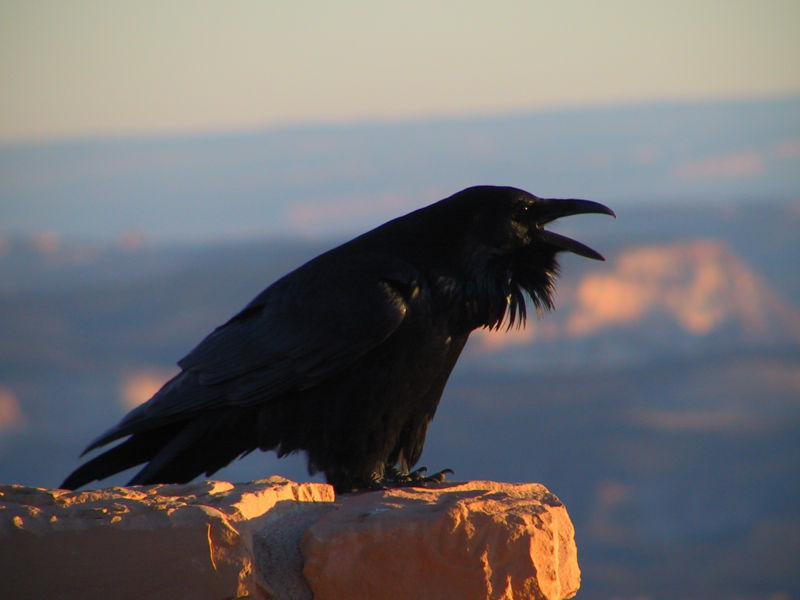
The Mid-Atlantic region boasts three of these large, black birds: the American Crow, the Fish Crow, and the Common Raven. American Crows may be found throughout the region; these are the common crows whose caws may be heard in almost any neighborhood. Fish Crows are birds of the coastal plain. They may be found in marshes and along rivers; their distinctive call is a nasal nuh-uh. Common Ravens inhabit the western mountainous provinces; they may be found as far east as the piedmont, but rarely. They have wedge-shaped tails and emit a deep croaking sound instead of a caw. (This is not to be confused with a guttural croaking noise that American Crows sometimes make.)

Common Raven / US NPS

Unfortunately, our local crow population have been hit hard by the outbreak of West Nile Virus. American Crows seem to be particularly susceptible, but corvids as a group suffer a higher death rate when exposed to the virus. The graph below, derived from Christmas Bird Count results in the DC area, gives a sense of their decline in the past decade.

Because of recent worries about West Nile Virus and highly-pathogenic poultry flu in humans, crows again are becoming ominous signs. Only now, it is the dead crows rather than the living ones that are a cause for worry. With both diseases, birds are under a greater threat than humans.

Note: Audubon at Home has some good suggestions for making Halloween less wasteful.

Crossposted at Blue Ridge Gazette.

Tags:

Wednesday, October 11, 2006

Birds of the Mid-Atlantic #25: Black-throated Blue Warbler

As I noted in my post on Saturday, I never get tired of watching black-throated blue warblers. They are a bit easier to watch than other warblers. Black-throated blues tend to stay in middle-level foliage: the tops of bushes and small trees like dogwoods and devil's walking stick. They keep their colorful spring plumage throughout the year, even when other warblers are at their most confusing. They are not shy and will go about their business even with a human watching at close range. Some guides refer to this quality as "confiding."

Black-throated Blue Warbler / Photo by Steve Maslowski (USFWS)

As you might expect, a male black-throated blue warbler has dark blue upperparts and a black face and throat, with white undersides. Females have greenish-blue upperparts with light-colored underparts. Both sexes show a white patch on the wing at the base of the primaries. Immatures might not show this patch, but otherwise it is a good indicator for the species. In spring, the black-throated blue song is a rising buzz, sometimes transcribed as beer beer beer beeee.

Relatively few black-throated blue warblers breed in the DC area, and those that do nest well to the west, among the ridges of the Appalachians. We only get to see them during two brief periods of the year: spring and fall migration. Luckily, their fall migration is sometimes quite protracted. In DC, they may be seen from mid-August through mid-November. Last year, my last sighting was on November 6; the Maryland Yellowbook gives November 16 as the late migration date. Even though most warblers are already gone, there still may be a chance to see a few black-throated blues before the winter.

Monday, September 25, 2006

Birds of the Mid-Atlantic #24: Swainson's Thrush

Like spring migration, fall migration proceeds in stages, each bearing different sets of species. The birds one sees on the morning after a cold front will be much different in late September than in early September. In the thrush family, most veeries pass through the D.C. area during early September. By late September, most veeries have departed, and the Swainson's thrushes and gray-cheeked thrushes are on the move. Sunday was a good day for spotting Swainson's thrushes, as I saw several of them at the National Arboretum in D.C.

Swainson's thrush is a member of the genus Catharus. Thrushes of this genus are small and brown with some degree of breast spotting. Most Catharus thrushes are noticeably smaller than American robins and slightly smaller than wood thrushes. Similarities in shape, size, and plumage make this the most challenging North American thrush genus, even though it is fairly easy to distinguish Catharus thrushes from other genera in the thrush family.

The most distinctive of eastern Catharus thrushes is probably the Swainson's thrush. The key field marks are on the face of this species. Swainson's has prominent buffy eye rings. A buffy line over the bill connects the eye rings so that the bird appears to wear spectacles. Now one field mark is not enough to base an identification, so make sure to check the back and breast even on bespectacled birds. The back, wings, and tail should be a cold grayish brown with no hint of rufous; from the rear a Swainson's thrush should resemble gray-cheeked more than hermit or veery. The breast should be covered with small dark spots on a buffy background; the spots are less heavy than a wood thrush but bolder and darker than a veery. The spots and buffy wash extend from the throat about halfway down the breast. Put these marks together, and you have yourself a Swainson's thrush.

Swainson's thrushes breed in a wide band across southern Canada and the northernmost states of the United States, including the Appalachians in upstate New York and Vermont. Very few spend the summer at the higher elevations of the Blue Ridge. Though they prefer spruce woods for breeding, Swainson's thrushes can be found in any type of forest and even some edge habitats during migration. The birds we are seeing now are on their way to the Andes of western South America.

Image credits: Top, Photo by NPS; Bottom, Illustration by Louis Agassiz Fuertes.

Crossposted at Blue Ridge Gazette.

Wednesday, September 20, 2006

Birds of the Mid-Atlantic #23: Red-eyed Vireo

On Sunday I attended the DC Audubon Society's annual September field trip to Rock Creek Park. For those not familiar with the area, Rock Creek Park is the hotspot for migratory songbirds in Washington, DC. Picnic areas 17/18 on Glover Road and the maintenance yard are particularly productive.

On Sunday, the most common neotropical migrant was probably the red-eyed vireo. Every tangle of vines, every tree, and every bush seemed to have a red-eyed vireo hopping in and out of the foliage. Other birders estimated that there were about 30 red-eyed vireos around the ridge, maintenance yard, and nature center that day.

Red-eyed Vireo / Painting by Louis Agassiz Fuertes

Red-eyed vireos reported in D.C. during the fall are a mixture of local breeders and migrants from up north. This species breeds as far north as the Yukon Territories in western Canada; in the east it ranges up to the southern half of Ontario and Quebec. In the mid-Atlantic, red-eyed vireos are widespread and common breeders. Throughout the summer one can hear their simple three-syllable songs echoing from high in the canopy. Even in the middle of the day, red-eyed vireos will keep singing: "Here I am. In the tree. At the top. Can't see me." All red-eyed vireos, whether they bred in D.C. or farther north, are on their way south to their wintering grounds in northern South America.

In the flurry of drab birds that make up fall migration, it is helpful to be able to recognize red-eyed vireos. Being able to confirm or eliminate red-eyed vireo quickly will help one to pick out other, less common, migrant species that share the red-eyed vireo's drab coloration. Within the vireo family, warbling vireo and Philadelphia vireo are superficially similar in their facial markings and drab backs. However, the eyebrow and eyeline of both species are far less bold than on a red-eyed vireo. A warbling vireo tends to be browner than a red-eyed vireo's olive-green back. Philadelphia vireos have clearly yellow throats and undersides, as well as a shorter tail.

Outside of the vireo family, red-eyed vireos may be confused with Tennessee warblers. Like red-eyed vireos, Tennessee warblers show gray heads, olive backs, and light undersides. However, one can usually tell the difference by the bill, which is hooked for vireos but straight and sharp for warblers. In addition, while Tennessee warblers have white eyebrows, they lack the bold black eyeline that distinguishes red-eyed vireos. Tennessee warblers also have shorter tails.

Get out and enjoy the challenge of fall migration while it is with us. Several species pass through in good numbers at this time but not at others. A cold front has just passed through the D.C. area, and we are sure to get a few more before all the warblers have passed. But time is short; by mid-October most of the warblers, and the red-eyed vireos, will be gone until next spring.

Tuesday, September 12, 2006

Birds of the Mid-Atlantic #22: Broad-winged Hawk

Birders typically divide the year into seasons devoted to certain activities. May, for example, is a time when birders want to be out as much as possible and in as many habitats as possible to see and hear birds on their way north. June and July tend to be times for searching out breeding birds, especially for birders participating in breeding bird surveys and atlas projects. August is a month devoted to shorebird-seeking. September and October are great for finding many species as they make their way south to their wintering grounds. I could list more, but you get the point.

The southbound migration of September and October is perhaps most distinctive for the massive flights of hawks along the Eastern Seaboard. Hawks migrate in other months as well, but the largest concentrations of raptors will be found in mid to late September. Among the most common hawks in the early stage of migration is the broad-winged hawk.

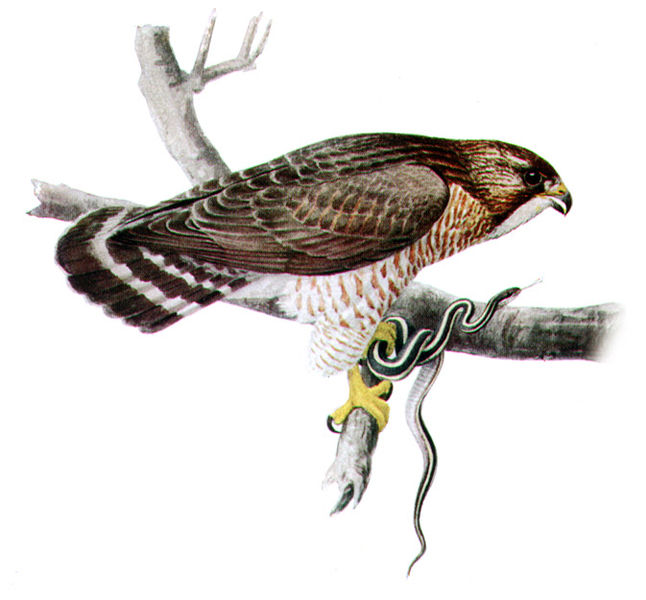
Broad-winged hawks are small for buteos: 15 inches long with a 34-inch wingspan (compared to 19 inches and 49 inches for red-tailed hawks). Adults may be distinguished in flight by their broad black-and-white tail bands, the dark edging around their wings, and the overall paleness of their undersides. Immature broad-wings do not show the tail bands but do have the dark edging around the undersides of their wings. During the breeding season, they nest in forests and may be hard to find. During their autumnal flights to Central and South America, they become far more apparent.

Broad-winged Hawk / Illustration by Louis Agassiz Fuertes

During migration, broad-winged hawks are notable for engaging in a practice known as "kettling." Large groups will migrate together; when they gather, the rising and falling motion of individual hawks gives the appearance of bubbles in a boiling kettle of water. This activity is not merely a sign of sociability; it is an important part of their migration flight. Unlike passerines, which migrate at night, hawks depend upon thermals and updrafts to minimize the work they need to do to stay aloft. Hawks use these to rise high in the air, and then glide onward until they meet another thermal, and repeat the process. "Kettles" usually occur where there happens to be a strong rising stream of air. (For photos of broad-winged hawks in flight, including a kettle, see here.)

The premier hawk-watches in the Mid-Atlantic are Cape May and Hawk Mountain. There are also many other good sites. While they may not have the volume of the premier sites, each makes for a good show. Many great sites for hawk watching are located along the peaks of the Blue Ridge in Virginia; DL Ennis has a list of such sites here. Rockfish Gap, for example, maintains hawk counts each migration season; last year that count recorded over 10,000 hawks during fall migration, dominated by over 7,000 broad-winged hawks. A list of hawk watching sites in Maryland can be found at the MOS website. In addition to the sites on that list, Point Lookout State Park, where the Potomac River and Chesapeake Bay converge, is productive for hawk watching under the right conditions. Several good spots lie along the Eastern Shore, notably Kiptopeke State Park in Virginia.

Unfortunately, Washington, D.C., does not have a high-quality hawk watch location. However, if you keep your eye on the sky, you are sure to see at least a few migrants on good days. To do your own hawk watch, choose a location that is somewhat elevated and has good sightlines in all directions. You may or may not see broad-wings, but you should see a variety of raptors.

Crossposted at Blue Ridge Gazette.

Tuesday, August 29, 2006

Birds of the Mid-Atlantic #21: Young Birds

Late summer is a time of change for birds. By now, the breeding season has ended for most species, and the young birds are out of the nest. Fledglings are rapidly maturing. Adults are molting their old feathers for fresh ones. Many species have already begun their journey south to their wintering grounds, such as the yellowlegs I covered last week. All this poses special challenges for birdwatchers. In some ways, this may be the most challenging times of the year.

Fledglings

Fledgling plumage may or may not be covered by field guides. Even the big Sibley Guide, for example, shows the fledgling plumage for American Robins, but it illustrates fledgling plumage less frequently for less common species. Fledgling robins themselves are sometimes a cause of confusion because of their spots. Adult robins do not have spots, but sport a solid orange breast. Fledglings, on the other hand, do have spotted breasts, much like other members of the thrush family. See below for an example.
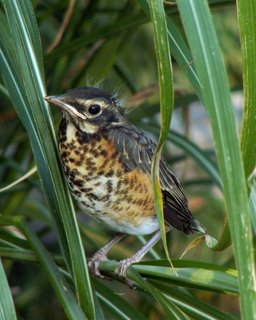
Baby American Robin / Photo by Sean Varner (USFWS)

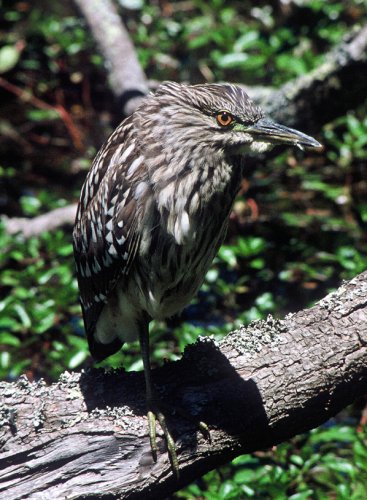
Another example of juvenile plumage is the Black-crowned Night-Heron, pictured below. As with the robin, the juvenile plumage seems designed to make the night-heron less visible to predators while it is still maturing. Adult night-herons are much more conspicuous. Juvenile night-herons are not too difficult to identify, but the cryptic plumage could be confused with that of a juvenile Yellow-crowned Night-Heron or adult American Bittern.
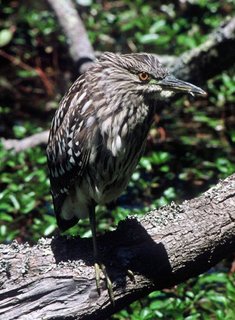
Juvenile Black-crowned Night-Heron / Photo by Lee Karney (USFWS)

The key to identifying juveniles, especially recent fledglings, is to remember that they are fledglings, and look for the species that they most resemble in structure. Bill length and shape, tail and wing size, and overall posture will be helpful here. Look for an answer among the common species first, before considering other, rarer possibilities.

Molt

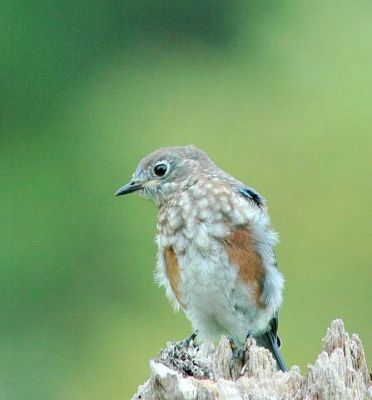
Juvenile Eastern Bluebird / Photo by Wendell Long (Texas Bluebird Society)

A different kind of challenge is posed by molting birds. Some birds keep more or less the same plumage year-round. Even if they do, they need to molt each feather at least once per year to make up for normal wear and tear and retain the feathers' usefulness for insulation, flight, and waterproofing. Birds that retain the same plumage patterns throughout the year will simply look a little scruffier while they undergo their yearly molt. You might observe feathers missing; this is most obvious in the flight feathers of the wings and tail.

In many cases, birds have more than one plumage. Most birds with multiple plumages have one for winter (basic) and one for the breeding season (alternate). The differences between them may be quite stark. While the plumage for the breeding season is bright and colorful, for the winter these species take on a plainer appearance to make themselves less conspicuous.

Differences between basic and alternate plumage can be hard enough to remember, but this time of year adds another dimension to the puzzle. Birds molt their feathers gradually; they lose just enough to replace the whole set in a relatively short time, but keep enough to remain fully functional. Therefore, in late summer one will often encounter birds that are in between their alternate and basic plumages, such as the Scarlet Tanager pictured below.
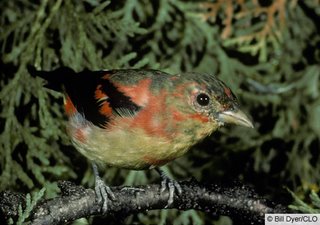
Scarlet Tanager / Photo by Bill Dyer (CLO)

With some birds, the molt may be so extreme that the bird will become bald for a short period of time. This seems to affect cardinals and blue jays most often, but other species will become bald occasionally. As with juveniles, the key is to focus on structural points and to consider the familiar possibilities first. Most of the time, a guess based on those criteria will be the correct one.

The following link is to a hunting website, but it has several waterfowl quizzes that might be of interest to you, including one on molting ducks. The photographs are worth a look.

None of the identification challenges presented here are insurmountable. Most birds that you see at this time of year can still be identified despite changing plumage and shifting populations. However, birding does require some more concentration and attention to detail now than at other times of year.

Crossposted at Blue Ridge Gazette.

Tuesday, August 15, 2006

Birds of the Mid-Atlantic #20: Yellowlegs

Fall migration is already upon us. In fact, it has been upon us for about a month now. Like spring migration, fall migration proceeds in a series of stages, with certain species or families dominating each stage. In contrast to spring migration, fall migration is less compressed, occurring over a period of about five months, as opposed to the three months of spring migration.

August is the time for shorebirds to move through the Mid-Atlantic region. The best way to experience shorebird migration is to visit one of the many large refuges along the Atlantic coast, as I did on Saturday. If you are stuck inland, there are still opportunities to see shorebirds as they pass through the area. (See, for example, this list of Maryland shorebird sites.) While species diversity is more limited, inland sites often provide an opportunity to study birds up close, without the need for a spotting scope. Shorebirds that commonly occur inland include the subjects of today's essay, greater and lesser yellowlegs.

Yellowlegs are the graceful counterparts to the many squat or chunky members of the sandpiper family. Unlike most other shorebirds, they have long yellow legs and elegantly-shaped head and neck. Their long legs allow them to wade out into deeper water where other shorebirds cannot go. There they hunt for insects and crustaceans, as well as an occasional small fish.

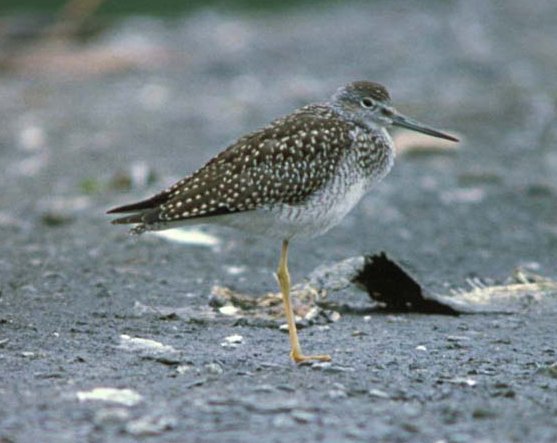
Greater Yellowlegs / Photo by USFWS

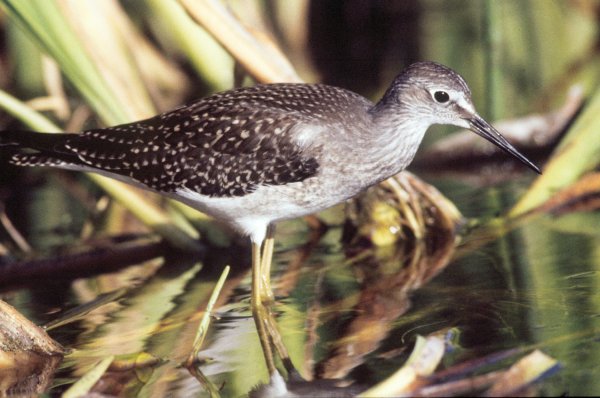
Greater and lesser yellowlegs have almost identical plumage, so a birder needs to pay attention to structural characteristics to make an identification. When the two species are next to each other, the size difference is apparent. On average, the greater yellowlegs is 3-4 inches larger than the lesser. With a single bird, or single-species flock, this is not so useful. Luckily, the bill can help answer the question. A lesser yellowlegs has a bill that is slightly longer than the head (minus the bill). Greater yellowlegs have bills that are 1.5-2 times longer than the head; their bills are also thicker and slightly upturned. Calls are another clue; the greater yellowlegs tends to give three-note calls (dew-dew-dew) while lesser yellowlegs whistle once or twice (tu-tu).

Lesser Yellowlegs / Photo by USFWS

Both yellowlegs species winter primarily in Central and South America. However, at least a few of each species winter in the southern United States and along the Atlantic coast.

To find shorebirds away from the coast, look for wet fields, pond and lake edges, and mudflats. Other common shorebirds that may occur at inland sites include killdeer, semipalmated plover, spotted sandpiper, solitary sandpiper, least sandpiper, semipalmated sandpiper, and western sandpiper. In Washington, DC, the best shorebird sites are the parks along the Anacostia River; nearby, there are good spots at Hunting Creek and Cameron Run in Virginia.

Crossposted at Blue Ridge Gazette.

Wednesday, August 09, 2006

Birds of the Mid-Atlantic #19: Eastern Kingbird

While some birds are known for their beautiful plumage or songs, others are known for their behavioral traits. One such bird is the eastern kingbird, whose prime behavioral characteristic is its aggressiveness. During the breeding season when pairs are establishing territories, this aggression will be directed against other kingbirds. Two males will engage in a flurry of posturing and calling (a call described as the sound of electrical wires being crossed). At other times it will be directed against other, larger, bird species and animals. I once observed a kingbird chase a crow across a river. The kingbird dove and pecked at the crow's back the entire way across. Hawks and other large birds perceived as threats have received the same treatment.

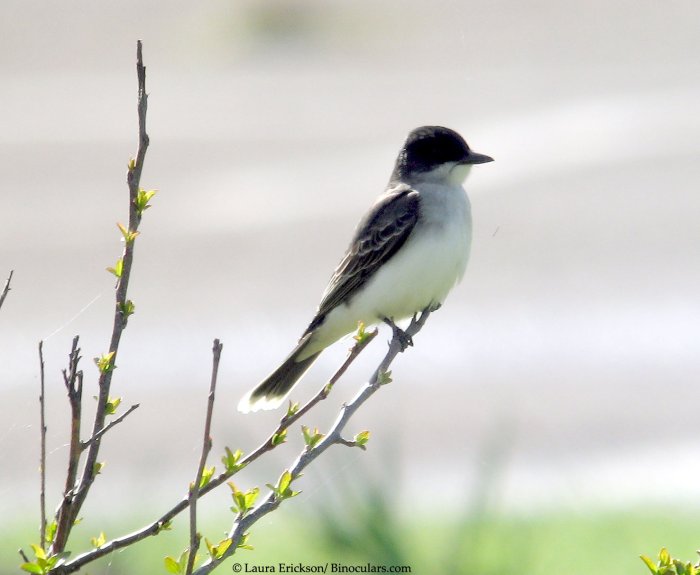
Eastern Kingbird / Photo by Laura Erickson

In comparison to other flycatchers, eastern kingbirds are larger, bulkier, have larger bills, and have more contrast between their black topsides and white undersides. The most prominent characteristic setting apart eastern kingbirds is the white band at the tip of the tail. This feature is easily noted even at a distance or in poor lighting. Kingbirds will sometimes flex this band in their territorial displays.

Kingbirds prefer open fields and grasslands. There they can sit out on a wire or branch and make sallies to catch insects. Yet these common birds can be found in less bucolic settings, even in urban areas. Kingbirds regularly spend the summer on the National Mall near the U.S. Capitol. One summer a pair nested in a tree on my downtown street, hardly ideal kingbird habitat!

When an eastern kingbird is sitting out in the open, it looks every part its name - kingbird in English and Tyrannus tyrannus in scientific terminology. The plumage is crisp and bold like a business suit while the bird's posture conveys that it is the boss of its territory. Attacks on other birds exhibit the bullying insinuated in its name. It is a common complaint of birders that some bird names mischaracterize the bird, but in the case of the kingbird, the name is apt.

Wednesday, August 02, 2006

Birds of the Mid-Atlantic #18: Ruby-throated Hummingbird

A characteristic bird of summer in the Mid-Atlanic region is the ruby-throated hummingbird. These unique birds are the smallest in eastern North America and have distinctively-shaped bodies. Though hard to spot, they are easy to identify because of their squat body shape and long, needle-like bills. Ruby-throated hummingbirds have iridescent green heads and backs with white breasts and bellies. Males have a red throat that females lack.

Ruby-throated hummingbird / Photo by USDA (via Wikimedia)

Hummingbird flight varies between fast and direct for forward flight and hovering at a near standstill for foraging. The flight of hummingbirds is so insect-like that many beginning birders and non-birders are surprised to learn that they are birds when they first see them. This insect-like flight is itself a useful field mark for identifying hummingbirds from other creatures. Look for something larger than an insect that flies like one.

Their flight is adapted for its foraging techniques, which center on two types of food. A hummingbird gains energy by drinking the nectar from flowers of various plants and trees. As a supplement, it may use a feeder if one is available. In either case, a hummer will hover and the food source and drink. Further nourishment is derived from catching small insects in midair. Sometimes one will see a hummingbird hover to glean insects and spiders from tree limbs.

Here is a video of some ruby-throated hummingbirds in action, mostly around a feeder. Both male and female are shown, with the frames slowed down to show wing action. It also includes a short clip of a sphinx moth, which may be confused with a hummingbird. The last shot of this video shows a characteristic feature of hummingbird plumage, namely its ability to change apparent color depending on the angle of the light. The head and throat feathers may at times appear black, only to flash red when hit directly by sunlight, as happens here. Here is a normal-speed video of feeding ruby-throated hummingbirds.

For most of the year, the ruby-throated hummingbird is the only hummingbird that is likely to be found in the Mid-Atlantic, or in eastern North America generally. It is our only breeding hummingbird. In the late fall and early winter, some western hummingbirds pass through this area and may even spend the winter if food is available. The most likely to appear is the rufous hummingbird. Other western hummingbirds that have been recorded in D.C. and Maryland include .... A few years ago, black-chinned and rufous hummingbirds at the Smithsonian Arts and Industries Building caused quite a stir among DC birders. Most western hummingbirds that winter along the east coast are immatures that took too much of an easterly route on their flight south, so identification of winter hummingbirds can be tricky.

You can attract hummingbirds to your yard with appropriate plantings and hummingbird feeders. Many types of flowers will attract hummingbirds, including salvia, cardinal flower, foxglove, jewelweed, and trumpet creeper. Plantings to attract hummingbirds will draw many butterfly species as well. A longer list of flowers is here.

Commercial feeders are available online and in nature stores. Fill these with a solution of one part sugar to four parts water. Clean feeders and refresh the solution regularly to prevent the spread of disease. Leave the feeders up in November and December if you would like to try to attract a migrating rufous hummingbird or other western species. For recommendations on maintaining feeders, see Hummingbirds.net and Rubythroat.org. For more information on winter hummingbirds, see Trochilids.com.

A hummingbird at a feeder or other food source may act aggressively towards other hummingbirds. For an example, see this video of two hummingbirds fighting over a single feeder. If you turn up the volume you can hear their chattering. For such small animals they are very feisty.

Thursday, July 27, 2006

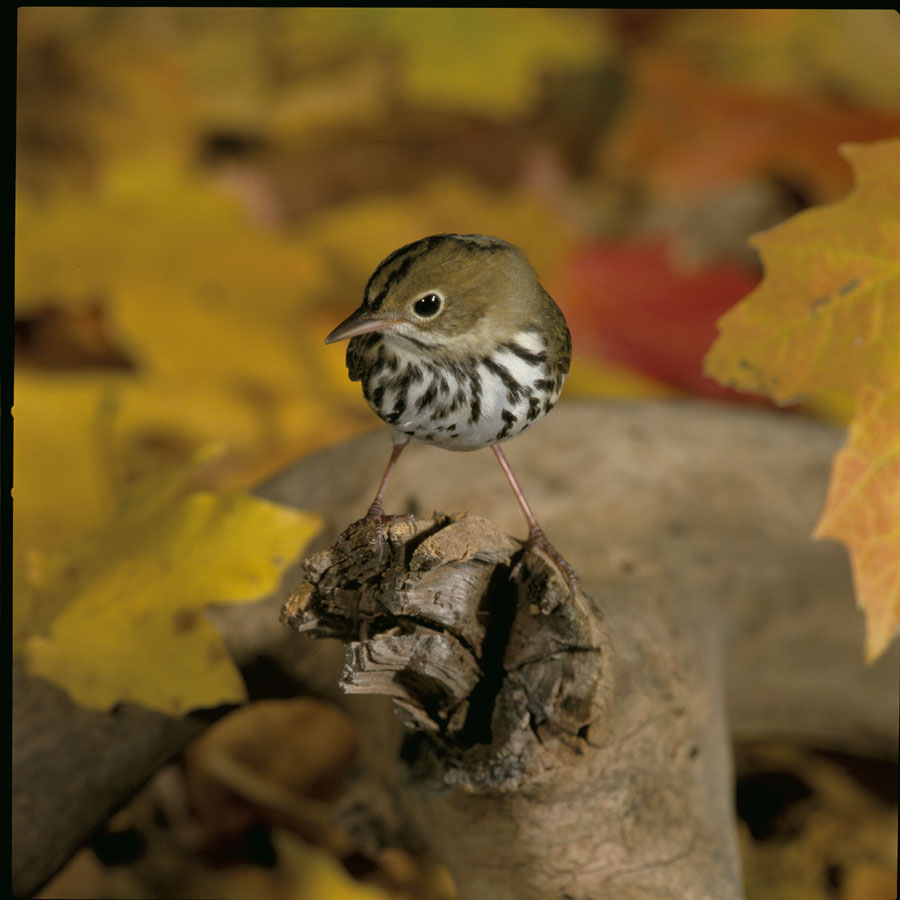
Birds of the Mid-Atlantic #17: Ovenbird

When we think of warblers, we tend to think of small, brightly-colored birds like the Yellow Warbler or American Redstart. Even most of the drab warblers have some sign of bright yellow or green about them. Yet there are some warblers that are almost all brown, almost looking like thrushes. Several of these are in the genus Seiurus: Louisiana Waterthrush, Northern Waterthrush, and Ovenbird. For today's post, by subject will be the last of these.

I saw my first ovenbird a little more than two years ago, during my first real spring migration. I was walking the trail from the Nature Center down to the picnic areas when I heard a loud, two-syllable song coming from the left side of the trail - teacher! teacher! teacher!. At the time I was just starting to learn bird songs, and I recognized this as a possible ovenbird song. Knowing that ovenbirds tend to forage on the ground, I searched for it there. Well, my search of the ground turned up no ovenbird. As I was going to leave in frustration, some movement caught my eye, and I spotted a small, brown bird perched on a bare branch at about eye-level.

Ovenbird / Photo by Steve Maslowski (USFWS)

Sure enough, it matched my ovenbird illustrations: brown back, white breast spotted with brown, big white eye-ring, and orange crown. (This last is the "aurocapillus" of its species name.) The eye-ring and lack of white eyebrows will distinguish an ovenbird from both waterthrushes. Having played hard-to-get, it then obliged with several renditions of its song while I watched through my binoculars at reasonably close range. (Slow movement and standing perfectly still has its benefits.)

Ovenbirds are fairly common in the Mid-Atlantic from the middle of spring through early fall. In Maryland they have been found breeding in all counties and geological provinces. Their nest is a small "oven" of twigs and leaves built on the ground. (See nest illustrations here and here.) While widespread, the ovenbird is confined to forests with sufficient understory to hide a nest. Forest size is important as well, since ovenbirds prefer larger tracts where they are less likely to fall victim to brown-headed cowbirds and various nest predators.

I will leave with the thoughts of Robert Frost, who wrote a poem on The Oven Bird:

THERE is a singer everyone has heard,
Loud, a mid-summer and a mid-wood bird,
Who makes the solid tree trunks sound again.
He says that leaves are old and that for flowers
Mid-summer is to spring as one to ten. 5
He says the early petal-fall is past
When pear and cherry bloom went down in showers
On sunny days a moment overcast;
And comes that other fall we name the fall.
He says the highway dust is over all. 10
The bird would cease and be as other birds
But that he knows in singing not to sing.
The question that he frames in all but words
Is what to make of a diminished thing.

(Thanks to NY State Bird Songs for the link.)

Note: Ovenbirds in North America are wood warblers. They are not related to the ovenbird family of Central and South America.

Crossposted at A DC Birding Blog and Blue Ridge Gazette.

Tuesday, July 18, 2006

Birds of the Mid-Atlantic #16: Indigo Bunting

As the summer enters its peak season, bird-watching becomes a matter of endurance. The temperatures are high (close to 100°F in Washington this week), humidity is high, and cool breezes are rare events. Biting insects and ticks are a constant nuisance. Most birds have reduced their singing and hunker down out of the heat. It is enough to make a birder want to stay indoors and long for late September.

Even so, there are a few birds that stay active through the middle of summer. These species help keep our parks lively and our birding interesting during the typical midsummer lull. One such bird is the lovely indigo bunting.

Indigo Bunting / Photo by Dave Menke (USFWS)

To find your own indigo bunting, listen around meadows and field edges for a prominent song with doubled phrases, like this. (The song is sometimes represented by a mnemonic as follows: Fire, fire! Where, where? Here, Here! Put-it-out, put-it-out!) Typically the singer will be perched on top of a tall shrub. The blue feathers will shine boldly in direct sunlight, but may appear subdued when backlit or on cloudy days.

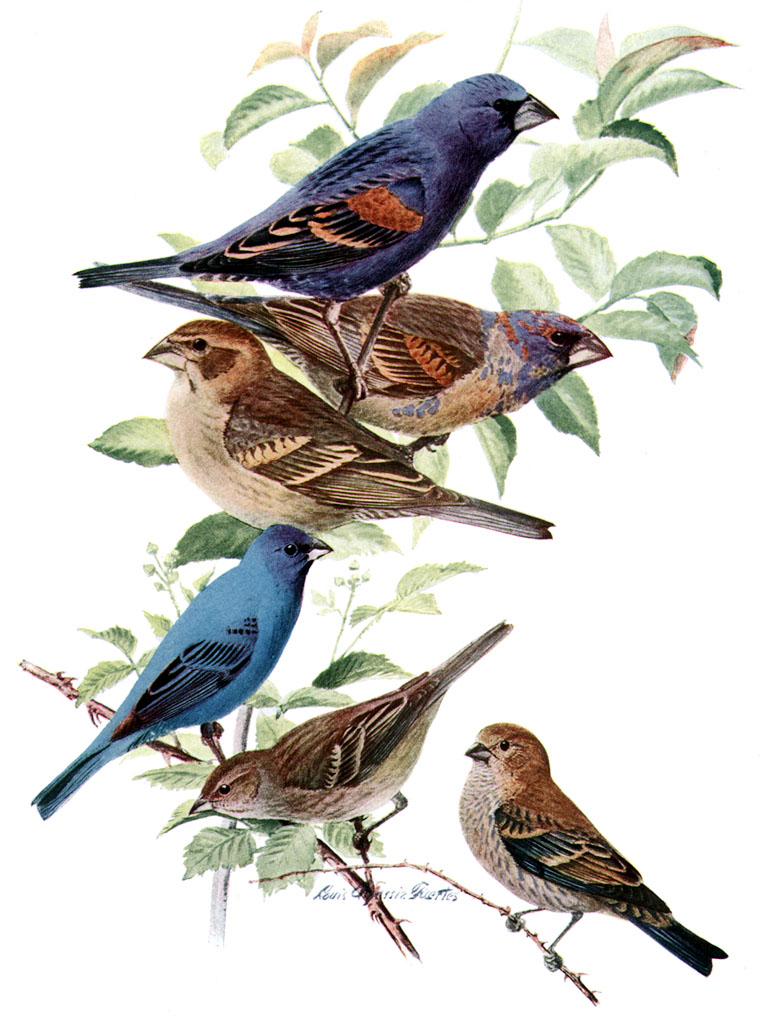
Indigo buntings are intensely blue and black. The blue is so bright and so intense as look almost artificial, as if the bunting were a midsummer Christmas ornament. The only bird that one might mistake for a male indigo bunting is a male blue grosbeak. The latter tends to be a darker, richer blue and has chestnut-brown epaulettes. In bad lighting, the heavier bill of the grosbeak should distinguish the two.

Blue Grosbeaks (top) and Indigo Buntings (bottom) / Painting by Louis Agassiz Fuertes (via WikiMedia)

Blue grosbeaks share similar habitat preferences with indigo buntings. Both birds prefer fields in the early stages of succession. In Maryland, blue grosbeaks are somewhat more likely to be found on the coastal plain or piedmont; blue finch-like birds in the western mountains are more likely to be indigo buntings.

If you plan to be out birding this week, make sure to bring along an extra supply of water and protect your skin from the sun. Heat exhaustion is a real threat during weather like this, even during light and moderate exercise. See the CDC's tips on preventing heat illness.

Crossposted at Blue Ridge Gazette.

Tuesday, July 04, 2006

Birds of the Mid-Atlantic #15: Bald Eagle

Our national symbol evokes different reactions in different observers. A bald eagle in flight shows grace and power. On the ground, it appears more clumsy, much like other large raptors. Despite its powerful appearance and hunting prowess, in many cases eagles prefer to scavenge or bully smaller hawks such as osprey into giving up their prey. (These habits led Benjamin Franklin to describe it as "a bird of bad moral character.")

Adult Bald Eagle / Photo by Steve Hillebrand (USFWS)

Still, the bald eagle makes for an appropriate national symbol. Because of their large size and charisma, eagles command the attention even of non-birders. One of the most popular bird topics in the DC area this year has been the plight of the Wilson Bridge eagles, who lost their hatchlings because the mother was injured in a fight. (See my posts on the subject here, here, here, here, here, and here.) New York has its red-tailed hawks, but DC has its Beltway eagles.

Bald Eagles Per Party Hour on Christmas Bird Counts, 1950-2004

Bald eagles almost disappeared a half-century ago because of human pressures, primarily from the use of DDT. The latter pesticide weakens the eggs of birds so that few eggs hatch; it had a greater effect on raptors because toxins concentrate in higher amounts as they move up the food chain. Thanks to the banning of DDT and the preservation of habitat, the eagle population has recovered. Eagles are now quite common along large bodies of water in the mid-Atlantic region, especially in winter.

Immature Bald Eagle / Photo by Harrison (USFWS)

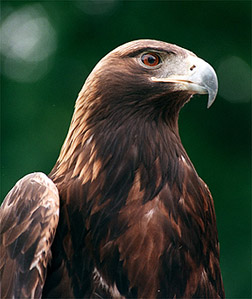
Young bald eagles are sometimes mistaken for golden eagles. The best way to tell the two species of eagles apart is by the amount of white. As you can see in the image above, the plumage of young bald eagles is flecked with white, all over the body and the wings. The amount of white differs depending on an individual's age; the key to note is that the white is widespread. Adult golden eagles will be completely brown, without any white. Young golden eagles will have distinct white patches near the tips of the wings and a distinct white band on the tail; other than those two features, the bird will be entirely brown. See the photograph below for an example of an adult golden eagle.

Golden Eagle / Photo by Illinois Raptor Center via Wikipedia

Another mistake that frequently occurs, not so much by birders as by entertainers, is the confusion of a red-tailed hawk's call with that of an eagle. Red-tailed hawks evoke feelings of wildness and fierceness when they scream. A bald eagle's high-pitched call sounds more harsh and whiny. It ill-befits such a majestic-looking bird. Watch for this in movies and television programs; red-tailed hawk calls are often attributed to almost any raptor, but especially to eagles.

Happy Fourth, everyone!

Cross-posted at A DC Birding Blog and Blue Ridge Gazette.

Tuesday, June 27, 2006

Birds of the Mid-Atlantic #14: Veery

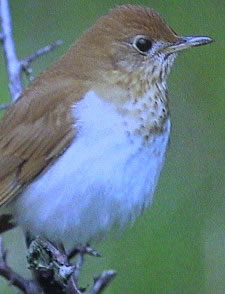
Deep in the woods of the mid-Atlantic Piedmont and the forests of the Appalachians, one may find a veery, a member of the thrush family. Slightly smaller than a robin, the veery has a rufous-brown back, white belly, and light rufous spotting at the top of the breast. In the dark, moist understory preferred by this species, individuals can be hard to spot. A veery will scurry along the forest floor from one inconspicuous place to another, all the while keeping a close eye on passers-by. Luckily, sight is not the only way to enjoy this species.

At right: Veery / Photo by NPS via Wikimedia

Despite its plain appearance, the veery is a prodigious songster. In fact, it sings my favorite bird song. The notes are resonant and cascade downward in a long stream. Even over cheap computer speakers, the song is beautiful; in a forest, the song has a wild and unearthly quality. Like other thrush songs, the veery's song is well suited to reproduction in standard musical notation. Here is one attempt to transcribe veery songs. While the instrumental version can match the pitch and rhythm of the song, it cannot match the beauty of the veery's performance.

Apparently I am not alone in my liking for the veery's song. Here is The Veery, a poem by Henry Van Dyke (text courtesy of Bartleby.com):

THE MOONBEAMS over Arno’s vale in silver flood were pouring,
When first I heard the nightingale a long-lost love deploring.
So passionate, so full of pain, it sounded strange and eerie;
I longed to hear a simpler strain,—the wood-notes of the veery.

The laverock sings a bonny lay above the Scottish heather; 5
It sprinkles down from far away like light and love together;
He drops the golden notes to greet his brooding mate, his dearie;
I only know one song more sweet,—the vespers of the veery.

In English gardens, green and bright and full of fruity treasure,
I heard the blackbird with delight repeat his merry measure: 10
The ballad was a pleasant one, the tune was loud and cheery,
And yet, with every setting sun, I listened for the veery.

But far away, and far away, the tawny thrush is singing;
New England woods, at close of day, with that clear chant are ringing:
And when my light of life is low, and heart and flesh are weary, 15
I fain would hear, before I go, the wood-notes of the veery.

The nightengale, laverock (sky lark), and blackbird are all European birds whose songs were celebrated by British poets. We have The Blackbird by Alfred Lord Tennyson, The Lover's Morning Salute to his Mistress by Robert Burns, and Ode to a Nightengale by John Keats. (One can certainly find more examples for each bird.) As the poet suggests, the veery deserves its place alongside these renowned songsters.

Links for recordings of veeries:
If you want to look for breeding veeries in Washington, DC, check in Rock Creek Park and Archbold-Glover Park. In migration, veeries may appear at either of those sites or at the National Arboretum. In the Blue Ridge, check the forests at higher elevations of the Blue Ridge Parkway.

Cross-posted at Blue Ridge Gazette and A DC Birding Blog.

Tags:

Tuesday, June 20, 2006

Birds of the Mid-Atlantic #13: Golden-winged Warbler

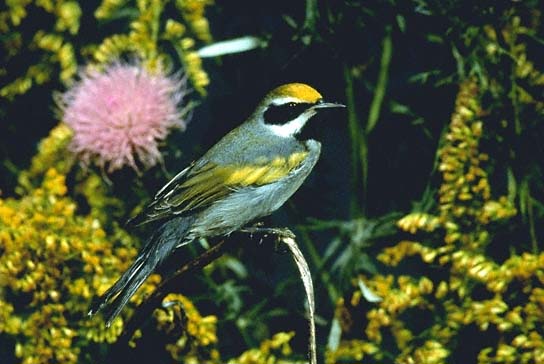
In the Birds of the Mid-Atlantic series so far I have covered only birds that I have seen myself. One eastern bird that I have not seen but would very much like to see is the golden-winged warbler. Golden-winged warblers breed in a wide band across the upper midwest and southern Canada (see BBS map). In the mid-Atlantic region, one is most likely to find them breeding in the middle and higher elevations of the ridge and valley province. During spring and fall migration the birds may be seen over a much wider area.

Males have a bold black and white facial pattern with a yellow cap and yellow wing coverts. Females have the yellow coverts but without as bold of a facial pattern. Golden-winged warblers behave much like chickadees, as they forage energetically and occasionally hang upside-down. The golden-winged song resembles that of the blue-winged warbler, but with a repeated second syllable.

Golden-winged Warbler / Photo by Ron Austing (NPS)

Like cerulean warblers, golden-winged warblers are in steep decline, enough to get the species red-listed on the Audubon Watch List. The causes for this warbler's decline are similar to those of other eastern songbirds, with habitat loss leading the list. Golden-winged warblers favor early successional habitats, which are associated with human disturbance such as old fields and power line cuts. As old fields grow into mature woodland, the lost habitats are often not being replaced by new old fields due to land use changes.

Some of the decline is attributable to other bird species. Birds nesting in edge and early successional habitats are especially vulnerable to brown-headed cowbirds, and the golden-winged warbler is no exception: about 30% of this species's nests receive cowbird eggs. Hybridization and competition with blue-winged warblers (yellow-listed on the Audubon Watch List) may also contribute. Blue-winged warblers are steadily invading the golden-winged's former range. Where the two species overlap, hybrids are common. A first-generation hybrid (i.e., blue-winged X golden-winged) is known as a Brewster's warbler; second generation backcrosses result in the Lawrence's warbler, which is much rarer. As blue-winged warblers enter the territories of golden-winged warblers, the latter slowly are pushed further north.

How can birders help? One way is to report sightings and participate in research programs that will guide conservation efforts. The Cornell Lab of Ornithology is conducting a multi-year Golden-winged Warbler Atlas Project to determine the breeding distribution and habitat requirements for the species. This year's project is drawing to a close, but the opportunity to participate will probably be open again in future years. Many local bird clubs, ornithological societies, and government agencies may also be able to use sighting information. (West Virginia, for example, asks for reports.) If you have seen either blue-winged or golden-winged warblers outside of the United States and Canada, you can send this information to the Alianza Alas Doradas.

Crossposted at the Blue Ridge Gazette.

Sunday, June 11, 2006

Birds of the Mid-Atlantic #12: Black-crowned Night-heron

So far in this series I have mostly written about diurnal birds - those that can be seen during the day. Most North American birds are in fact diurnal species, since birds tend to encounter the world through sight and sound, much like humans. But aside from the diurnal species there is a world of crepuscular and nocturnal birds, some of which are rarely encountered, and others that are more often seen than heard.

Two such species are the night-herons - the yellow-crowned night-heron and the black-crowned night-heron. These two species emerge in the evening as shadows lengthen and return to their roosting spots at sunrise, after a full night of hunting fish and invertebrates. Since night-herons are colonial breeders, the best bet for seeing them during the day is to visit a known nesting or roosting site.

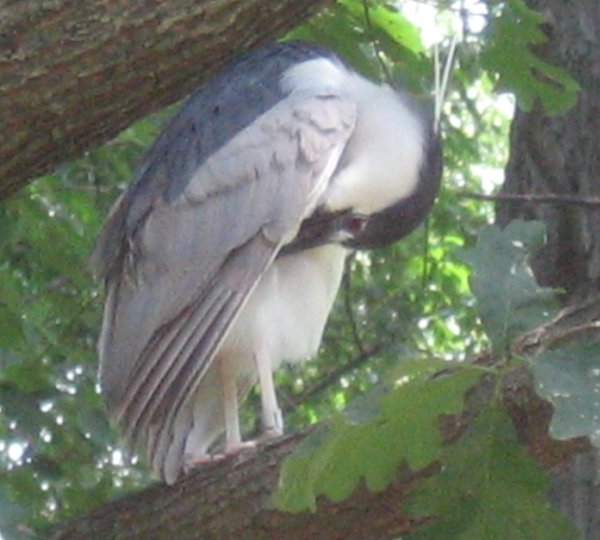
One local spot where seeing black-crowned night-herons is virtually guaranteed (in the proper season) is the National Zoo in Washington, DC. A colony has been nesting over the outdoor flight cages near the bird house for several decades. At this time of year, one can see adults like the above bird perched in the trees around the bird house. Later in the summer, once this year's chicks fledge, immature night-herons will frequently patrol the duck ponds, and do not flee closely-approaching humans. Yes, these are wild birds, despite their nesting location and despite their tameness.

If you enlarge the photograph and look closely, you can see that this individual has been banded. These two photographs show the key identification points for adult black-crowned night-herons. Night-herons have a stocky, hunched appearance, even when not preening, and have a thick, heavy bill. Adult black-crowned night-herons have an obvious black crown, as well as a black back. (Note that the yellow crown of yellow-crowned night-herons is not always apparent.) Like great blue herons, black-crowned night-herons sport long breeding plumes at the backs of their heads.

While black-crowned night-herons are widespread across North America, they are particular about their habitats, and in particular they much prefer the lower elevations of the coastal plain and prairies to mountain ranges.

This entry is crossposted in Blue Ridge Gazette. Images are by the author.

Tuesday, May 23, 2006

Birds of the Mid-Atlantic #11: Bobolink

A flock of small dark birds suddenly rises out of a field with a chirping, bubbling call. Just as quickly, the flock settles back down in a different part of the field. What were they?

In my city of Washington, DC, a flock matching this description is most likely to be starlings, or perhaps one of the common species from the blackbird family. At this time of year, however, it is good to check such a flock for bobolinks. This species now occurs in DC only during migration. In the ridge and valley province of western Maryland and Virginia, bobolinks breed in hay fields.

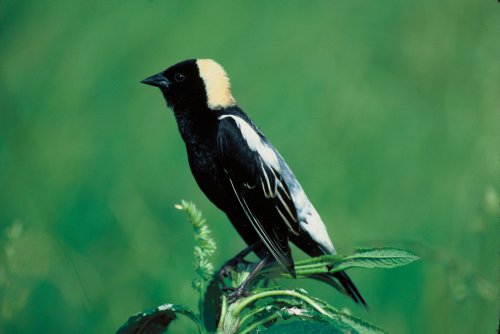
Bobolinks are members of the icterids, the diverse family that includes blackbirds and grackles, meadowlarks, and orioles. A male bobolink is mostly black, but has a cream-colored patch on the back of its head, a large white rump, and broad white stripes where its wings meet its body (i.e., white scapulars). Females are sparrow-like in coloration, with dark brown wings, buffy bodies, and dark brown cap and eyestripe.

Bobolink / Photo by S. Maslowski (USFWS)

The distinctive appearance of this species has given rise to colorful nicknames. "Butter-bird" and "skunk blackbird" came about because of the white and cream-colored patches on its back and head. The appellation "ricebird" notes bobolinks' affection for grassy meadows and wild rice patches.

Since bobolinks spend much of their time foraging on the ground, one needs to be ready to spot them in flight. Luckily, several factors make this easier, if you know to look for them. Bobolinks are a highly social species, and travel in flocks, like cedar waxwings and some blackbirds. Such a flock is itself a clue that bobolinks may be present. In flight, the contrast in coloration between males and females is quite striking; look for flocks that include both black and light brown birds. The white patches on the otherwise black makes stand out quite readily if you see the birds from the side or rear. In addition, the song of the bobolink, frequently is helpful if you recognize it. Unfortunately I do not, but you can listen to samples here and here, as well as at the CLO site.

Like other grassland species, bobolinks have declined due to loss of habitat. This can be attributed to changes in agricultural practices, development of former farmland into suburban housing, and former fields being overtaken by woody vegetation. One solution that individual farmers can implement is to delay summer mowing from June until late July, after most nestlings have fledged. Such action would benefit not only bobolinks, but also other grassland species such as grasshopper sparrows and eastern meadowlarks. Grasslands managed for bobolinks should be mowed or burned at least every two years to reduce woody plants.

Tags:

Thursday, May 18, 2006

Birds of the Mid-Atlantic #10: Prothonotary Warbler

Spring migration brings many beautiful birds into our region, but none are as emblematic of the changing seasons as the wood warblers. Among the wood warblers there are few as boldly colored and as striking as the Prothonotary Warbler.

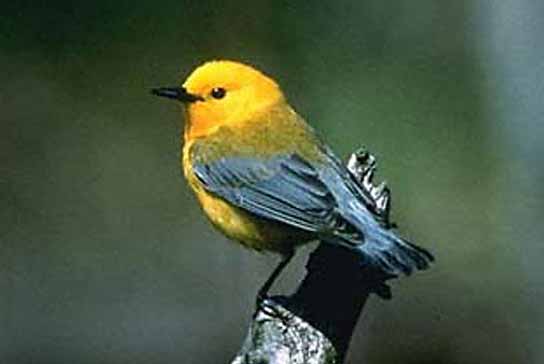
A prothonotary warbler is bright yellow, with the yellow appearing to intensify around its head almost to the point of becoming orange. It is a bird of contrasts. Its jet black eye and bill appear ready to pop off as if they do not belong on such a bright head. Their song is also distinctive in its simplicity: a loud single note repeated about five or six times per phrase. Sweet! Sweet! Sweet! Sweet! Sweet! Sweet! (Examples: here and here) Prothonotary warblers are not subtle, either by sight or sound.

Prothonotary Warbler / Photo by Harold Lindstrom (NPS)

Unlike most other warblers, prothonotaries build their nests in cavities rather than hanging a small cup nest from a branch. They may use natural cavities or nest boxes; many times they take over cavities previously used by chickadees since the two species have similar space needs. Prothonotaries show a strong preference for cavities directly over water. The two requirements limit these warblers to flooded bottomland forests. Despite the habitat limitations, their population appears to be stable, and may even be expanding northward.

This warbler's name derives from a title for papal officials in the Roman Catholic Church, protonotarius apostolicus. Like the name for the Northern Cardinal, also derived from an ecclesiastical title, this name was probably first applied by French settlers in Louisiana. A protonotarius is responsible for registering official acts and canonizations. The connection with the warbler is that protonotarii may wear golden yellow ceremonial vestments. (A sixteenth-century portrait of a protonotarius is here; I cannot quite tell whether he is dressed in yellow or red.) Some U.S. states, such as Pennsylvania, retain the title "prothonotary" to designate clerks in the civil court system.

Crossposted at the Blue Ridge Gazette.

Tuesday, May 09, 2006

Birds of the Mid-Atlantic #9: Cerulean Warbler

A few days ago, I finally saw a bird that had eluded me for several years, the cerulean warbler. (I have an account of the encounter here.) For BRG readers who may be unfamiliar with my blogging history, the cerulean warbler has been both the mascot of my blog and my principal nemesis bird. Even though it passes regularly through the DC area every spring, and even though I bird regularly in places where it appears, I had never seen one before last Sunday.

The Latin word caeruleus, from which the species's English and scientific names are derived, is related to the Latin caelum, or "sky." It means sky-blue - not a light blue, but deep blue like the midday sky. It is an appropriate name for this little bird, which is brilliant blue on its head and back and white underneath, with a blue "necklace" and blue stripes on its sides. (Females are more of an aqua-green color.) Despite its sharp colors, this bird defies any observer who tries to see it. Cerulean warblers forage and nest near the very tops of trees; searching them out will induce the malady known as "warbler neck."

Cerulean Warbler / Photo by Brian Small (NPS)

Fortunately for us, cerulean warblers have a distinctive song: 3-5 notes on a single pitch followed by a rising buzzy trill. It can be distinguished from the northern parula because the parula's song rises in a continuous trill and then falls over the top, without introductory notes on an even pitch. The blackburnian warbler's song has a similar rhythm but is much higher pitched without the buzziness. Its ending note is almost at the limit of human hearing. The song of the black-throated blue-warbler has a lazier pace and is a thinner-sounding buzz than the cerulean's.

Cerulean warblers have undergone two demographic shifts since the species was first discovered. Prior to the twentieth century, the species was rare as a breeder east of the Appalachians. Over the last century, the species has expanded its range steadily into the Mid-Atlantic and Northeast. In Maryland, the breeding population is concentrated in the mountainous western counties and somewhat less common in the central Piedmont region.

The other shift has been a steep decline in numbers. Cerulean warblers have endured one of the steepest declines among North American birds, a loss of close to 80% of the population between 1966 and 2003. It has landed on the Audubon Watchlist as a result. So far, attempts to have it listed as an endangered or threatened species have been unsuccessful because of federal inaction.

As with many other species, the cause of the cerulean warbler's decline is habitat loss and degradation. Cerulean warblers require large tracts of mature forests in order to breed. Such tracts are becoming harder to find due to logging and development. In the Appalachians, cerulean warblers face a threat from mountaintop removal mining. The species also faces pressures on its wintering grounds in northern South America, where deforestation for agricultural uses has become common. (A Colombian reserve was recently founded to address this problem.)

Even in some places where otherwise suitable habitat exists, cerulean warblers have disappeared because of the lack of an understory due to overbrowsing by white-tailed deer. A study by the USFWS in Pennsylvania found that ceruleans disappeared when the deer population rose about 20 per square mile. In many areas of the eastern United States, the population is far higher than that.

It is hard to be optimistic about this species's outlook. While cerulean warblers are not about to go extinct in the near future, decline is likely to continue without serious conservation measures. Such measures face many political and financial roadblocks and may be difficult to achieve in the current climate.

While we seek for the causes and solutions for the decline of the cerulean warbler and other eastern songbirds, we need to enjoy the birds while we have them. When I heard and saw cerulean warblers last Sunday, I was not thinking about their problems. I was thinking about what a beautiful bird it was and how happy I was to be seeing it, finally.