Visit Bug Girl's post on the new bee research to learn more about the problem with neonicotinoid pesticides.

 Posts
All Comments
Posts
All Comments
 Pacific Black Duck / Photo by interllectual
DEC Pollution Response Unit environmental hazards manager Ken Raine said birds were seen frothing at the mouth and staggering around at the tip yesterday before scores of dead birds were discovered within a kilometre radius of the landfill site.The DEC's investigators are now blaming the deaths on a pesticide, Fenthion, but have not determined who dumped it at the landfill or why.
By today the body count had climbed to more than 200 with ibis, silver gulls, pacific black ducks, a raven and a pelican among the dead....
Some seriously ill birds have also been found among the bodies and are being monitored in a bid to determine the cause of the mass deaths.
DEC pollution response manager Ken Raine said samples had been taken from waterways to check for contamination and the rubbish tip had been covered with sand while investigations were continuing.A year ago, about 200 gulls died near the same location from an unknown cause. In 2007, lead poisoning killed about 4,000 birds in Esperance on Australia's southern coast.
Fenthion is a broad-spectrum organophosphorus insecticide used to control horticultural pests such as fruit fly and aphids as well as mosquitoes and other insects.
It is an active ingredient in a number of products sold at hardware stores, including fly baits and fruit fly sprays. It was not known yesterday how much poison would have been needed to cause so many deaths.
A DEC spokeswoman said if the birds were deliberately poisoned it was an offence under the Wildlife Conservation Act, with fines of up to $4000 for each bird species affected. Illegal dumping of pesticides was covered by the Environmental Protection Act.
This week the EPA announced its final ban on carbofuran residue in foods, to take effect by December.
The Environmental Protection Agency has revoked regulations that permitted small residues of the pesticide carbofuran in food. Carbofuran is a toxic insecticide that does not meet current U.S. food safety standards. EPA’s action will eliminate residues of carbofuran in food, including all imports, in a move to protect people, especially children, from dietary risk. Ultimately, EPA will remove this pesticide from the market.Carbofuran is a highly-toxic pesticide that has been implicated in deaths of many songbirds as well as human health problems. There is background information on the issue here, here, here, and here.
EPA is proceeding to cancel the remaining carbofuran registrations, or licenses, which will address risks to pesticide applicators and birds in treated fields. In 2006, EPA identified significant dietary, ecological and worker risks from the use of carbofuran and concluded that all uses must be cancelled. While FMC Corporation voluntarily withdrew 22 uses of this pesticide, it was insufficient for the agency to conclude that dietary exposures to carbofuran are safe.
The final carbofuran tolerance rule becomes effective in December. EPA is encouraging growers to switch to safer pesticides or other environmentally preferable pest control strategies.
This might interest readers in Washington, DC:
Rachel Carson's Silent Spring, published in 1962, inspired our
nation's most comprehensive legislative protections of the natural
world. Now, her story reaches the big screen. Join The D.C.
Environmental Film Festival, Sense of Wonder Productions, and the
National Women's History Project as we celebrate the release of the
new Rachel Carson film, A Sense of Wonder, in a one-night-only special
screening at The Smithsonian's National Portrait Gallery.
Washington, D.C.
March 18, 2009 at 7:00 pm
Free!
The National Portrait Gallery
Donald W. Reynolds Center for America Art and Portraiture, Nan Tucker
McEvoy Auditorium
Eighth & F Streets, NW (Link to Map)
http://www.dcenvironmentalfilmfest.org/films.php?FilmID=225
Appearances by Actress Kaiulani Lee and Special Guests!
For more information, visit www.asenseofwonderfilm.com
About the Film:
When pioneering environmentalist Rachel Carson published Silent Spring
in 1962, the backlash from her critics thrust her into the center of a
political maelstrom. In A SENSE OF WONDER, actress Kaiulani Lee
embodies this extraordinary woman, portraying Carson in the final year
of her life. Intimate and poignant, this 55-minute, documentary-style
film is a reflection of Carson as she emerges as America's most
successful advocate for the natural world.
Back in 2006, the EPA decided against renewing the registration of carbofuran as a permitted pesticide for sale in the United States, on the grounds that its application threatened the health of farm workers and killed millions of wild birds. This week, the agency announced that it would no longer allow food to contain carbofuran residues, this time because it poses undue risk to the health of small children. The regulation applies to both domestic and imported produce. Since the chemical is already being phased out in U.S. agriculture, it will probably have a greater effect on imported food, especially rice, coffee, bananas, and sugar cane.
An EPA fact sheet includes the following among the ecological effects of carbofuran:
 The extent to which humans have managed to poison the planet is scary. In the latest case, the pesticide DDT has been found in Adélie penguins in Antarctica, a place where DDT was never sprayed.
A 1964 survey found modest amounts of the pesticide in Adélie penguins, and Geisz's team expected to see even less four decades later. Instead, her team found DDT levels unchanged in birds that live near the continent's western peninsula.The levels of DDT and DDE present in the Adélie penguins are too low to cause much harm. However, the findings indicate the presence of other harmful chemicals being released as the glaciers melt. The Arctic and Antarctic are visibly pristine landscapes, but the pollutants we release in warmer regions all migrate there eventually.
As DDT crawls up the food chain, from plankton to krill to penguins, it breaks down into a sister molecule called DDE. The more DDE in an animal, the longer the chemical has been around, Geisz says. But her team recorded low levels of DDE in the birds, suggesting a fresh source.
Geisz couldn't figure out where the DDT came from until she looked back at glacial records. In the 1950s and 60s, Antarctic glaciers swelled, potentially locking in chemicals like DDT.
However, average winter temperatures on the Antarctic Peninsula have warmed 6 °C the past 30 years, and glaciers now melt faster than they grow. A recent study noted elevated levels of DDT in glacial runoff.
As the continent's western ice sheet melts, the DDT drips back into the ecosystem at a rate of 1 to 4 kg per year, her team estimates.
 A couple weeks ago, I linked a story from Richmond, Virginia, in which a large flock of cedar waxwings became stuck in pigeon repellent. Many of them died on the scene; others died at a rehabilitation center. Recently, two more waxwings died, bringing the total deaths to about 60. (It is difficult to find an exact body count.) The remaining survivors are still in rehabilitation.
According to the Virginia state government, the repellent was "an EPA registered product ... used in accordance with the manufacturer's instructions." That does not mean that its use was wise or even legal. The repellent is not named in the news stories, but it is usually described as "a sticky substance." Sticky repellents have been known to cause problems in the past. (See the cases from Arizona and New York.) The Humane Society recommends that such repellents not be used for pigeon control:
Sticky substances (polybutenes) are sold to discourage pigeons and other birds from landing on treated surfaces and are often marketed as "humane." However, The HSUS does not recommend these products because they can adhere to and foul the feathers of pigeons who comes into contact with them, and are even more harmful to smaller species and various "non-target" birds.The Cornell Lab of Ornithology also warns against use of sticky repellents (in this case against woodpeckers):
Although some people recommend applying sticky repellents such as Tanglefoot Pest Control, Roost-No-More, and Bird Stop to areas where damage is occurring, we are against using them. These products can get on a bird’s plumage, impairing its ability to fly and stay warm.The incident may also be a violation of the Migratory Bird Treaty Act. Rock pigeons, of course, are not protected by the law because they are a nonnative species introduced by humans. However, cedar waxwings are protected; killing several dozen of them is an unauthorized take.
Occasionally proponents of renewed DDT use will claim that the pesticide, banned in the United States as an ecological hazard, has no harmful effect on humans. That is actually not true, as there is already evidence of a connection with reproductive problems. In addition to early miscarriages, it may also cause premature birth or decrease men's sperm quality.
A new study links exposure to DDT in early life with an increased chance of breast cancer.
The results are something of a surprise, researchers said, because several previous studies have found no link between cancer and the insecticide, which was widely used during the 1950s and '60s but was banned in the United States in 1972.There is some discussion of the report at Effect Measure.
The new work differs from all other studies, however, by focusing on the age at which women were exposed. Echoing the situation with some other breast cancer risks, such as radiation, it finds that DDT increases the risk of breast cancer in adulthood only if the exposure occurred at a young age, before the breasts were fully developed.
All told, girls who had the highest levels of the chemical in their blood during that crucial developmental period were five times more likely to get breast cancer years later than were girls who had the lowest levels. That fivefold increase is a bigger boost in risk than is now attributed to hormone replacement therapy or having a close relative with breast cancer.
Sunday is Rachel Carson's 100th birthday, and in honor of the occasion, Senator Ben Cardin (D-MD) planned to introduce a resolution to commemorate Carson and her work. However, Senator Tom Coburn (R-OK) has threatened to block the legislation. His office trotted out the familiar claim that Carson caused millions of deaths.
In a statement on his Web site yesterday, Coburn (R) confirmed that he is holding up the bill. In the statement, he blames Carson for using "junk science" to turn public opinion against chemicals, including DDT, that could prevent the spread of insect-borne diseases such as malaria, which is spread by mosquitoes.Coburn is also blocking a bill that would name a post office after Carson in her hometown.
Coburn, whose Web site says he is a doctor specializing in family medicine, obstetrics and allergies, said in the statement that 1 million to 2 million people die of malaria every year.
"Carson was the author of the now-debunked 'The Silent Spring,' " Coburn's statement reads. "This book was the catalyst in the deadly worldwide stigmatization against insecticides, especially DDT."
These are important problems and must be met. No responsible person contends that insect-borne disease should be ignored. The question that has now urgently presented itself is whether it is either wise or responsible to attack the problem by methods that are rapidly making it worse. The world has heard much of the triumphant war against disease through the control of insect vectors of infection, but it has heard little of the other side of the story - the defeats, the short-lived triumphs that now strongly support the alarming view that the insect enemy has been made actually stronger by our efforts. Even worse, we may have destroyed our very means of fighting.Rachel Carson should not be blamed for deaths from malaria.
A distinguished Canadian entomologist, Dr A. W. A. Brown, was engaged by the World Health Organization to make a comprehensive survey of the resistance problem. In the resulting monograph, published in 1958, Dr Brown has this to say: Barely a decade after the introduction of the potent synthetic insecticides in public health programmes, the main technical problem is the development of resistance to them by the insects they formerly controlled. In publishing his monograph, the World Health Organization warned that the vigorous offensive now being pursued against arthropod-borne diseases such as malaria, typhus fever, and plague risks a serious setback unless this new problem can be rapidly mastered. [quoted here]
On Tuesday I linked to a call for public petitions to ban carbofuran, a pesticide known to harm birds. Yesterday the EPA announced that its new recommendations would include not re-registering carbofuran, as well as tighter restrictions on other pesticides.
According to the EPA press release, what is being banned is not "most uses" but "all uses" of carbofuran.The study, which focused on more than 230 chemicals known as organophosphates and carbamates, could lead to the elimination of 3,200 uses and the modification in use of 1,200 others, like chlorpyrifos, diazinon and methyl parathion, which have been long been controversial for their role in causing illnesses.
Environmental groups applauded the recommendation to cancel most uses of carbofuran, a common insecticide used on corn, rice, tobacco and other crops that has had particularly deadly effects on birds.
“Removal of this pesticide will save tens of thousands of birds, including bald eagles, hawks and migratory songbirds,” said George Fenwick, president of the American Bird Conservancy. “Carbofuran’s toxicity to wildlife made it one of America’s most harmful licensed products.”
EPA is proposing to cancel all uses of the pesticide carbofuran and to revoke the associated tolerances (legal residue limits on food). The agency announced today its conclusion that there are considerable risks associated with carbofuran in food and drinking water, risks to pesticide applicators and risks to birds that are exposed in treated fields....In the current political climate, it is good to see steps forward like this one.
EPA is proposing to immediately cancel the majority of carbofuran uses. A four-year phase-out is being proposed for six, minor agricultural uses, which will provide time to find effective alternatives.
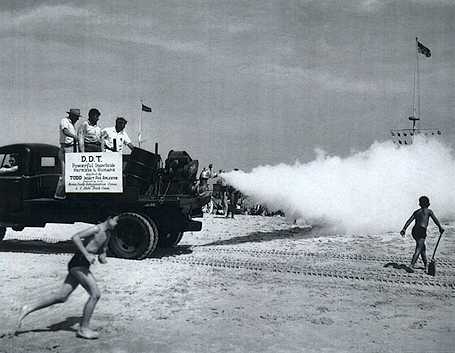 There is talk of reviving the pesticide DDT for use in preventing malaria in developing nations. It has been approved for such use by the U.S. Agency for International Development, and presumably the World Health Organization will do so as well. For now at least, DDT would be used for indoor spraying and not for agricultural use.
Very small amounts would be used to treat only house walls, so the probability of human and environmental contamination would be low.As the article notes, there is a danger that this could open the door to more widespread use if the pesticide is not carefully controlled.
Even small amounts of DDT deliver a lot of bang for the buck as an effective, cheaper, and longer-lasting pesticide, supporters say.
"For duration of activity there is no [competitive] chemical that even comes close to DDT, and of course the duration is a big factor in overall cost," Roberts, of Uniformed Services University, said....
"[Treating house walls] is a perimeter treatment," Roberts explained. "The people you're trying to protect are on the inside of the perimeter, so mosquitoes will come up to that wall, detect the DDT in the vapor phase, and move away from it," Roberts said.
The American Bird Conservancy is asking birders to petition the Environmental Protection Agency to remove the pesticide carbofuran from agricultural use. This pesticide is known to kill birds even in small quantities, and effective alternatives exist for most of its uses. To voice your support for the ban, do the following:
We ask you to email carbofuran@epa.gov, CCing gshire@abcbirds.org telling the EPA to ban carbofuran now because of its danger to birds, other wildlife, and people. Your email can be brief.... What is important is that you tell them in your own words that you do not want carbofuran to be used in the United States. Alternatives exist that are equally effective and not deadly to birds. There is no reason to keep carbofuran registered.See Birderblog.com for a fuller explanation of this issue.
Please send your email before 5pm Wednesday August 2, 2006!
Alternatively you can fax your comments to 202-564-0512.
Tags:Despite the agency’s insistence that pesticide regulations follow scientific guidelines, several agency scientists said industry determined how chemicals were regulated.
“It’s how the game is played,” said an E.P.A. specialist involved in the pesticide program who spoke on the condition of anonymity because, he said, critics within the agency often lose choice assignments.
“You go to a meeting, and word comes down that this is an important chemical, this is one we’ve got to save,” he said. “It’s all informal, of course. But it suggests that industry interests are governing the decisions of E.P.A. management. The pesticide program functions as a governmental cover for what is effectively a private industry licensing program.”
Another senior E.P.A. scientist who also spoke on condition of anonymity said the agency often ignored independent scientific studies that contradicted the industry-subsidized study that supported many regulations on pesticides.
She cited a North Carolina researcher who found that chlorpyrifos might have a more damaging effect on developing brains than other studies. “What we heard back from headquarters was, ‘No, he’s wrong,’ ” the scientist said.
“Chemicals like these can be harmful to children in ways we don’t understand yet,’’ the scientist said. “If there is disagreement, doesn’t that cry out for further research?”
Our national symbol evokes different reactions in different observers. A bald eagle in flight shows grace and power. On the ground, it appears more clumsy, much like other large raptors. Despite its powerful appearance and hunting prowess, in many cases eagles prefer to scavenge or bully smaller hawks such as osprey into giving up their prey. (These habits led Benjamin Franklin to describe it as "a bird of bad moral character.")
 Adult Bald Eagle / Photo by Steve Hillebrand (USFWS)
 Immature Bald Eagle / Photo by Harrison (USFWS)
Today, May 11, has been designated by the U.S. Senate as Endangered Species Day (pdf). The day comes at a time when the Endangered Species Act and the protections they afford may themselves be endangered by Congressional legislation weakening its provisions and by non-enforcement of its regulations in the executive branch. (Oddly enough, one co-sponsor of the Senate resolution has led efforts to weaken the ESA.) The National Audubon Society has some suggestions for activities to honor the occasion.
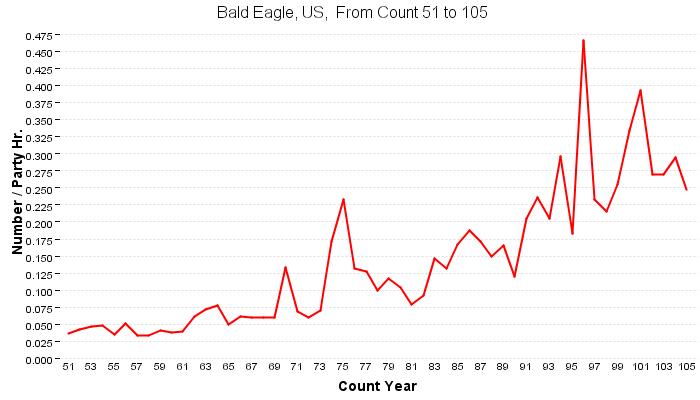
This is a day to celebrate the successes of endangered species recovery. Since this is a birding blog, I will highlight two bird species that have had tremendous success under the ESA. Bald eagles were down to 417 nesting pairs in the lower 48 states by 1963; now there are 7,066 known nesting pairs in the lower 48. The species was downgraded to "threatened" status in 1995, and may soon be removed from the list entirely. Peregrine falcons had an even more severe population crash in eastern states in the mid twentieth century and likewise have rebounded to the point that they are no longer on the endangered list. In both cases, the recovery was assisted by a combination of habitat preservation, captive breeding programs and nesting site monitoring, and addressing environmental causes for decline - in this case the widespread use of DDT.
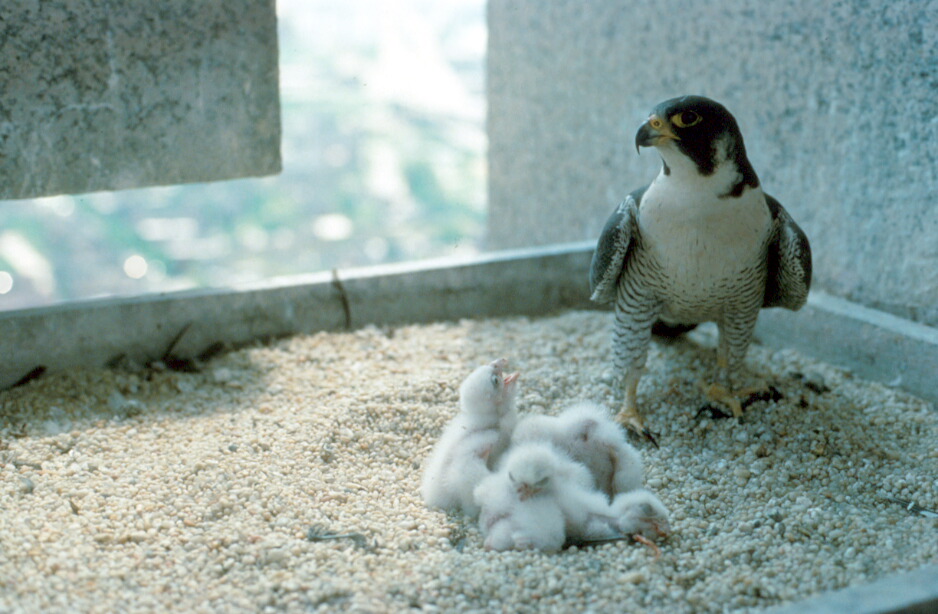 Peregrine Falcon With Chicks / Photo courtesy of USFWS
The red-shouldered hawk is a characteristic raptor of eastern woodlands. They get their name from the rufous coloration on the leading edge of their wings, which are otherwise checkered with black and white. The scientific name, Buteo lineatus, refers to the black and white striping on its tail.
 Red-shouldered Hawk / Photo by Lee Karney (USFWS)
Some Bird News
Over the past week, there have been a series of articles reporting a finding by biologists that certain toxic hotspots in the Arctic resulted from pollution carried in the feces of seabirds, especially northern fulmars. The pollutants left in fulmar nesting colonies include mercury and DDT. I had avoided blogging about this earlier because the report is rather depressing; even relatively wild areas are being fouled by our excesses. It is also a reminder of how pervasive pollutants are; just as the seabirds are carrying such dangerous chemicals within their systems, we too are carrying many contaminants within our own bodies.
The reason I decided to write about this story now is partly because of the hand-wringing over the ivory-bill controversy. Several people have opined that the challenge to the identification of the Arkansas woodpecker as an ivory-bill might be used as an excuse for anti-environmentalists to roll back species protection and specifically to remove some protections set in place for the areas where the putative ivory-bill was discovered. I share some of these worries. But I think that reports like this one about the fulmars represent a greater challenge to environmentalists because it appears to let humans off the hook. From this editorial it appears that those worries may be justified:
It's harder to understand the careless conclusion that the birds were in some way responsible for the contamination.Tom Anderson has noted a similar reaction when it comes to the effects of storms and other natural phenomena on endangered species around the Long Island Sound. In both cases, the real problem is not what the storms or birds are doing, it is what humans are doing to aggravate the situation.American papers tended toward the simple birds-are-to-blame angle, describing their function in terms such as "trafficking." An Irish journalist, unencumbered by logic, wrote that the findings "will come as a shock to the guilt-ridden who blame us humans for putting the planet in jeopardy by damaging the polar environment. Though long condemned, as a matter of course, for the fouling of the Arctic, we have been found not guilty."
Amazing. As if the birds were synthesizing PCBs in their gizzards, or going out of their way to forage on foods rich in DDT.