Showing posts with label Hummingbirds. Show all posts

Monday, August 18, 2008

Winter Hummingbird Banding

The Louisiana Ornithological Society just released its annual report on winter hummingbird banding within their state. The report covers the 2007-2008 winter season. Hummingbirds were banded, and their crowns were marked with colored paper so that observers could identify individuals. There was frequent turnover over the course of the winter, which necessitated return trips to document new individual hummingbirds.

One interesting result is that 19% of the hummingbirds were returning to the same location where they were previously banded. That was especially notable among rufous hummingbirds, 38% of which were returnees.

Saturday, July 12, 2008

Are Hummingbirds in Decline This Year?

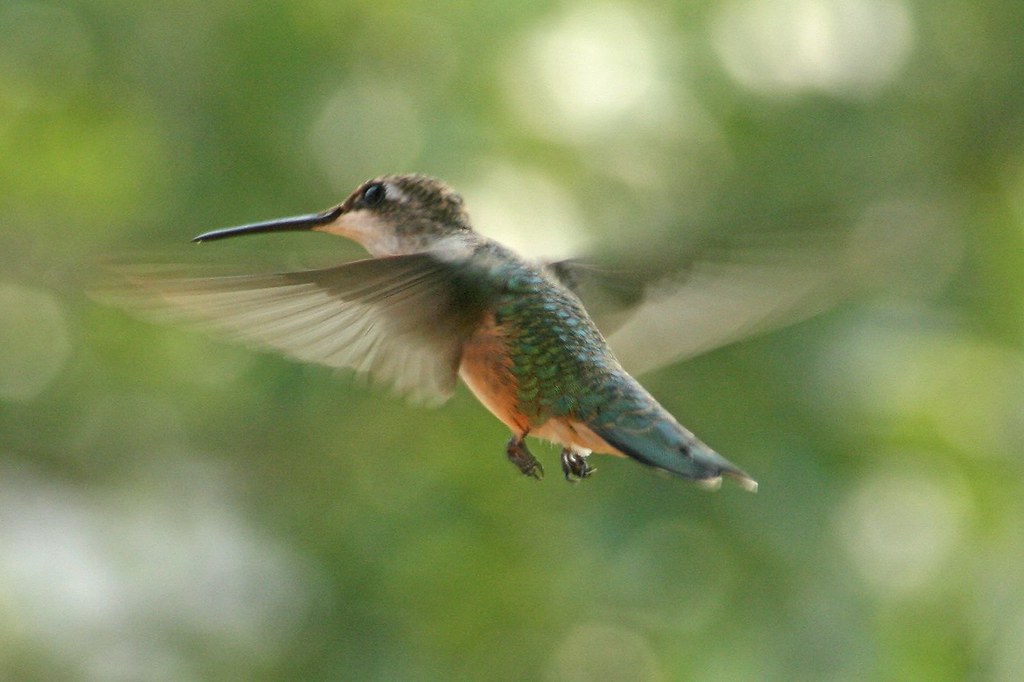
Airborne originally uploaded by c-eight

A couple days ago, Birdchick posted an email she received that asked about the status of ruby-throated hummingbirds. Apparently a lot of people have noticed declines in the number of ruby-throated hummingbirds coming to their feeders. I have received queries about this myself, both last year and this year, and it has been a frequent topic on discussion boards and email lists that deal with hummingbirds. The discussion that I have seen so far, though, has been mostly anecdotal; I would prefer to see it backed up with some data.

One easily-accessible source of distribution information is eBird, which allows users to break down sightings for a species by year. I downloaded the line graph data for ruby-throated hummingbirds during breeding seasons from 2004-2008 and created my own line graphs with Google Docs. The data covers the entire United States. (I would have liked to use a smaller area, but I could either pick the whole country or an individual state.)

The first graph is for frequency, the percentage of checklists from the breeding season (i.e., June-July) on which ruby-throated hummingbirds were reported. Each point on the graph represents a single week. Ignore the flatline near the end of line for 2008; those weeks have not happened yet.

The second graph is for abundance, the average number of birds reported on all checklists from the breeding season, including checklists that do not report the species. Again, ignore the dip at the very end of the line for 2008.

My read of the eBird statistics is that ruby-throated hummingbirds are being reported about as frequently but that birders have been seeing fewer individuals during 2007 and 2008. That might indicate a population decline. Conceivably it could result instead from a range shift or delayed start to the breeding season. In any case, the effect seems to be a small one, and the species does not appear to be undergoing a sudden population crash or catastrophic decline.

With a volunteer source like eBird, there may be some inconsistency in reporting at work in the results. It would be interesting to see whether the same result holds in data sources with more standarized protocols, like the Breeding Bird Survey (BBS) or banding stations. However, as one commenter on Birdchick's post noted, even some of these sources might underreport hummingbirds. BBS picks up mostly singing birds during short point counts, and not all bird banders are trained to band hummingbirds.

Any ideas for a better source on the hummingbird population?


Related posts:
Stokes Birding Blog also has a roundup of recent information on the hummingbird population.

Tuesday, May 15, 2007

Introducing the Gorgeted Puffleg

Two ornithologists have announced the discovery of a new species of hummingbird, the Gorgeted Puffleg (Eriocnemis isabellae). Alexander Cortés-Diago and Luis Alfonso Ortega found the pufflegs in the Serrania del Pinche, a mountain range in south-west Colombia. The new hummingbird appears to be endemic to the Serrania del Pinche's cloud forests.

“We were essentially following a hunch,” said Alexander Cortés-Diago of The Hummingbird Conservancy (Colombia) and co-discoverer of Gorgeted Puffleg. “We had heard that a new species of plant had been discovered in the region in 1994. This discovery and the isolation of the Serrania led us to believe there could also be new species of vertebrates.”

“Though we expected to find new species of amphibians and new ranges for birds, the discovery of a new hummingbird was completely unexpected.”

The highly distinct new species is characterised by an enlarged, bicoloured iridescent throat patch (hence ‘Gorgeted’) in males and white tufts above the legs which are characteristic of ‘Puffleg’ hummingbirds.
Cortés and Ortega suspect that other new species may be present in the same area. They are working through their respective organizations - the Hummingbird Conservancy and Fundación Ecohabitat - to protect the cloud forest. One proposal is designation as an Important Bird Area.

Gorgeted Puffleg / Photo by Alexander Cortés

(crossposted)

Wednesday, August 02, 2006

Birds of the Mid-Atlantic #18: Ruby-throated Hummingbird

A characteristic bird of summer in the Mid-Atlanic region is the ruby-throated hummingbird. These unique birds are the smallest in eastern North America and have distinctively-shaped bodies. Though hard to spot, they are easy to identify because of their squat body shape and long, needle-like bills. Ruby-throated hummingbirds have iridescent green heads and backs with white breasts and bellies. Males have a red throat that females lack.

Ruby-throated hummingbird / Photo by USDA (via Wikimedia)

Hummingbird flight varies between fast and direct for forward flight and hovering at a near standstill for foraging. The flight of hummingbirds is so insect-like that many beginning birders and non-birders are surprised to learn that they are birds when they first see them. This insect-like flight is itself a useful field mark for identifying hummingbirds from other creatures. Look for something larger than an insect that flies like one.

Their flight is adapted for its foraging techniques, which center on two types of food. A hummingbird gains energy by drinking the nectar from flowers of various plants and trees. As a supplement, it may use a feeder if one is available. In either case, a hummer will hover and the food source and drink. Further nourishment is derived from catching small insects in midair. Sometimes one will see a hummingbird hover to glean insects and spiders from tree limbs.

Here is a video of some ruby-throated hummingbirds in action, mostly around a feeder. Both male and female are shown, with the frames slowed down to show wing action. It also includes a short clip of a sphinx moth, which may be confused with a hummingbird. The last shot of this video shows a characteristic feature of hummingbird plumage, namely its ability to change apparent color depending on the angle of the light. The head and throat feathers may at times appear black, only to flash red when hit directly by sunlight, as happens here. Here is a normal-speed video of feeding ruby-throated hummingbirds.

For most of the year, the ruby-throated hummingbird is the only hummingbird that is likely to be found in the Mid-Atlantic, or in eastern North America generally. It is our only breeding hummingbird. In the late fall and early winter, some western hummingbirds pass through this area and may even spend the winter if food is available. The most likely to appear is the rufous hummingbird. Other western hummingbirds that have been recorded in D.C. and Maryland include .... A few years ago, black-chinned and rufous hummingbirds at the Smithsonian Arts and Industries Building caused quite a stir among DC birders. Most western hummingbirds that winter along the east coast are immatures that took too much of an easterly route on their flight south, so identification of winter hummingbirds can be tricky.

You can attract hummingbirds to your yard with appropriate plantings and hummingbird feeders. Many types of flowers will attract hummingbirds, including salvia, cardinal flower, foxglove, jewelweed, and trumpet creeper. Plantings to attract hummingbirds will draw many butterfly species as well. A longer list of flowers is here.

Commercial feeders are available online and in nature stores. Fill these with a solution of one part sugar to four parts water. Clean feeders and refresh the solution regularly to prevent the spread of disease. Leave the feeders up in November and December if you would like to try to attract a migrating rufous hummingbird or other western species. For recommendations on maintaining feeders, see Hummingbirds.net and Rubythroat.org. For more information on winter hummingbirds, see Trochilids.com.

A hummingbird at a feeder or other food source may act aggressively towards other hummingbirds. For an example, see this video of two hummingbirds fighting over a single feeder. If you turn up the volume you can hear their chattering. For such small animals they are very feisty.

Wednesday, December 14, 2005

Winter Hummingbirds Note

The Washington Post today has an article on hummingbirds that winter in the Washington area. It features the banding of a rufous hummingbird spotted recently in suburban Maryland.