Showing posts with label Maryland. Show all posts

Wednesday, March 18, 2009

Maryland Announces New Horseshoe Crab Policy

Some conservation groups are praising Maryland's new horseshoe crab policy. Maryland, like other mid-Atlantic states, has been trying to rebuild the populations of horseshoe crabs and the shorebirds that depend on their eggs while maintaining a profitable commercial fishing industry. Horseshoe crabs come ashore along the Atlantic coast to spawn in late spring, and many shorebird species time their migrations to arrive in our area when fresh horseshoe crab eggs are most abundant. Red Knots were hit particularly hard by the sudden spike in horseshoe crab harvests in the 1990s and remain on the brink of extinction as a result. Other shorebirds like Semipalmated Sandpipers are also threatened by the reduced food supply.

It is not clear to me that this new policy is significantly better than the default option offered by the Atlantic States Marine Fisheries Committee. The ASMFC has set a harvest quota of 170,000 crabs in Maryland for the past two years. All the Maryland policy appears to add to the commission's policy is a 2:1 male-to-female harvest ratio. So crabs will continue to be removed from beaches at the same rate as last year, but there may be more females to lay eggs.

By most accounts, it will take some time before the Red Knot population can recover. First, horseshoe crabs need to recover sufficiently to provide a large mass of eggs on Atlantic coast beaches. Since horseshoe crabs take nine years to mature and spawn, that could take a decade or more. Red Knots presumably will need even more time for their population to reach stable levels. So over all that time, there will be a continual need to have harvest restrictions in place.

If government agencies continue to push male-only harvests or 2:1 male-to-female ratios in order to sidestep the issue of whether the overall limit is low enough, then over time we may see the development of an unnatural imbalance in the numbers of male and female horseshoe crabs. For the present that may not be too much of a concern, since the sex ratio is presumably close enough to natural. In the future, it could have unintended effects if pushed too far, such as making it more difficult for females to find enough mates or reducing genetic diversity among younger crabs. It is an issue that bears watching, and I hope that our regulatory agencies have taken it into account in their planning.

Saturday, May 31, 2008

Sea Level Rise in the Chesapeake Region

Last week the National Wildlife Federation issued a detailed report on the potential effects of sea level rise in the Chesapeake Bay. The report assumes a mean sea level rise of 11 inches by 2050 and 27.2 inches by 2100. This represents the high end of the IPCC's most recent climate forecast. Some climatologists, such as James Hansen, predict that the sea level will rise much faster – up to 5 meters by 2100. The Delmarva Peninsula is particularly vulnerable to sea level changes because of its flatness and long coastline. Around the Chesapeake, sea level rise is exacerbated by land subsidence since so much water is diverted for agriculture.

With a 27.2-inch sea level rise, the Chesapeake Region would lose many of its characteristic habitats. Tidal marshes on the whole would decline by 36% – with many freshwater marshes turning into saltmarsh. Tidal swamps would decline by 57%. Over 167,000 acres of dry land would disappear. Ocean and estuarine beaches would each decline by more than half. In their place would be over 266,000 more acres of open water.

Within the Chesapeake Region, one of the most vulnerable places is the area around Blackwater National Wildlife Refuge. The peninsula surrounding Blackwater currently consists of a diverse mixture of freshwater marshes, swamps, coastal forest, and agricultural lands. By 2100, most of the freshwater marshes and swamps would disappear. They would be replaced mostly by saltmarsh and open water.

You can get some idea of how the Blackwater region would change by looking at the maps below. As you can see, most of the refuge – the area enclosed by the purple line – would be under water by 2100. Such a drastic change in habitats would force the waterfowl that currently winter around the refuge to look elsewhere. Where they would go remains to be seen.

Blackwater area now

Blackwater area in 2050

Blackwater area in 2100

All maps were produced by the National Wildlife Federation for the report. (Click to enlarge)

(crossposted)

Monday, January 14, 2008

Upcoming Event: C&O Canal Count

The 10th Annual C&O Canal Midwinter Bird Survey will take place next Saturday, January 19th. This count is coordinated by the DC Audubon Society with the help of several other bird clubs and numerous individuals. Each January, teams of observers fan out along the 184.5-mile canal to count birds along short sections of the towpath. Last year, at least 80 birders participated on count day. Somewhere between 100 and 150 birders have participated at least once during the past ten years.

The count was begun to monitor the winter birdlife in the C&O Canal National Historical Park, which follows the course of the Potomac River from Washington, DC, to Cumberland, Maryland. The park's biodiversity is impressive; volunteers have recorded 113 species over nine years, and over 80 species will be found in a typical year.

We hope that the bird survey may eventually reveal how some long term trends affect the park's birdlife. Counties of Maryland and Virginia west of DC have undergone a remarkable land use transformation in the past two decades. Former agricultural areas have been paved over to create suburbs and exurbs. In addition, climate change has altered migration patterns of many species, with some wintering farther north and others not coming south in lower numbers.

Most of the mile segments have been assigned, but there is still time for DC-area birders to sign up and participate. (Currently miles 30-33, 39, and 76-80 have no volunteers at all.) Just send an email to canalcount@gmail.com and let us know your skill level and what areas of the canal interest you the most.

Monday, January 07, 2008

Turbines in State Forests?

The Maryland Department of Natural Resources is holding hearings on whether to allow a private wind company to lease state land for a wind farm.

A Pennsylvania company, U.S. Wind Force, is asking the state for leases in Potomac and Savage River state forests so it can clear about 400 mountaintop acres and erect about 100 wind turbines, each about 40 stories tall. The turbines would be visible from Deep Creek Lake and much of Western Maryland.

The agency has moved the first public hearing from an elementary school, which had a small capacity, to the larger Garrett College Auditorium at 687 Mosser Road in McHenry. This hearing has been moved back a week, from the original Jan. 23 date to Jan. 30 at 6:30 p.m.

The second hearing, also postponed for a week, will now be will held at 6:30 p.m. on Jan. 31 in Room 161 of the Arundel Center, 44 Calvert St. in Annapolis.
Comments may also be submitted online.

I generally support the use of wind power as a source of cleaner energy, but this project seems dubious to me. One concern with wind power is what effect turbines may have on birds in a particular location, particularly during migration. The most obvious threat is the possibility of birds hitting the turbines. A more insidious threat is the reduction of habitat by 400 acres, and the degradation of surrounding forest with the introduction of more edge areas. Answering that concern would require significant field research; I would hope that the DNR would have that data on hand before granting permission for the project. (There is at least some cause for concern.)

My second concern is the use of public land for private gain. State parks and forests should primarily benefit the public - by conserving natural resources, preserving historic sites, and providing opportunities for recreation. Some commercial use of public lands is acceptable. For example, I would certainly endorse leasing fields for agriculture in WMAs since the practice benefits both the leaseholder and wildlife. A 400-acre wind farm is something else entirely. It would present a substantial and permanent intrusion into one of the wildest areas of Maryland. All of the profits would go to the energy company while the citizens of Maryland would be left with a smaller state forest and possibly less wildlife.

Overall, I think this is one project that the DNR should drop. What do you think?

Tuesday, October 02, 2007

Weird Feeder Bird

BirdCouple - Warren and Lisa - recently set up a camera to photograph activity at their birdfeeders while they were away from home during the day. Within a week, it caught a photo of one very strange-looking feeder bird. It most closely resembles a common redstart (Phoenicurus phoenicurus). But then, how would a common redstart end up in Annapolis? A summer resident of northern Europe, the common redstart migrates to Africa, not Maryland, for the winter. If this identification is correct, the bird probably escaped from captivity, though it is possible that it made it on its own.

My original guess was that the bird was an abnormal chickadee, perhaps one of the local Carolina chickadees or a wayward boreal chickadee. Alternately, it could be a trick of lighting and contrast, though that seems less likely. What do you think? Leave a comment over at the BirdCouple blog if you have any ideas about its identity or provenance.

Common Redstart

For more images, see the common redstart account at oiseaux.net.

Monday, June 04, 2007

Brightly-colored Birds

On Saturday I helped lead a DC Audubon field trip to Little Bennett Regional Park in Montgomery County. (Go there for photos from Saturday.) Little Bennett covers 3700 acres of bottomland forest and old fields in various stages of succession. The habitats preserved in the park have become more valuable in the light of recent changes; land around the park that was open space until very recently is now occupied by subdivisions. We visited Little Bennett in search of breeding birds that can be hard to find in the DC area. We started out at the Kingsley Trail, since that winds through a mix of habitats, and then moved on to a spot on the north end of the park. About a dozen participants attended, which is a good size for a field trip.

Prairie Warbler / Photo by Steve Maslowski (USFWS)

We heard and saw several prairie warblers along the course of the Kingsley Trail and Purdum Trail, starting with a bird singing near the parking lot. Later in the morning, we had a great look at a male as it foraged, popping in and out of some low shrubs. Along the Kingsley Trail, we had eastern bluebird, white-eyed vireo, yellow warbler, black-and-white warbler, Louisiana waterthrush, scarlet tanager, and Baltimore oriole. A northern parula was singing near the schoolhouse, which hosted an eastern phoebe nest in its cupola. When we walked uphill to the Purdum Trail campground, we found cedar waxwing, pine warbler, ovenbird, and field sparrow near the top.

The pine warbler gave a lesson in the trickiness of distinguishing trills. As I looked at a pine warbler through my binoculars, I could hear a trill, which I assumed was another male pine warbler. Soon enough, however, someone else spotted the real source of the song - a chipping sparrow.

Kentucky Warbler / Photo by Steve Maslowski (USFWS)

At the north end of the park, we hoped to find a Kentucky warbler that had been reported along the closed section of Hyattstown Mill Road. As we walked down the road, we had the opportunity to watch a singing Louisiana waterthrush and a yellow-throated vireo. Otherwise the road was fairly quiet. Finally, my co-leader spotted a Kentucky warbler, and it stayed in the open long enough for most of the group to get at least a short look. Before we left, we had a second, better look at a Kentucky warbler. This bird stayed at eye level and showed off its spectacular colors. As we returned to the cars, a bright red bird flashed across the road. My first thought was cardinal, but something did not seem right about the identification - the red was too bright, the red tail far too short. After conferring amongst ourselves and consulting our field guides, we concluded that the bird was a summer tanager, a southern species that breeds in a few locations around the DC area.

Scarlet Tanager / Photo by Steve Maslowski (USFWS)

One of the paradoxes of birding is that some of the most brightly-colored birds are also the hardest to find. Male scarlet and summer tanagers, for example, are a brilliant scarlet red. It is hard to find a brighter red among North American birds. Even cardinals have trouble competing against the tanagers. Looking at a field guide illustration, one might think that tanagers would be easy to spot, like cardinals. Many warblers are also brightly colored, at least in breeding plumage.

The reality is that the bright colors and bold patterns of forest birds can be easily missed. In the case of warblers, like a prairie or Kentucky warbler, those bold patterns help to break up a bird's shape, while the typically olive upperparts and white or yellow underparts tend to blend into the foliage. Tanagers present a special problem because they spend most of their time in the upper canopy. At the tops of trees, their bright colors sometimes work against a bird watcher because they disappear in the patterns of dappled light.

On this occasion, we would not get a second look at the summer tanager, though we could hear the bird singing nearby. Brightly-colored birds may not always be easy to spot, but they offer a high reward to those that can find them. On Saturday we were rewarded with stunning looks at great birds.

Sunday, March 25, 2007

Morning at Hughes Hollow

Today DC Audubon made its annual spring trip to Hughes Hollow in Maryland. The choice of dates turned out of be fortuitous, as the day was absolutely gorgeous. We finally got a break from the yo-yo temperatures mixed with rainy days. The early dense fog lifted to reveal blue skies and a mild morning.

Hughes Hollow is part of the McKee-Beshers WMA, a mixed-use conservation area managed for hunters, hikers, and birders. The portion we covered today comprises only about one-sixth of the WMA; in the distance we could hear dog trials in another part of the WMA and shots at a nearby gun club. Because of the hunting pressure, waterfowl in the impoundments tend to be very jumpy. Nevertheless, the refuge offers diverse habitats that attract many species of birds.

This field trip is timed to coincide with the return of tree swallows to the area, and sure enough, swarms of tree swallows were flying over the impoundments when we arrived. A large raft of ring-necked ducks was in the left impoundment. The ring-necked ducks were joined by a pied-billed grebe and a few chicken-like American coots. Songbirds were also plentiful. Flocks of red-winged blackbirds croaked their song, while eastern bluebirds and yellow-rumped warblers foraged in the trees along the sides of the dike. Towards the end of the dike, a few of us saw a red-headed woodpecker, the first of several. I think that in total we saw four, so most attendees got a good look at this striking species by the end of the day.

After leaving the impoundments, the main trail winds its way through fields, hedgerows, and wooded swamps. These areas are full of the characteristic wetland species. We got many good looks at all seven woodpeckers, noisily displaying red-shouldered hawks, eastern phoebes, and swamp sparrows. Some people saw rusty blackbirds, which I missed. Waterbirds, as I noted, were a little harder to see; most sightings of wood ducks, black ducks, hooded mergansers, and northern pintail were brief, at a distance, or partially obscured by brush and trees. I and a few others had great looks at green-winged and blue-winged teal when we turned down a side path.

A later (unofficial) stop at Seneca Lock turned up a singing pine warbler (not seen), a bufflehead, and a few horned grebes, which are my first for the year. (Somehow I kept missing them despite ample opportunities.) Seneca also yielded a swarm of box elder bugs.

SPECIES SEEN: 53*

Pied-billed Grebe
Horned Grebe
Double-crested Cormorant
Great Blue Heron
Canada Goose
Wood Duck
Green-winged Teal
Mallard
American Black Duck
Northern Pintail
Blue-winged Teal
Ring-necked Duck
Bufflehead
Red-breasted Merganser
Black Vulture
Turkey Vulture
Osprey
Red-shouldered Hawk
Red-tailed Hawk
American Kestrel
American Coot
Mourning Dove
Belted Kingfisher
Red-headed Woodpecker
Red-bellied Woodpecker
Yellow-bellied Sapsucker
Downy Woodpecker
Northern Flicker
Pileated Woodpecker
Eastern Phoebe
Tree Swallow
Golden-crowned Kinglet
Northern Mockingbird
Eastern Bluebird
American Robin
Carolina Chickadee
Tufted Titmouse
White-breasted Nuthatch
Blue Jay
American Crow
Fish Crow
European Starling
Yellow-rumped Warbler
Pine Warbler
Eastern Towhee
Song Sparrow
Swamp Sparrow
White-throated Sparrow
Dark-eyed Junco
Northern Cardinal
Red-winged Blackbird
Common Grackle
Brown-headed Cowbird

* These are my sightings only. The full trip list will be posted on the DC Audubon website.

Monday, February 26, 2007

Rarities on the Loose

New York and New Jersey birders are excited about the appearance of an adult ivory gull in Piermont, N.Y. Ivory gulls are birds of the Arctic, and are rarely seen on the east coast south of Newfoundland. There are good accounts of the sighting at Lovely, Dark, and Deep; Hawk Owl's Nest; and City Birder. The sighting even has Maryland birders excited.

Closer to D.C., but still out of my reach, unfortunately, a thick-billed murre has been spotted at the Ocean City Inlet. See the details here and here.

Update: The ivory gull is now gone.

Saturday, February 24, 2007

Non-Bird Notes from the Eastern Shore

Trapping is still practiced near the Blackwater NWR. A local hunter traps muskrats on the refuge during the winter season. Their fur goes to the garment industry, musk glands are sold for perfumes, and the meat is sold by local grocery stores. The practice may sound cruel to modern ears, but it does play a role in refuge management. Trapping helps keep the muskrat population in check and prevents muskrats from overrunning the refuge and destroying the aquatic vegetation that migrant waterfowl need. Blackwater only recently eradicated its population of invasive nutria, which had stripped much of the marshes bare of their grasses.

Historic Highways

Many Washington-area birders travel to Delaware Refuges such as Bombay Hook and Prime Hook to view their concentrations of waterbirds and shorebirds in fall and spring. Many of the rural roads we travel to reach these refuges are also rich in history. Northern Delaware was an important corridor for the Underground Railroad. A portion of that network may be designated as a scenic and historic highway.

Travelers who make the journey from the Choptank River in Maryland to the Pennsylvania border will follow routes 10, 15, 9 and 299, passing more than 20 sites connected to the Underground Railroad. The landmarks include houses, churches, fields and vacant lots.

"We are not pointing out one particular Underground Railroad route, but using contemporary roadways to touch on as many sites as we can to give people a sense of the passage from west to north and from the south to the north," said Debra Martin, preservation planner for the city of Wilmington.

One of my sisters has been working on this project and researching some of the sites for the past year.

Saturday, February 03, 2007

Winter Birding at the Beach

Today I went out to Ocean City on a DC Audubon Society field trip. We began the morning at the Ocean City inlet, where we quickly found common and red-throated loons, surf scoters, red-breasted mergansers, and lots of the usual gulls. The jetty on the far side was crowded with American oystercatchers, which occasionally took off as a flock to resettle on another part of the jetty. The near jetty had sanderlings, ruddy turnstones, purple sandpipers, and at least one dunlin. As we stood to watch these birds, a flock of Bonaparte's gulls flew past. Careful looking revealed two northern gannets cruising over the ocean. The stop at Ocean City included the traditional break for fries at Thrasher's.

On the drive to the next stop, we could see thousands of snow geese floating on one of the many coves to the west of the road. At Indian River Inlet we were greeted by the sight of a great cormorant flying out towards the ocean. Following the pattern from Ocean City, there was less waterfowl diversity than last year, with fewer numbers of the species that we did see. A small flock of long-tailed ducks patrolled the entrance to the inlet. Other than that we saw the same scoters, loons, and shorebirds as before.

Silver Lake in Rehobeth, the third stop, had its usual raft of canvasbacks. Alongside the canvasbacks was a large flock of ruddy ducks. Smaller numbers of black ducks, northern shovelers, and coots were also on the water here. A great blue heron worked the edges. This pond, nestled in the midst of housing developments, is a rather unremarkable location at first glance. Somehow it manages to be a waterfowl magnet year after year.

We capped off the day with two stops at Cape Henlopen State Park. Gordon's Pond, on the south side of the park, had more waterfowl, including tundra swans and northern pintail. A great egret and a half-dozen greater yellowlegs braved the winter cold. Two adult bald eagles were sitting on a log in the middle of the marsh. Bushes along the side of the trail held a hermit thrush and some yellow-rumped warblers.

From there we went to the north side of the park, the point of Cape Henlopen. The nature center feeders were sparsely populated by the time we arrived, with only chickadees, titmice, and juncos, plus a red-breasted nuthatch that I missed. Venturing out to the point, we found that the day had grown much colder and windier, made more obvious by the lack of protection from the northwest winds. Going out onto the beach was worth braving the wind chill, however, because we were rewarded with a flock of snow buntings that flew in and out of the dunes.

The list below reports the species I saw today. More images from today's trip are available here.

SPECIES SEEN: 58

Red-throated Loon
Common Loon
Northern Gannet
Double-crested Cormorant
Great Cormorant
Great Blue Heron
Great Egret
Mute Swan
Tundra Swan
Snow Goose
Canada Goose
Brant
Mallard
American Black Duck
Northern Pintail
Northern Shoveler
Canvasback
Long-tailed Duck
Surf Scoter
Bufflehead
Red-breasted Merganser
Ruddy Duck
Black Vulture
Turkey Vulture
Bald Eagle
Northern Harrier
Sharp-shinned Hawk
American Kestrel
Peregrine Falcon
American Coot
American Oystercatcher
Greater Yellowlegs
Ruddy Turnstone
Sanderling
Dunlin
Purple Sandpiper
Ring-billed Gull
Great Black-backed Gull
American Herring Gull
Bonaparte's Gull
Rock Pigeon
Mourning Dove
Eastern Bluebird
Hermit Thrush
American Robin
Carolina Chickadee
Tufted Titmouse
Fish Crow
European Starling
House Sparrow
American Goldfinch
Yellow-rumped Warbler
Song Sparrow
Dark-eyed Junco
Snow Bunting
Northern Cardinal
Red-winged Blackbird
Boat-tailed Grackle

Wednesday, January 24, 2007

Western Maryland and the C&O Canal Count

As I have mentioned previously on this blog, this past Saturday was the C&O Canal Count. This count, in its ninth year, aims to survey bird life along the length of the C&O Canal, which runs parallel to the Potomac River for 184.5 miles from Georgetown in Washington, DC, to Cumberland, Maryland. I was one of several birders who traveled from the DC area to cover a stretch in Allegany County. Since the distance from Washington is so far, our group stayed in the Little Orleans Lodge both Friday and Saturday nights.

At dawn on Saturday there was a fresh coat of snow on the ground. This quickly disappeared as the day warmed. Predicted heavy winds never materialized on this stretch of the canal, though they did further downstream. The canal in the 130s through 150s is generally protected by high ridges and deep bends in the Potomac River. The Little Orleans team spread out to cover 3-6 mile sectors between mileposts 136 and 153. I paired with another birder to cover the area between mileposts 140 and 144.

The two of us encountered a typical winter birding phenomenon: long stretches with few birds and concentrated patches of mixed-species flocks. We saw six woodpecker species, brown creeper, winter wren, my first black-capped chickadees of the year, tufted titmice, dark-eyed juncos, eastern bluebirds, and a few large flocks of cedar waxwings. Eastern phoebe and belted kingfisher were two lingering warm weather species. Near the end of the count we spotted a subadult bald eagle seeking thermals; once it found one, it soared high into the air over the river valley. Oddly enough, the four miles we covered had few sparrows and no cardinals. For an urban birder like me, it was even more disconcerting to see only two rock pigeons and no starlings at all. An evening walk - not part of the official count - turned up a barred owl barking from across the Potomac.

On Sunday, our team from DC took a side trip to do some birding in the Green Ridge State Forest. Those spots turned out not to be very birdy, possibly because the morning was so raw. Three of us pushed on along the canal to see the Paw Paw Tunnel in mile 155. The 3,118-foot-long tunnel is impressive work, especially considering the technology available at the time. After its completion, the tunnel allowed canal boats to bypass some of the many deep bends in the Potomac River. The cut on the eastern end of the tunnel is itself worth seeing; on Sunday the sheer rock was lined with cascades of icicles, as well as overhanging ferns and conifers. A winter wren popped in and out along the rocky slope.

The three of us walked through the tunnel; when we emerged from the western end of the tunnel, snow was falling. Snow continued falling as we backed over the tunnel hill trail and along the canal. Despite the snow, we encountered some active flocks of birds, including more phoebes, creepers, chickadees, titmice, juncos, and a kingfisher. With few people out on the towpath, and no sound except for flowing water and our own footsteps, the walk was very peaceful. Snow made the canal all the more beautiful.

The weekend offered some great birding, but not so much in the numbers of species or individuals. Great birding can also consist of close-up looks at birds, looking for birds in a spectacular setting, or birding with skilled companions. All three were certainly the case this weekend.

Notes:

A growing list of reported species and individuals is here. If you visit that page, keep in mind that we are still in the process of collecting data from observers and not all reports have been verified. Until we release the final report, the totals listed there should be regarded as tentative. We have set up a gallery with images from the count here.

SPECIES OBSERVED (over two days): 33

Canada Goose
Mallard
American Black Duck
Common Merganser
Bald Eagle
Red-tailed Hawk
Rock Pigeon
Barred Owl
Belted Kingfisher
Red-bellied Woodpecker
Yellow-bellied Sapsucker
Downy Woodpecker
Hairy Woodpecker
Northern Flicker
Pileated Woodpecker
Eastern Phoebe
Golden-crowned Kinglet
Cedar Waxwing
Carolina Wren
Winter Wren
Northern Mockingbird
Eastern Bluebird
Black-capped Chickadee
Tufted Titmouse
White-breasted Nuthatch
Brown Creeper
Blue Jay
American Crow
Song Sparrow
White-throated Sparrow
Dark-eyed Junco
Northern Cardinal
American Goldfinch

Wednesday, January 17, 2007

Eagles at Blackwater

The Post this morning has an article on watching bald eagles at the Blackwater NWR on the Eastern Shore of Maryland. Here is a taste:

Still, there are whole generations of Americans who have never seen their national emblem in the wild. For them, and for all lovers of majestic birds, there is Blackwater Refuge and the surrounding tidal marshes of Dorchester County. On this soggy patch of the Eastern Shore, less than two hours from Washington, is one of the largest concentrated bald eagle populations in the country (the largest on the East Coast outside of Florida). And for the next couple of months, eagle-watching conditions are perfect: The number of birds is at its annual peak; courtship and nesting activities are getting underway; and unlike in summer, when the eagles seek the afternoon shade, they are active all day in the cool open air. Between December and March, eagle-spotting at Blackwater is about as close to a sure thing as you can get in the maddening world of wildlife viewing.
Read the rest.

C&O Canal Count Update

Most mile segments of the C&O Canal will be covered during the Mid-winter Bird Survey on Saturday. However, we still have a few open sections in western Washington County. Any birders in western Maryland or West Virginia who would be interested in covering these segments should email us at canalcount@gmail.com as soon as possible to register.

To learn more about the purposes and past results of the survey, visit the canal count homepage.

Sunday, December 10, 2006

Christmas Bird Counts Coming Soon

Christmas is two weeks away, and that means one thing for birders - it is time for Christmas Bird Counts. The count season is due to begin this Thursday, December 14, 2006, to January 5, 2007.

Each count aims to record every individual bird heard or seen within a defined count circle. Count circles are divided into sectors, each of which is covered by a small team. Of course, results can vary a great deal from year to year, depending on the number of participants, time spent in the field, and the weather. However, the counts can present valuable data about bird population trends over a long period of time.

Christmas Bird Counts are the longest running "citizen science" project. The first took place in New York City and 24 other places in 1900. As the Audubon page explains:

Prior to the turn of the century, people engaged in a holiday tradition known as the Christmas "Side Hunt": They would choose sides and go afield with their guns; whoever brought in the biggest pile of feathered (and furred) quarry won. Conservation was in its beginning stages around the turn of the 20th century, and many observers and scientists were becoming concerned about declining bird populations. Beginning on Christmas Day 1900, ornithologist Frank Chapman, an early officer in the then budding Audubon Society, proposed a new holiday tradition-a "Christmas Bird Census"-that would count birds in the holidays rather than hunt them. So began the Christmas Bird Count.
Since that time, CBCs have proliferated to cover almost all of North America and many places outside our continent.

The Washington, DC, count will be next Saturday, December 16. Call ANS at 301-652-9188 x10 for details on how to participate.

A full list of Christmas Bird Counts in the Maryland/DC area is available at the MOS website.

Once CBCs are complete, there are a few midwinter counts in January and February. The most ambitious is one along the length of the C&O Canal.

Saturday, November 18, 2006

Visit to Blackwater

Today I went out to Blackwater National Wildlife Refuge with DC Audubon. Blackwater is a large tract of land that encompasses the marshes of the Little Blackwater River just south of Cambridge, Maryland. In addition to marshes and freshwater impoundments, the refuge includes managed agricultural fields and some of the largest stands of loblolly pine on the Eastern Shore. The Fish and Wildlife Service maintains a five-mile Wildlife Drive that winds through most of the habitat types that the refuge offers. Recently two new hiking trails opened, and roads around the outside of the refuge include good birding spots as well.

The chief attractions for birders in the fall are the waterfowl that gather at Blackwater in large numbers. Canada geese, of course, were well represented, as were snow geese. A few tundra and mute swans were present as well. The first impoundment, pictured above, had about a dozen of my favorite duck - northern shoveler. Several impoundments had northern pintails, including one at close enough range for us to study the pattern of white and brown on the back of its head. Other waterfowl species were seen more sporadically today, mostly on Shorters Wharf road east and south of the refuge. There, a nice mixed group included blue-winged and green-winged teal, plus American wigeons.

Bald eagles, which breed at the refuge, are also a major attraction. Several times we had groups of up to 4 eagles circling overhead. It was about as good of a view of eagles as one could ask for. While the eagles kept our attention up high, northern harriers searched low over the fields for small rodents.

The large stands of loblolly pines offer an Eastern Shore specialty. The Eastern Shore is the northern limit of brown-headed nuthatches, which are residents of the southeastern U.S. These nuthatches are smaller cousins of the white-breasted nuthatch, have brown caps instead of black, and emit a call that sounds a bit like a squeaky toy. We caught up with about a dozen brown-headed nuthatches along the road near the Marsh Edge Trail. They flit around quickly near the tops of the pines to gather seeds from the cones, then break the seeds open against the bark of the trees. Other birds were using the same stand of pines: ruby-crowned and golden-crowned kinglets, a yellow-bellied sapsucker, and a blue-headed vireo.

We saw too many other birds for me to go into detail on all of them. Then, since we were traveling in several cars, each carload of birders had a slightly different experience. Our little group saw a juvenile black-crowned night-heron. Others saw birds that I missed, including American white pelicans.

More images from the trip are available at the DC Audubon website. The species list appended to this post is my personal list for the day.

SPECIES SEEN: 58

Double-crested Cormorant
Great Blue Heron
Black-crowned Night-Heron
Mute Swan
Tundra Swan
Snow Goose
Canada Goose
American Wigeon
Gadwall
Green-winged Teal
Mallard
American Black Duck
Northern Pintail
Blue-winged Teal
Northern Shoveler
Turkey Vulture
Bald Eagle
Northern Harrier
Sharp-shinned Hawk
Red-tailed Hawk
American Coot
Killdeer
Greater Yellowlegs
Ring-billed Gull
Great Black-backed Gull
American Herring Gull
Laughing Gull
Forster's Tern
Rock Pigeon
Mourning Dove
Belted Kingfisher
Red-bellied Woodpecker
Yellow-bellied Sapsucker
Downy Woodpecker
Hairy Woodpecker
Northern Flicker
Pileated Woodpecker
Golden-crowned Kinglet
Ruby-crowned Kinglet
Cedar Waxwing
Carolina Wren
Northern Mockingbird
Eastern Bluebird
American Robin
Carolina Chickadee
Brown-headed Nuthatch
Fish Crow
European Starling
House Sparrow
Blue-headed Vireo
House Finch
Song Sparrow
Swamp Sparrow
White-throated Sparrow
Dark-eyed Junco
Northern Cardinal
Red-winged Blackbird
Common Grackle

Friday, November 17, 2006

C&O Canal Count Results

Each January the DC Audubon Society coordinates a one-day bird survey along the length of the C&O Canal, which runs 184.5 miles from Washington, DC, to Cumberland, MD. Last winter, I counted birds along a small section in western Maryland. My post about that section is here.

Results from last winter's count are now available at the DC Audubon website. Data from the count is presented in an Excel spreadsheet. My written report on the results from 2006 is here.

***

There will not be a "Loose Feathers" post this week because there were not enough interesting news stories to make it worthwhile.

Tags:

Monday, November 13, 2006

State of Our Waterways

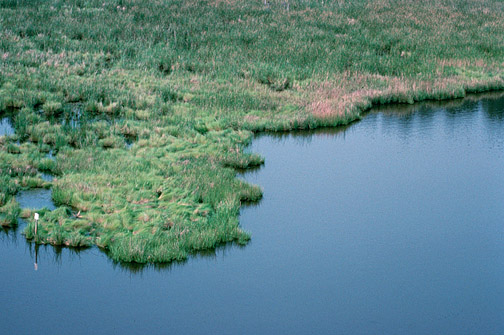
Chesapeake Bay Wetland / USFWS

The Chesapeake Bay Foundation has released its annual report on the health of the Bay. The result is better this year than previous years: 29 instead of 27 out of a possible 100. This comes out to a D- on the CBF scale. The score is based on a variety of factors, including levels of nitrogen and phosphorus, health of aquatic vegetation, and presence of dead zones. Here is some interpretation:
"Maybe, just maybe, 2006 will be remembered as the turning point of the bay," said foundation president William C. Baker. "But this report isn't good news. Clearly a great deal more needs to be done. It's time to get serious about saving the bay."

Baker said weather made the biggest difference in the bay's slight improvement; rain washes pollutants into the bay, so the dry weather helped.

Despite the generally gloomy assessment, Baker praised Maryland, Virginia and Pennsylvania for beginning to address the bay's two biggest pollutants, nitrogen and phosphorus, which come primarily from farm runoff and sewage treatment plants. In the past decade, the states have encouraged the planting of cover crops, restoring forest buffers and managing farm waste.
Here is the full State of the Bay report.

The CBF also recently released a report on water quality in the Anacostia River. The report showed some improvement but not enough to move the river above its failing grade.
Improvements were seen in fecal coliform bacteria, suspended solids, dissolved oxygen, wetlands, and government action. The rising score is linked to early efforts to reduce sewage leaks and overflows and stream restoration efforts. Trash, toxics, and nitrogen pollution, largely a result of stormwater runoff, showed no improvement this year.
Obviously the river still has a long way to go.

Tuesday, November 07, 2006

Maryland Ballot Question

If you are voting in Maryland today, make sure to vote "YES" on Ballot Question 1.

The Board of Public Works may not approve the sale, transfer, exchange, grant or other permanent disposition of any state-owned outdoor recreation, open space, conservation, preservation, forest, or park land without the express approval of the General Assembly or of a committee that the General Assembly designates by statute, resolution or rule.
This amendment is intended to prevent sales of public lands without oversight, as was attempted in 2004.

Monday, November 06, 2006

Maryland Will Buy Blackwater Property

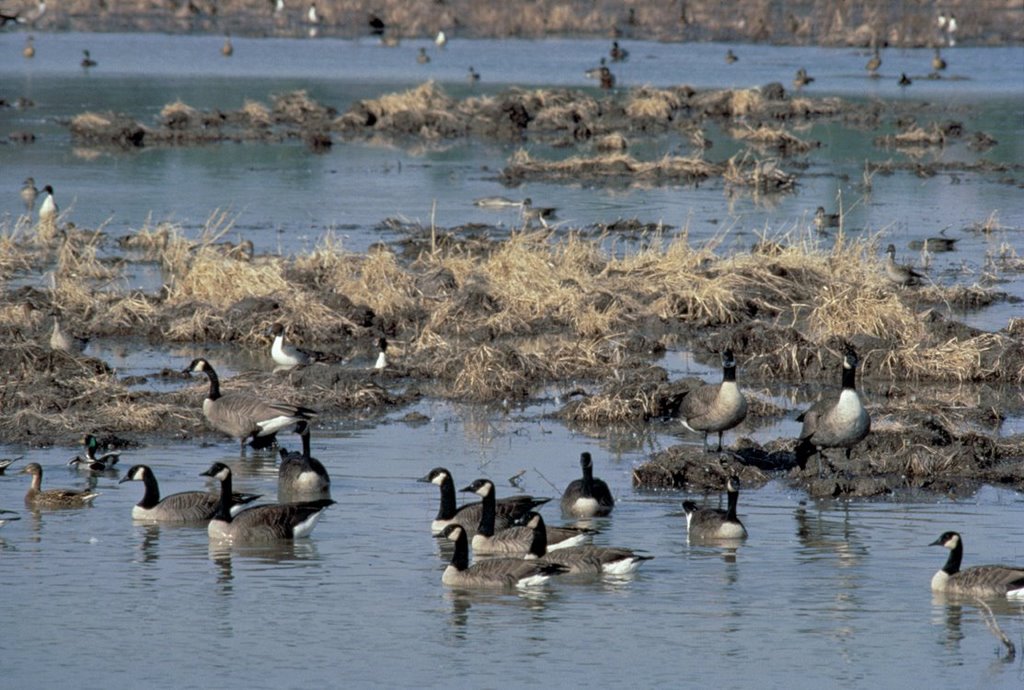
Waterfowl at Blackwater (USFWS)

For the past year, environmental groups on the Eastern Shore have been fighting a proposed development near Blackwater National Wildlife Refuge. The development would have occupied 1,080 acres in the watershed of the Little Blackwater River. The site would have held a golf course, hotel and conference center, and 2700 homes. (See here and here for background.) Today Maryland announced that it will use conservation funds to purchase most of the land upon which the development would have been built.
The state will spend up to $10.4 million to buy 754 acres of about 1,080 acres of what is now mostly farmland. A developer, Duane Zentgraf, originally planned to build thousands of new homes plus a golf course and hotel on the land.

Today's agreement, subject to an appraisal and final state approval, leaves room for 675 homes, most of them for older adults only. A golf course, hotel and conference center originally planned have been scrapped.
The announcement represents a victory for conservation and smart growth advocates, and for the wildlife that depends upon the refuge and its surroundings for habitat.

Saturday, October 14, 2006

Migrants at Point Lookout

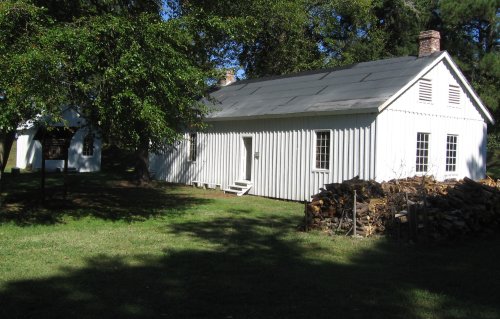
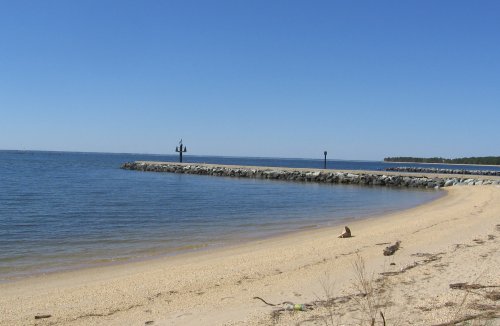
Today I attended a field trip with my local Audubon chapter to Point Lookout State Park in Maryland. Point Lookout is a peninsula at the confluence of the Potomac River and Chesapeake Bay. The very tip of the peninsula is occupied by a Coast Guard station; thus it is off-limits to the general public. However, just north of the station is a park with picnic groves and mixed deciduous-coniferous forest, including several large stands of loblolly pine. The park includes the site of a Civil War fort and prison camp, shown below. The peninsula acts as a funnel so that southbound migrants gather in the park before heading across the bay.

Thursday's cold front did not bring many migrants, unfortunately. However, the passing front left behind a cold, crisp autumn day. The sun was bright, the sky was deep blue, and the humidity was low, so that visibility extended far out on either side of the peninsula.

We were treated to two species in large numbers - bald eagles and brown pelicans. We first saw a group of one adult and two juveniles all flying together at close range. Later at least eight bald eagles were kettling together off in the distance, some almost at the limit of sight. Likewise, we started out seeing one brown pelican sitting on a piling. Then about ten more flew past, and then another dozen at very close range - maybe about ten yards away. At the north end of the park, another dozen or so were perched on a breakwater. There were also lots of yellow-rumped warblers, ruby-crowned and golden-crowned kinglets, brown creepers, and white-throated sparrows. Raptor flyovers included a merlin and a northern harrier.

A full report will eventually be available on the DC Audubon website, so I will leave my blog description at that. Some pictures are available at the DC Audubon site now, and more will appear later. Below is my personal trip list.

SPECIES SEEN: 41

Brown Pelican
Double-crested Cormorant
Canada Goose
Black Scoter
Turkey Vulture
Bald Eagle
Northern Harrier
Sharp-shinned Hawk
Merlin
Virginia Rail (h?)
Ring-billed Gull
Great Black-backed Gull
American Herring Gull
Laughing Gull
Forster's Tern
Rock Pigeon
Red-bellied Woodpecker
Yellow-bellied Sapsucker
Downy Woodpecker
Northern Flicker
Eastern Wood-Pewee
Eastern Phoebe
Tree Swallow
Golden-crowned Kinglet
Ruby-crowned Kinglet
Carolina Wren
House Wren
Northern Mockingbird
Eastern Bluebird
American Robin
Carolina Chickadee
Brown Creeper
Blue Jay
American Crow
European Starling
Yellow-rumped Warbler
American Redstart
Chipping Sparrow
Song Sparrow
White-throated Sparrow
Northern Cardinal