Sunday, November 13, 2005

Birding Along The Anacostia

When I watch birds I tend to visit the same places quite frequently; readers of this blog will notice a report on the National Arboretum practically every weekend. Part of this is that, being dependent on Metro, I need to find places that are easy to access. There is also benefit in birding a patch. But I do like to explore new areas from time to time. That is what I did today.

Anacostia Park is a narrow strip of open greenery that runs along the east side of the Anacostia River from the U.S. Naval Air Station north to Benning Road, NE. In practice, however, the usable parts of it are smaller, mainly the areas on either side of Pennsylvania Avenue, SE, south to the 11th Street Bridge and north to the CSX railroad tracks. I had long been puzzled about how to access the park as its east side is bounded by a highway (Route 295/Anacostia Freeway). With the help of Google Earth (a really neat service), I found that the correct approach was to use the Potomac Avenue stop on the Metro and walk across the Pennsylvania Avenue Bridge.
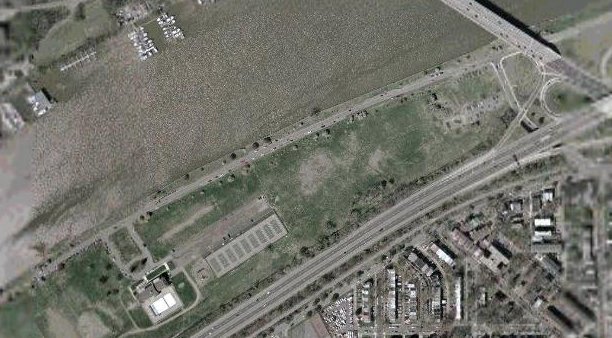
A small part of Anacostia Park. Pennsylvania Avenue is in the upper right.

Unfortunately there were not too many birds to be seen today. I think I may have covered the park at a lull in the season. There were plenty of gulls on hand, including all four locally regular species for fall migration: ring-billed, herring, great black-backed, and laughing gulls. The laughing gulls seemed to keep to themselves a bit more while the others mixed it up. One gull seemed to be trying to pull a crayfish out of the water.

Back on the west side of the river, I walked up a gated roadway that runs behind the Congressional Cemetery and DC General Hospital and up to RFK Stadium. (It seemed to be okay for people to walk here; it was closed to vehicles but not blocked for pedestrians.) The road was lined with trees and underbrush on both sides. Flocks of golden-crowned kinglets and dark-eyed juncos moved ahead of me as I walked down the path. Up at the stadium there was a reprise of more of the same gulls, plus a few Canada geese.

SPECIES SEEN: 20

Double-crested Cormorant
Canada Goose
Turkey Vulture
Ring-billed Gull
Great Black-backed Gull
American Herring Gull
Laughing Gull
Rock Pigeon
Mourning Dove
Belted Kingfisher
Downy Woodpecker
Golden-crowned Kinglet
Northern Mockingbird
Fish Crow
European Starling
House Sparrow
Song Sparrow
White-throated Sparrow
Dark-eyed Junco
Northern Cardinal

Loose Feathers #4

More links from around the internet about birds, birding, and the environment.

  • A recent study has shown that birds on islands can return and colonize the mainland, and not only the other way around. See here for a summary and explanation.
  • The neotropic cormorant that has been observed in Maryland has moved on from Violette's Lock to Pennyfield Lock. (Monitor MDOsprey for updates.) With a little luck, maybe it will continue moving downstream and spend a little time in D.C. After all, what's the point of coming this far north if it's not going to visit the tourist destinations in the nation's capital? :-)
  • The DC Audubon Society will have its next field trip next Saturday, November 19, to Blackwater NWR. Directions and contact info are on the DCAS webpage.
  • Cave swallows were seen in Ohio for the first time this week. The event was not just notable for being the first record in that state, but also for the numbers in which they appeared. One birder estimated about 70 swallows, spread over two flocks. Like other southern species, cave swallows frequently appear along migration routes north of their range during autumn, as Kenn Kaufman explained in some messages reproduced here.
  • Apparently there has been a rise in grizzly bear shootings in Montana over the past two years: 21 bears over two years as opposed to an average of 3 per year for the previous thirteen years. It is not clear if the rise in killings is coincidental or part of a concerted effort. The article is interesting from the standpoint that it looks at demographic changes in Montana and the "New West," and resulting cultural conflicts.
  • A North American birder has observed 700 species this year. (List here.)

Saturday, November 12, 2005

National Arboretum Walk

This afternoon I did my usual circuit around the National Arboretum. There is not much to report from today because the bird activity was fairly minimal except for a small pocket with a few individuals here and there. The foliage, however, was beautiful, and the weather was perfect for enjoying it.

The red-breasted nuthatches were still present in the conifers on Hickey Hill. Today they were more easily heard than seen, especially since the sun was making it difficult to scan the treetops. I believe I am starting to recognize the difference between the red-breasted and white-breasted nuthatch calls, though not well enough to explain it yet.

Odd note of the day: Down by the river I heard a call that I could have sworn was coming from a red-tailed hawk, but it turned out to be some blue jays. I think this is the first time I have noticed their mimicry in action.

SPECIES SEEN: 26

Great Blue Heron
Canada Goose
Mallard
Sharp-shinned Hawk
Ring-billed Gull
Rock Pigeon
Mourning Dove
Red-bellied Woodpecker
Downy Woodpecker
Northern Flicker
Northern Mockingbird
American Robin
Carolina Chickadee
Red-breasted Nuthatch
White-breasted Nuthatch
Blue Jay
American Crow
Fish Crow
European Starling
House Sparrow
American Goldfinch
Eastern Towhee
Song Sparrow
White-throated Sparrow
Dark-eyed Junco
Northern Cardinal

Friday, November 11, 2005

Hawks on the Mall

I walked along my end of the Mall late this afternoon. The sun was low in the sky and cast long shadows over the grass but also bathed the rows of elms in a golden light. The Capitol slowly turned from its daytime white to a twilight rose. Towards the middle of the Mall, a stage with red, white, and blue bunting was set up, presumably left over from Veteran's Day commemorations earlier in the day.

Though I had not brought binoculars along, I did note a few birds. The usual starlings and house sparrows were around, as well as a few robins (mainly near the Capitol). One flock of about fifty common grackles flew overhead, and a large contigent of mourning doves were picking something - either gravel or seeds - out of the protected sections. (Every winter the Park Sevice fences off a few sections of the Mall to rejuvenate the grass, which gets quite a beating in the summer.)

As I waited to cross one of the streets that cross the Mall, a red-tailed hawk glided past - almost at head level - and disappeared into the trees on the other side of the street. I walked over to that stand of elms but could not relocate it. Shortly after I saw a red-tailed hawk soaring high over the National Gallery. I am not sure if this was the same bird or a different one.

The National Mall tends to be a good place to spot hawks, especially the larger and more adaptable ones like the red-tailed hawk and the Cooper's hawk. Osprey and bald eagles will also turn up, though they are more likely to be seen down along the Potomac. But the Mall offers fine amenities for a raptor. Most of it consists of a big open field, and even the treed areas tend not to have much understory. This makes it easier for a hawk to find prey. And there is plenty of prey to be found. Eastern gray squirrels are ubiquitous and practically tame, making them easy targets. (I have had squirrels jump on the same bench and even on me when I eat lunch on the Mall or in nearby parks. They seem to have little fear.) Other rodents like rats and mice are also plentiful. There are plenty of "trash" birds that are attracted by the easy availability of leftover people food. Starlings are probably the most common of these.

The Cooper's hawk in the list below was seen earlier in the day, near Union Station.

SPECIES SEEN: 8

Cooper's Hawk
Red-tailed Hawk
Ring-billed Gull
Mourning Dove
American Robin
European Starling
House Sparrow
Common Grackle

Thursday, November 10, 2005

Zoo Birds

Late this afternoon I took a short stroll through the National Zoo and the part of Rock Creek that flows through its lower portions. Despite the stiff wind, it was a beautiful afternoon: plenty of sun with the foliage near its peak. I was a little underdressed for the wind. Once I started birding, though, the chill went away.

There may have been birds out other than the ones I have listed here, but I was primarily interested in checking the waterfowl numbers along the creek. The upper zoo was mostly quiet except for the flocks of starlings and robins that gather in the tree tops at night. The creek held mallards and wood ducks. The close range between the path and the creek allows the best looks at wood ducks that one could hope to see. The males are particularly spectacular at this time of year when their breeding plumage is fresh. Further along the creek there were several robins bathing themselves in the shallows.

SPECIES SEEN: 10

Wood Duck
Mallard
Rock Pigeon
Red-bellied Woodpecker
Downy Woodpecker
American Robin
European Starling
House Sparrow
White-throated Sparrow
Northern Cardinal