Saturday, October 07, 2006

Birding in the Rain

During the long, hot D.C. summers, I tend to forget just how cold 50 degrees feels when it is windy and overcast. Then one day in October I get a reminder. Today was one of those days. This week the temperature fell about thirty degrees in two days, from a high in the mid 80s on Wednesday to a daytime high in the low 50s yesterday. This morning felt even colder when I went over to the National Arboretum.

Birds are starting to switch from late summer species to mid-fall species at the National Arboretum. Today I had several first-of-the-fall species, including brown creeper, yellow-bellied sapsucker, and both kinglets. The white pines near the visitor center held a large flock of chattering golden-crowned kinglets. As usual with kinglets it was difficult to pin down the species, not because the two kinglet species have confusing field marks, but because the birds will not sit still. The one ruby-crowned kinglet I saw was on the far side of the Azalea Garden.

A few warblers are still moving through. I saw at least three black-throated blue warblers (two males and a female) and a few ovenbirds. Black-throated blue warblers tend to linger around D.C. in the fall. Last year, I saw them at the Arboretum well into November, after most other species in their family were long gone. I am glad they do stick around because I never get tired of watching this species. Unlike some other warblers, black-throated blues keep their colorful summer plumage in the fall. They are also an exception in not inducing "warbler neck," as they move around in middle-level foliage.

Unfortunately my time for watching warblers was cut off by the arrival of heavy rains. The initial downpour quickly lightened into a drizzle, but even that was enough to shut down most bird activity. So I wrapped up my birdwatching and left the Arboretum.

By the way, BirdLife International has declared this weekend as its annual World Bird Festival. It encourages birders to go out and visit Important Bird Areas over the next two days.

SPECIES SEEN: 24

Ring-billed Gull
Rock Pigeon
Mourning Dove
Red-bellied Woodpecker
Yellow-bellied Sapsucker
Downy Woodpecker
Northern Flicker
Eastern Phoebe
Golden-crowned Kinglet
Ruby-crowned Kinglet
Carolina Wren
Gray Catbird
Wood Thrush
American Robin
Tufted Titmouse
Brown Creeper
Blue Jay
European Starling
House Sparrow
Black-throated Blue Warbler
Ovenbird
Eastern Towhee
White-throated Sparrow
Northern Cardinal
Friday, October 06, 2006

New Addition to the US Botanical Gardens

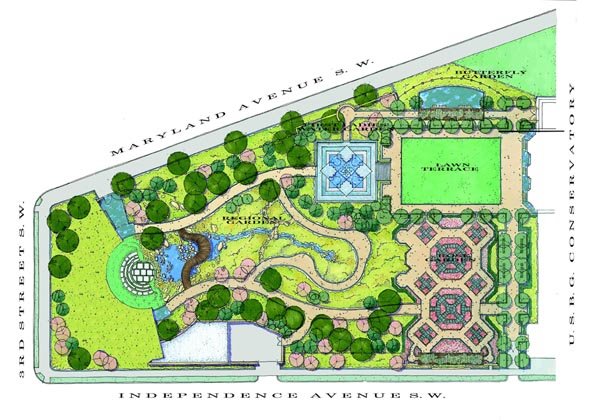
The U.S. Botanical Gardens, located on the west side of the U.S. Capitol, recently constructed a new three-acre garden. The National Garden opened to the public this past Sunday, October 1. It consists of several interlinked parts: an open lawn, a butterfly garden, a rose garden, and a garden of regional plants placed around a meandering stream. A fountain and amphitheater round out the garden. Right now, the gardens do not look like much because the plants are still very young. But I expect that in a year or two the beds will be bristling with flowers.

Unfortunately, the gardens are surrounded by a gated fence, and the access hours for the National Garden appear to match those of the Conservatory. So Bartholdi Park may still be the USBG's only option for an evening walk.

Plan of the National Garden / USBG

Of course, as a birder I want to know what the birding possibilities for the new gardens will be. The shrub cover is not quite dense enough to attract many species, and the downtown location makes bird diversity unlikely. Still, this evening I spotted a few species, including mourning doves, a song sparrow, and my first white-throated sparrow of the fall. Best of all was a flock of palm warblers - more than 10 - all twitching and pumping their tails as they foraged on the ground. There may have been a common yellowthroat and yellow-rumped warbler in the mix as well. That is pretty good for downtown D.C.

The east end of the National Mall now has a belt of gardens, running from Bartoldi Park on the south side of Independence Avenue, through the new National Garden, to the garden of the National Museum of the American Indian. None of this is prime habitat, but all three spots ought to attract some migrants in spring and fall. It makes another option for walking and casual bird watching.

Week in Review

This was a slow posting week, but there should be more next week.

Tuesday: More Bad News for Wilson Bridge Eagles

Wednesday: Migrating Birds Nap Frequently

Thursday: Blackwater Resort Partially Blocked

Friday: Loose Feathers #69

Loose Feathers #69

News and links about birds, birding, and the environment, plus a few other things.

  • Ultralight aircraft are leading 18 endangered whooping cranes on their southbound journey from their breeding grounds in Wisconsin to their wintering grounds in Florida. The population restoration program uses aircraft to train captive-bred cranes to migrate south for the winter; in the spring the cranes will know where to go without assistance.
  • Little egrets, a southern species, are now breeding in London for the first time. The species was hunted nearly to extinction in the 19th century. Just as the hunting of great and snowy egrets in North America led to the formation of the National Audubon Society, the near extinction of little egrets prompted the foundation of the Royal Society for the Protection of Birds in Britain.
  • Here is a profile of the fox sparrow, one of my favorite species.
  • This week Congress renewed the Neotropical Migratory Bird Conservation Act, which provides grants for bird conservation projects.
  • When a rare rose-coloured starling appeared in England and then died, neighbors and news reports blamed birders who had come to see the species. The RSPB attributes the bird's death to two large ticks that were lodged into the starling's head.
  • Yet another new bird species has been found in Colombia: the Yariguies Brush-Finch (Atlapetes latinuchus yariguierum). Update: The brush-finch was discovered in the Serranía de los Yariguíes, a mountain range in northern Colombia northeast of Bogota. See ProAves for more information. The site is near the Cerulean Warbler reserve.
  • In upstate New York, former agricultural land is being reverted to wetlands in the federal and state refuge systems.
  • Judges in western jurisdictions have been expressing frustration with the Bush administration over non-enforcement or reinterpretation of many statutes dealing with wildlife and land conservation.
  • Check out Laura Erickson's coverage of the North American Ornithological Conference at Birderblog, including coverage of presentations related to ivory-billed woodpeckers here, here, and here. Attending the same conference, Nuthatch has a report on the River of Raptors hawk watch.
  • Stop by and say hi to Cindy of Woodsong, who has been dealing with a major illness.
  • Also, Shakespeare's Sister celebrated its second blogiversary yesterday.
  • And, as always, the Friday Ark is boarding.
Tags:

Thursday, October 05, 2006

Blackwater Resort Partially Blocked

The Maryland state Critical Area Commission has blocked the development of 313 acres of the proposed development near Blackwater National Wildlife Refuge in Cambridge, Maryland. The project would have built 2,700 homes, a convention center, retail complex, and a golf course on 1,080 acres of land adjacent to the Little Blackwater River. This river flows through the National Wildlife Refuge and eventually empties into the Chesapeake Bay. Runoff from the site could affect the resources of both. The 313 acres blocked by the commission would have held the golf course and retail complex. The developer could still build on the rest of the land, but any revised project would need to go through the local approval process again.

A five-member panel from the Critical Area Commission held hearings on the project and made a recommendation to the full commission. You can read the report here (pdf). The report sets forth the panel's concerns point-by-point and advises rejection. The main objections stem from a lack of data to support the developer's claims regarding impact on pollution, and noncompliance with watershed regulations. The commission's hearings were attended by over 100 people, and the commission received over 4,000 emails on the subject. Most responders opposed the project.