Thursday, March 10, 2011

Some Moths from the Files

Recently I started re-examining some of my unidentified moths from last year to see if a second or third look might turn up IDs for some of them. So far I have been mostly successful. A few are probably not identifiable, but there are others that I probably overlooked while I was working on some of the larger and easier moths. Leading off this post is a Small Mottled Willow Moth (Spodoptera exigua), a species introduced from southeast Asia.

The small moth appears to be a Kearfott's Rolandylis Moth (Rolandylis maiana). 

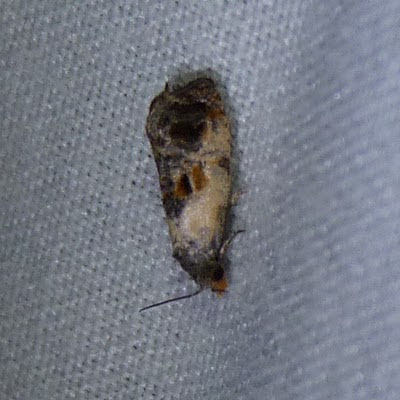
It took a few trips through the same set of moth plates for me to figure out that this is probably a Decodes basiplagana, a tortricid that appears to lack a common name.

After I posted this on Flickr, Ali Iyoob suggested Palmerworm Moth (Dichomeris ligulella), which seems to fit the shape of this moth pretty well. Sometimes it pays to revisit unsolved identification problems!

Wednesday, March 09, 2011

More About the Banded Goose

I received my certificate from the Bird Banding Laboratory faster than usual this time. I reported a banded Canada Goose on Saturday and received the certificate on Monday. Certificates usually include some interesting information about where or how the bird was banded. In the case of this bird, the certificate states that it is a female and that she "was too young to fly when banded," which means that she was big enough to keep a size 8 band on its leg but had not grown her first set of flight feathers yet. The bird was banded in 1997, so she has probably produced plenty of her own (probably banded) offspring.

The banding site was given as Dunellen, New Jersey, and lies about 5.8 miles (as the goose flies) from where I saw the bird. The site appears to be a wetland of some sort, and it appears to be connected by a stream to the Dismal Swamp area. So far every banded Canada Goose I have reported has come from either that site or Raritan Center.

Tuesday, March 08, 2011

Red Knot to be Listed as Endangered in NJ

New Jersey's Department of Environmental Protection is proposing to change the state's listing of Red Knot from threatened to endangered. The proposal is based on a few years of studying their population trends, but it was made more urgent by recent reports from South America:
In late February, biologists returned with sobering news from their annual trip to the bird's wintering grounds in Tierra del Fuego, Chile.

Immense flocks of red knots once swooped over the vast tidal mudflats, rich in tiny organisms that were a nonstop banquet. In recent years the number declined to 16,000, but remained stable.

Now, the count showed the population dropping again, to between 10,000 and 11,000.

"We're dismayed," said Larry Niles, former chief of the DEP endangered-species program, now a wildlife consultant. He has led red knot research for more than a decade.

The crew of more than a dozen international researchers had hoped for an uptick because conditions on Delaware Bay last spring were so favorable. The weather held, the crabs laid their eggs, the birds feasted.

Data from netted birds showed that nearly 80 percent were at or near ideal body weight, prime for breeding.
An online version of the state's proposal is here, for anyone who wants to read and comment on it. Comments must be received by March 19. It looks like comments have to be submitted by mail even though NJDEP asks for an electronic copy.

Monday, March 07, 2011

Bird-Smart Wind Power

Wind energy holds some potential for reducing the amount of greenhouse gases emitted by our power sources, but this environmental benefit comes at a cost. Wind farms may harm birds and bats, either by creating obstacles for them to strike or by habitat degradation. The American Bird Conservancy is circulating a petition calling for mandatory standards for the wind industry to reduce the threat to birds and bats. The petition reads as follows:

Wind power is the fastest developing source of energy in the United States and can be an important part of the solution to climate change. However, wind farms can harm birds through collisions with turbines and associated structures, and through loss of habitat birds need for survival. These losses are largely avoidable. The solutions are within our reach.
I support bird-smart wind power that includes mandatory standards to minimize bird deaths and habitat impacts.
Bird-smart wind power:
1. Is carefully sited to avoid harm to birds
2. Uses best technology and best management practices to minimize harm to birds
3. Employs effective, federally reviewed and approved, site-specific, pre- and post-construction studies/assessments to assist with improved siting and operation, and to properly quantify impacts.
4. Compensates fully for unavoidable harm to birds caused by collisions with wind turbines or associated structures, and lost or degraded habitat.

If you agree with this, you can sign onto the petition here. The petition is a shortened version of ABC's policy statement on wind power, which provides more information about what they mean by each of those four points.

(via the ABA blog)

Sunday, March 06, 2011

Birds at Johnson Park

I took a walk through Johnson Park yesterday afternoon. I was hoping to see some waterbirds on the ponds, which had been frozen over on my last visit to that park about a month ago. Aside from the usual Canada Geese and Mallards, the only waterfowl I saw were a few Common Mergansers that flew past and some distant Common Goldeneye. There was a large group of gulls on a sandbar across the river from the park. I made out one Lesser Black-backed Gull among the group. A few other dark-backed gulls looked like candidates for Lesser Black-backed Gulls based on size, but I couldn't quite tell if other field marks were also consistent. A blackbird flock at the horse track included one Rusty Blackbird. Most of the birds in the flock were European Starlings, with a few dozen each Red-winged Blackbirds and Common Grackles, as well as one Brown-headed Cowbird. The flock flushed pretty frequently, so it was difficult to make out anything more than that.

As I was leaving the park, I came upon a flock of Canada Geese close to the pathway. They tolerated my presence enough that I could get close and photograph them. A few birds were banded, and I was able to get a complete band number for one of them. The bird above has the band number 0908-42802. After I entered the band on the Bird Banding Laboratory's website, I got an automatically-generated email from them saying that the goose was banded in New Jersey in 1997. I am waiting to receive a certificate with more information about the bird.

Another goose in the same group had an odd wing. Its left wing was held slightly away from the body, and it appeared to have a dark underneath. The right wing looked normal. I am not sure if this was due to injury or some other cause. Whatever the cause, it did not seem to hamper the goose's ability to feed itself. With few predators capable of taking on a goose, this bird is probably relatively safe. I did not see this group of birds take off, so I am not sure if the wing is actually injured enough to prevent it from flying.