Showing posts with label Evolution. Show all posts

Wednesday, September 07, 2011

A Pollinator's Perch

Credit: Image courtesy of Oxford University Press (OUP)
Small South African irises in the genus Babiana have evolved an upright perch to attract sunbirds to pollinate them.
The research consisted of fieldwork across the western Cape, examining Babiana and making observations of the sunbirds that pollinate them. Barrett said: "What we found is when sunbirds visit Babiana ringens, they always land on this perch and then turn upside down to feed on nectar from the the ground-level flowers. In contrast Babiana carminea doesn't have a perch, and here we found that sunbirds land on the ground and probe flowers to feed on nectar. Ground level flowers are highly unusual in bird-pollinated plants because of the likely predation risk and to find two contrasting feeding strategies among related species is remarkable."

"Babiana avicularis has a perch, but these plants are only visited by the southern double collared sunbird. This is a smaller sunbird, and it looks like Babiana avicularis may have evolved a specialised relationship with it. Larger malachite sunbirds don't visit this plant but are the exclusive pollinators of Babiana ringens which has larger flowers. No one had seen birds pollinate this plant before and it's now one of the smallest bird-pollinated plants known."
The image above shows a sunbird feeding on a Babiana flower from one of those evolved perches. There is also some variation in the size of the perch, with the perch length being longer wherever sunbirds visited Babiana more frequently.
"What we also found with Babiana ringens is that the perch length was smaller in the east of our survey area. This is the region where we saw fewest sunbird visits to plants. So with fewer pollinators around there's less natural selection to maintain large perches, and it also makes sense to have self-pollination as a back-up when the alternative may be no pollination at all."

Barrett is pleased that the work provides insight into the most specialized bird perch in the plant kingdom, but warns that there is still much that we do not know about how the perch evolved in the first place: "Our research shows a clear functional basis between perches and bird pollination, but that's not all it shows. At the same time we're also seeing self-pollination and it's clear Babiana can adopt different mating strategies in different locations depending on the availability of sunbirds."
The study was published in Annals of Botany.

Tuesday, January 26, 2010

Dunlin Lose Weight to Avoid Peregrines


A new paper based on studies from the Fraser River estuary in British Columbia finds that hunting pressure from Peregrine Falcons (Falco peregrinus) is changing the behavior of Pacific Dunlin (Calidris alpina pacifica). The peregrine population crashed forty years ago, primarily thanks to pesticides, and has since rebounded. All of those new falcons need to eat, and shorebirds are suitable prey because of their size, numbers, and penchant for foraging and loafing in open spaces. Shorebirds have to adopt evasive behaviors to avoid being eaten.

One way of avoiding predation is to move to areas without much raptor activity. Some dunlin do this by finding safer roosting locations away from where peregrines are hunting, even if it means flying longer distances to reach them. Others utilize a behavior known as "over-ocean flocking": during high tides, they fly out to sea and remain in flight there for an extended period of time. This behavior was rarely noted by observers prior to the late 1990s, but since then it has been observed regularly. According to daily observations from January 2006, "over-ocean flocking" occurred on 15 out of 17 days, and dunlin spent an average 2.8 hours over the ocean at a time.

Most shorebirds build up their body fat reserves to avoid starvation during the winter. The extra weight helps them survive when food supplies are low, but has the trade-off of making it more difficult to escape predators in flight. In the face of increased predation, shorebirds like dunlin will need to carry less body fat to avoid becoming prey. According to bird banding data, that is exactly what happened when peregrines rebounded. Data from the 1970s shows that dunlin mass builds quickly and remains high through November and December before falling in January and February. By the 1990s, the average autumn peak weight had fallen by about 4 grams, or about 7% of their historical peak body mass.

This study is a good example of how conservation actions to benefit one species can have unintended results elsewhere in the ecosystem. In this case, the increased presence of peregrines around coastal areas is forcing dunlin to change their feeding and roosting behaviors.


ResearchBlogging.orgYdenberg, R., Dekker, D., Kaiser, G., Shepherd, P., Evans Ogden, L., Rickards, K., & Lank, D. (2010). Winter body mass and over-ocean flocking as components of danger management by Pacific dunlins BMC Ecology, 10 (1) DOI: 10.1186/1472-6785-10-1

Tuesday, November 24, 2009

150 Years of Evolutionary Theory


On this day in 1859, Charles Darwin's On the Origin of Species by Means of Natural Selection, or the Preservation of Favoured Races in the Struggle for Life was published for the first time. Even before Darwin's work, other scientists had speculated that existing species could be transformed into other species. Darwin drew from these concepts, but he advanced the idea that species are continually adapting in response to natural selection. Despite its vilification by creationists, evolution by natural selection remains the guiding concept of the biological sciences. Many bloggers are more qualified than I to discuss the implications of Darwin's work and how evolutionary theory has developed since 1859, so I will leave more detailed discussions to them.


Birders, however, should celebrate this anniversary as we are in a particularly strong position to appreciate the results of evolution. We do not necessarily think consciously about evolution when we go birding; in my own experience, I think about Darwin very rarely while I have binoculars around my neck. But among birds, we can observe the diversity of forms and behaviors produced by natural selection. Warbler species, for example, evolved to fill many specific ecological niches. One warbler species forages mainly among dead leaf clusters; another breeds only in jack pine forests of a certain age; yet another warbler with bark-like black-and-white streaking specializes in picking invertebrates off the trunks and limbs of trees. Whether we realize it consciously or not, these evolutionary adaptations help us to identify birds. That buzzy, insect-like call is likely to mean different sparrow species in a grassy field and a saltmarsh; the same goes for a trilled song heard in a swamp and a suburb. Without some awareness of these species' adaptations to ecological conditions, birding by ear and birding by GISS would be a lot more difficult.


Since On the Origin of Species is old enough to be in the public domain, there are many complete digital copies of this book available online. Try Literature.org, TalkOrigins, Bartleby, or Project Gutenberg if you want to read it.

For other evolution-related reading on this blog, see my review of Pilgrim on the Great Bird Continent, an article on the evolution of wood warblers, the announcement of a new crossbill species in Idaho, an analysis of the evolution of waterfowl genitals, and a more recent post on new research into birds of the Galápagos.

Wednesday, November 18, 2009

Darwin's Birds: Evolution and DNA in the Galápagos


Whether by chance or by design, this week witnessed the publication of two studies on birds from the islands made famous by Charles Darwin. The first concerns one of the best-known examples of evolution, the Galápagos finches. A married pair of biologists have been banding and tracking finches on Daphne Major for several decades. In 1981, they banded a medium ground-finch (Geospiza fortis) that was significantly larger than most other medium ground-finches on the island. Since then, its descendants, which have unusual beaks and songs, have stopped breeding with other medium ground-finches.
The fact that 5110's descendants haven't mixed could be because they differ from the natives. The Grants note that the descendants have a differently shaped beak from those native to Daphne Major. As finch beaks are vital in identifying potential mates, this could serve to keep them reproductively isolated.

5110's offspring also have the avian equivalent of a strange accent. These finches learn their songs from their father, and the Grants suggest that 5110 sang the songs from his birth home of Santa Cruz then modified his come-hither ballad by roughly copying the Daphne Major birds'. This imperfect copying, they suggest, has over time acted as a barrier to interbreeding.

Lukas Keller of the Zoological Museum at the University of Zurich, Switzerland, agrees that 5110's case is special. However, he thinks it may be possible to generalize to other species who learn behaviours such as singing in a similar way. "For me it's a very exciting paper," he says.

Whereas Darwin thought that a new species would take a considerable amount of time to appear, Keller says that this paper "shows how rapidly reproductive isolation can develop".
It is not yet clear that this is a new species, even though some headlines give that impression. However, it does provide a real-time view of how reproductive isolation and speciation can begin.

The second study reports on the feasibility of introducing a rare mockingbird into part of its former range. Darwin and his colleagues had collected specimens of the Floreana mockingbird (Mimus trifasciatus) from Floreana Island, part of the Galápagos archipelago. Due to human interference, the mockingbird became extinct on Floreana but survived on nearby islands. The Charles Darwin Foundation wants to bring the Floreana mockingbird back to Floreana. Before attempting to do so, they compared DNA samples from the remaining subpopulations to that of specimens collected by Darwin.
This revealed that the two sub-populations split from each other very recently. This split, the researchers said, was likely caused by the Floreana mockingbird becoming extinct.

Its extinction would have severed a "bridge" between the two populations - meaning that it was no longer possible for them to interbreed.

Even though they have evolved independently and become inbred, this study showed that the tiny sub-populations have retained much of the important "genetic variation" once found in the mockingbirds on Floreana.

This is good news for the survival of the species.

It has led the researchers to conclude that future conservation plans should focus on protecting "the two satellite populations in situ and establishing a single third population on Floreana".

This reintroduction could use birds from both islands, the researchers said, "to maximize genetic diversity".
I suppose one remaining question is whether the mockingbirds from these subpopulations will be inclined to interbreed after being separated for so long. That issue is not addressed in the BBC article, but the scientists seem confident enough that it may not actually be a problem.

Aside being fascinating examples of biodiversity in action, these two studies highlight the continued usefulness of bird research techniques that may seem dated. The mockingbird study showed the importance of museum collections as repositories of physical evidence for future generations of ornithologists. In this case, it provided DNA evidence for a study of subpopulations, a use that probably was not imagined by Darwin and his companions when they collected the specimens. The study of ground finches relied on bird banding to identify and track individual birds.

Wednesday, May 20, 2009

Humans and Extinction in the Past and Present

One of the mysteries of prehistoric North America is why many large mammals suddenly became extinct around 11,000 years ago. At least some hypotheses put the blame on the arrival of humans on the continent.

For decades, the dominant theory, proposed by Paul Martin, a geoscientist at the University of Arizona in Tucson who's now retired, was a rampage of hunting by humans who'd just arrived across a land bridge from Asia. Within a few hundred years, Martin theorized, a "blitzkrieg'' of killing wiped out more than half of all the mammals that weighed more than 100 pounds.

As a result, "Americans live in a land of ghosts,'' Martin wrote in his 2005 book, "Twilight of the Mammoths."

MacPhee, however, thinks that it wasn't over-hunting but the diseases people brought with them that ravaged animal populations in North America. As a parallel example, he noted how microbes introduced by European conquerors destroyed Central and South American civilizations 500 years ago.

Other scientists, such as Russell Graham, a museum director at Pennsylvania State University in University Park, think that climate change was "the major driving force that caused the extinctions.'' It destroyed animals' native habitats and reduced their geographic range so much that they could no longer survive.
We probably cannot know for certain what was the most important factor in that wave of extinctions. The fossil record gives an incomplete picture at best, and we do not have eyewitness accounts, unlike with more recent extinctions. This is not an idle question, as our planet is currently undergoing radical changes due to anthropogenic climate change and habitat destruction. The upshot may be another mass extinction event in the near future. Already 12% of the world's birds are threatened, and 1 in 10 odonates face extinction. Knowing how past extinctions occurred could give some insight into how we might prevent the current one.

Human contribution to prehistoric extinctions becomes more believable each time I read of something like this.
Asia Pulp & Paper and Sinar Mas Group have acquired a license to clear hundreds of hectares of unprotected rainforest near Bukit Tigapuluh National Park on the Indonesian island of Sumatra, report environmental groups who say the activity threatens a population of critically endangered orangutans that have been re-introduced into the wild.

"It took scientists decades to discover how to successfully reintroduce critically endangered orangutans from captivity into the wild. It could take APP just months to destroy an important part of their new habitat," said Peter Pratje of the Frankfurt Zoological Society. "These lowland forests are excellent habitat for orangutans, which is why we got government permission to release them here beginning in 2002. The apes are thriving now, breeding and establishing new family groups."

Asia Pulp & Paper and Sinar Mas intend to log the concession for timber and plant it for industrial timber and oil palm plantations. The companies say they plan to follow all legal procedures according to Reuters, but environmental groups are nonetheless concerned about the fate of orangutans and other endangered species, including Sumatran tigers and elephants. Bukit Tigapuluh is home to perhaps a quarter of the world's remaining wild Sumatran tigers.
When Walmart declines to buy your products because of environmental concerns, it is a pretty good indicator that your practices are out of line. In this case, APP is threatening the survival of two large mammal species, and presumably hundreds of endemic birds, herps, and invertebrates. And this is just one company in one tract of land.

Wednesday, March 04, 2009

A New Crossbill Species in Idaho

The Red Crossbill (Loxia curvirostra) has long been considered a candidate for splits into multiple spines. This holarctic bird appears in multiple forms with differently sized bills and nine distinct call notes. Despite this variation, evidence for distinct species has been lacking. Crossbills tend to be nomadic since they depend on seed cone crops that may be plentiful one year but not the next. When and where crossbills breed may vary from year to year as a result. This makes it difficult to demonstrate reproductive isolation of any one particular population.

One exception is the Red Crossbill population of Idaho's South Hills and Albion Mountains. There, the absence of Red Squirrels leaves the crossbills with little competition for pine seeds, and the cone crop is consistent from year to year. Thus an abundant seed bank has developed, allowing crossbills to retain the same territories. Banding studies have shown that the crossbills of the South Hills have far greater site fidelity and are more likely to follow a seasonal breeding pattern than other crossbill forms.

Since these crossbills are a resident population in the South Hills, they have coevolved with the local lodgepole pine variety. The local pines have evolved thicker, scalier cones to defend their seeds from crossbills. This favors crossbills with deeper bills to retrieve seeds. Comparison with nearby crossbill types shows that the South Hills population has larger bodies and distinctively deeper bills. In addition to morphological differences, the South Hills population uses the type 9 call. South Hills crossbills only rarely mated with crossbills using another call type. Differences in bill shape and call notes suggest genetic isolation from nearby Red Crossbills with other call types.

Based on these findings, the authors of the linked paper recommend recognizing the South Hills Crossbill as a new species, with the scientific name Loxia sinesciuris. (Sinesciuris means "without squirrels.") Assuming that the relevant authorities accept the paper's findings, adding this species to a life list could present an identification challenge as difficult as any Empidonax flycatcher. Here is how the paper describes its field marks:

Diagnosis. Very similar to other Red Crossbills in North America but larger (body mass and bill depth, but upper mandible relatively short) on average than other Red Crossbills currently found commonly north of Mexico (Table 1) and with distinctive vocalizations (see below; Smith and Benkman 2007). As in other Red Crossbills, males are reddish in body coloration whereas females are greenish-gray and smaller than males (Table 1; see below).
In other words, they basically look the same as Red Crossbills, but you might be able to identify them by vocalizations. The paper includes sonograms of South Hill Crossbill flight calls and songs. So far I have not been able to find any online audio of type 9 call notes. A photo of a South Hills Crossbill can be found here.

Saturday, February 14, 2009

Repost: Pilgrim on the Great Bird Continent

In honor of Charles Darwin's 200th birthday, I am reposting this review of Pilgrim on the Great Bird Continent, an examination of how birds shaped Darwin's thought during his travels in South America.
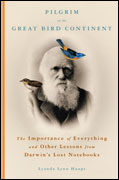
Lately the theory of evolution by natural selection has been in the news. There have been attempts in Kansas, Pennsylvania, and elsewhere to have biology curricula diluted or altered to remove evolution or teach it alongside "alternative" theories, usually some form of creationism. Such attempts have mostly been quixotic wastes of taxpayer money, but in the meantime have generated heated arguments. One thing that tends to get drowned out in the attacks on "Darwinism" is the man himself: who was Charles Darwin, and how did he come to the conclusions he put forth in Origin of Species?

One new book to fill that void is Lyanda Lynn Haupt's Pilgrim on the Great Bird Continent: The Importance of Everything and Other Lessons from Darwin's Lost Notebooks. As the author states at the outset, this book is not a true biography or a explanation of the theory of evolution. Rather, it is a sympathetic look at how Darwin grew from an "enthusiastic amateur" to a "professional scientist" during the course of his voyage on the H.M.S. Beagle from 1831 to 1836. To do this Haupt relies on Darwin's Diary from the voyage, as well as a collection of records published as the Ornithological Notes, to trace the young Darwin's reaction to the birds he encountered and how they shaped his thinking.

When Darwin sailed from England, he had little background in the study of birds. Soon, though, he found himself captivated by birds, and this is reflected in the pages of his journals. As he traveled along the east coast of South America, he recorded a greater amount of detail on birds, eventually including notes on voice and behavior. It is no wonder that he would fall in love with birds on a voyage to South America, the continent that can claim the most recorded bird species. One species that particularly impressed Darwin was the Andean Condor both for its graceful soaring and for the ability of large flocks of condors to converge suddenly on a fresh corpse. For other species Darwin's close observations led him to see elements of human personality, something that modern-day birdwatchers can appreciate.

Birds play an important role in Darwin's argument in the Origin of Species due to their diversity. The Greater and Lesser Rheas are a prime example of two closely-related species that developed in different geographical areas. The fourteen species of finch that Darwin found on the Galapagos Islands are an exemplar of diversity in a limited area to take advantage of different food sources. These finches have come to play a greater role in retrospect than Darwin originally realized at the time. His diaries from that visit show more interest in mockingbirds and tortoises. In fact, the finches look so dissimilar that Darwin did not realize that all belonged to the same genus until he had time to study the specimens in England.

Ultimately, Haupt did not intend this book to focus solely on Darwin. The account of Darwin's voyage serves as a springboard for reflecting on questions faced by those of us interested in the natural world. A central principle of the theory of evolution by natural selection is that humans and other organisms exist on a continuum and evolved by the same means. This implies first that a human-centered view of the universe is incorrect, and second that God is not an active interventionist. For the nineteenth century, both implications were shocking; even now they cause great resistance from religious groups and others. (This, by the way, is a problem mainly for biblical literalists, and not so much for other religious approaches.) From an ethical standpoint, common descent suggests that we humans need to ensure that our actions do not upset the delicate ecological balance.

Darwin's journals are presented as a model for modern naturalists. (What Haupt means by a naturalist is open to question; she suggests that Darwin's experience on the voyage may be more akin to amateurs than professional scientists today.) The first is to pay attention to detail. Darwin followed a principle that nothing is beneath notice. In his work it was reflected in the careful and exhaustive studies that he made of barnacles and pigeons to support his conclusions. In his journals it appears in his careful recording of minute details about a bird's appearance. A second is that individual organisms are valuable as individuals, but each should be studied in the context of its environment. Finally, study of nature should lead to reflection on the human role within the ecosystem - and to better choices in how we live.

As much as I enjoyed reading this book, I have some reservations about Pilgrim on the Great Bird Continent. The first is her tendency to insert narratives from her own life, some of which seem to add little to the story. Each chapter of this book contains at least one lengthy passage in which Haupt narrates a story from her own life. In some cases this helps to move the narrative forward. When she describes her first sighting of a black-necked stilt, for instance, it helps the reader understand Darwin's reaction to South American representatives of the genus Himantopus. In other cases the purpose of these narratives is less clear, and they serve as more of a distraction. A related problem is the tendency to engage in long philosophic digressions, such as her application of Buddhist philosophy to Darwin's study of vultures and condors. Like the personal narratives, these are less help than hindrance.

My second main reservation is that Haupt frequently appears to indulge in historical fiction. At the very outset she announces her intention to use imagination "as a bridge across the spaces," and she makes good on this promise. For example, we read passages like this: "Darwin liked what he wrote. But then, no, he hated it. He wrote again the next day. The fact that he did not indulge in tracing of his own interior 'process' in the diary itself does not make his struggle with that process any less real, or even less present on the page." (p. 46) Haupt rarely signals where her portrait of Darwin is firmly based on his writings and where her imagination takes hold; passages like the above do not inspire confidence.

A final issue of concern is that Haupt appears to have a chip on her shoulder when it comes to modern biology. She seems to be most upset with the use of mathematical models instead of field observation. The accuracy of her portrayal of modern biology is something that I cannot judge myself. I would be interested to hear what professional scientists think about this.

Pilgrim on the Great Bird Continent is a fun read and at the same time raises some compelling questions. It made me want to travel to see some of the sights Darwin described in his journals. I would recommend this book to people who are interested in understanding what made Darwin tick, who wish to read about the questions that Haupt raises, or who simply enjoy travel narratives. Readers looking for a full account of the voyage or an explanation of the theory of evolution would do better with a different book.


Lyanda Lynn Haupt, Pilgrim on the Great Bird Continent: The Importance of Everything and Other Lessons from Darwin's Lost Notebooks. New York and Boston: Little, Brown and Company, 2006. Pp. 276; map and illustrations. $24.95 cloth. ISBN: 0316836648.

Thursday, February 12, 2009

Darwin's Birds

Today marks the 200th birthday of two of the most important people from the 19th century: Abraham Lincoln and Charles Darwin. The latter, known primarily for his ground-breaking On the Origin of Species by means of Natural Selection, took a great interest in birds. During his voyage of discovery, he found a diverse group of ground finches that later became a key piece of evidence for the theory of evolution. Later in life he bred pigeons as part of his research on how natural selection could produce the diversity he observed in nature.

Here is a list of the birds named for Darwin:

I do not know if the list is complete; if you know of others, please list them in the comments.

Sunday, October 26, 2008

Early Feathers for Display?

A recent fossil discovery indicates that the earliest dinosaur feathers, worn by Epidexipteryx hui of the Jurassic period, were for show rather than flight.

The remains date back to 152 million to 168 million years ago, making the newfound creature slightly older than Archaeopteryx, the most primitive known bird....

Like other avialans—birds and their closest dinosaur relatives—Epidexipteryx is a theropod, a group of two-legged animals that includes Tyrannosaurus rex.

Researchers think the pigeon-size Epidexipteryx might have used its plumes as flashy ornaments, since it was mostly covered in short feathers that lack the structure necessary for flight.

"For example, [the feathers] could potentially have played a role in displays intended to attract a mate, scare off a rival, or send a warning signal to other individuals of the same species," said study co-author Fucheng Zhang, a paleontologist at the Chinese Academy of Sciences in Beijing.

"This is very exciting indeed, since it gives us a window into a stage of avialan history just preceding the appearance of the classic 'first bird,'" Zhang said.

"It shows that the use of feathers for visual communication—as opposed to other functions such as insulation and flight—was a very early development."
Unfortunately the article spends too much time playing up the "bizarre" nature of this dinosaur's anatomy, which does not sound bizarre at all. (Wow, a theropod with teeth?!? Who would have guessed?!?) It does quote at least one palaeontologist who thinks that feathers served to help Epidexipteryx run faster. I do not see these functions as necessarily being in opposition to each other, since feathers on modern birds often serve both functions. (Consider the case of a northern cardinal. Are its feathers for show, for flight, or for insulation?) In any case, it is an interesting find.

Tuesday, September 30, 2008

Feathers as Decoration


The oldest known feathered dinosaur precursor to birds, the newly-discovered Epidexipteryx hui, may have used its feathers principally for ornamentation rather than flight.

The remains date back 152 million to 168 million years ago, making the newfound creature slightly older than Archaeopteryx, the most primitive known bird....

Researchers think the pigeon-size Epidexipteryx might have used its plumes as flashy ornaments, since it was mostly covered in short feathers that lack the structure necessary for flight.

"For example, [the feathers] could potentially have played a role in displays intended to attract a mate, scare off a rival, or send a warning signal to other individuals of the same species," said study co-author Fucheng Zhang, a paleontologist at the Chinese Academy of Sciences in Beijing....

"It shows that the use of feathers for visual communication—as opposed to other functions such as insulation and flight—was a very early development."
The fossil (pictured above) was discovered in Inner Mongolia in 2007. It shows long tail feathers on the left and what appears to be a ridge of feathers along its back.

Sunday, September 28, 2008

Goose Ancestor Discovered in England

Fifty million years ago, a giant goose-like bird with a toothy bill patrolled the waters covering the modern-day British Isles.

With a five metre wingspan, these huge birds were similar to albatross in their way of life. Albatross have the largest wingspan of any living bird, but that of Dasornis was over a meter and half greater. Despite these similarities, the latest research suggests that the closest living relatives of Dasornis and its fossil kin are ducks and geese.

“Imagine a bird like an ocean-going goose, almost the size of a small plane! By today’s standards these were pretty bizarre animals, but perhaps the strangest thing about them is that they had sharp, tooth-like projections along the cutting edges of the beak” explains Gerald Mayr, expert palaeornithologist at the German Senckenberg Research Institute and author of the report.

Like all living birds Dasornis had a beak made of keratin, the same substance as our hair and fingernails, but it also had these bony ‘pseudo-teeth’ “No living birds have true teeth - which are made of enamel and dentine - because their distant ancestors did away with them more than 100 million years ago, probably to save weight and make flying easier. But the bony-toothed birds, like Dasornis, are unique among birds in that they reinvented tooth-like structures by evolving these bony spikes.”

So why did Dasornis have these pseudo-teeth? “Its linked to diet” says Mayr, “these birds probably skimmed across the surface of the sea, snapping up fish and squid on the wing. With only an ordinary beak these would have been difficult to keep hold of, and the pseudo-teeth evolved to prevent meals slipping away.”
I am not sure what precisely links Dasornis with geese and ducks rather than albatrosses; the article does not explain.

Wednesday, August 06, 2008

Linnaeus' Legacy #10

Welcome to the 10th edition of Linnaeus' Legacy!

We birders received a reminder last week of how closely our pursuit is intertwined with the scientific study of taxonomy when the AOU suddenly reorganized the gulls and shortened a few birders' life lists. From an outsider's perspective, taxonomic decisions can seem arbitrary. After all, a gull still looks like a gull, even if it is in a new genus. In reality, classification is based on careful consideration of their form, behavior, and genetics. The posts for this carnival describe those features for an array of living taxa.

What's in a name?

Christopher Taylor of Catalogue of Organisms breaks down the grammatical complexities of Latin nomenclature in The Gender of a Table.

Bacteria

Christopher Taylor of Catalogue of Organisms reviews the first few billion years of evolution in Life Before it had Facial Features.

Crustaceans

Eric Heupel of The Other 95% describes one of the most diverse groups of crustaceans in Ostracod or Ostracode. Included is a photo of a gigantic ostracod.

Snails

Aydin Örstan of Snail's Tales reviews an article on a new genus and species from the tricky land snail family Enidae in A fossil snail fits in between, or, maybe not.

Eels

What do we know (or what don't we know) about moray eels, based solely on museum specimens sitting in jars? Rick MacPherson of Malaria, Bedbugs, Sea Lice, and Sunsets asks a few distinguished museum curators of fish collections for their perspectives and reports the results in That's A Moray Monday: The "You Ask-I Deliver" Edition.

Birds

Delson Roche of Friendly Animals presents photographs of a Spot Billed Pelican.

Mike Bergin of 10,000 Birds reviews the AOU's reorganization of the Larinae in When is a Larid Not a Larus? (I would also recommend his post on that other group in Laridae, the Sterninae.)

Grrlscientist discusses a paper on the evolution of Australian rosella parrots in Rosellas, Rings, and Speciation: Testing the Ring Species Hypothesis. The genetic evidence is more complex than plumage and geography would indicate.

Grrlscientist presents the unusual breeding arrangements of Eclectus parrots in Evolution of the Enigmatic Eclectus. These parrots are among the few bird species in which the females have flashier plumage than the males.

Nick Sly of Biological Ramblings reviews the evidence for a split of North American Winter Wrens into eastern and western species, as was recently proposed, in The Winter Wren is multiple species!

Did you know that a subspecies of the Black-throated Green Warbler breeds only in the southeastern coastal plain? Nate of The Drinking Bird compares museum specimens of the coastal plain and nominate subspecies in It's not easy being Green, less so Black-throated.

Finally, my contribution is Evolution of the Wood Warblers, which discusses a recent genetic study on the Dendroica genus.

That is all for this month's edition. The September edition will be hosted by Eric Heupel at The Other 95%.

Hosts are still needed for future editions of Linnaeus' Legacy. A blog carnival depends on hosts to keep it going, so please consider hosting if you are interested in the subject.

Monday, July 14, 2008

Evolution of the Wood Warblers

Ever since I started birding, I have especially delighted in the birds of the family Parulidae, the North American wood warblers. So it should not be surprising that this blog has one of its genera as its domain namesake, or that I write about them frequently, or that I use one species as my mascot. It is with good reason: these jewels of North American woodlands provide a prime example of avian diversity. The genus Dendroica, in particular, includes (at least) twenty-seven species with a multitude of plumages and specialized adaptations.

This remarkable diversity evolved in a short burst soon after the genus Dendroica split from its ancestral lineage. Most species in the genus emerged within its first million years, and then the rate of diversification slowed down considerably. One explanation for this is that rapid diversification occurs when new ecological opportunities open. As the available niches fill, increased competition from existing species makes it harder for new species to appear.

The authors of the linked paper devised a mathematical model to test that explanation against other possible causes for a decline in speciation rates. An extensive DNA analysis for all continental members of the genus established both the order in which new species appeared and how quickly they did so. (See their new phylogenetic tree below.) The timeline established via DNA analysis supported the idea that the diversification rate for Dendroica warblers spiked quickly and then dropped due to niches being filled.

Phylogenetic tree of Dendroica wood warblersFigure 1: Maximum clade credibility (MCC) tree from Bayesian analysis of all continental North American Dendroica wood warbler species. Nodes marked with asterisks are supported by posterior probabilities of more than 0.95. Tree is based on more than 9kb of mtDNA and nuclear intron sequence. Branch lengths are proportional to absolute time. (Source: Proceedings of the Royal Society B, DOI: 10.1098/rspb.2008.0630)


This paper builds on an earlier finding that the Dendroica lineage arose in the late Miocene or early Pliocene, roughly five million years ago. That transition was accompanied by climate change. As the North American climate became hotter and drier, extensive woodlands fragmented into smaller patches. This change in the landscape may have given wood warblers their opportunity to diversify. Later in the Pliocene, the climate and landscape became more like the present, and those changes may have sparked the secondary burst of speciation.

As an aside, it is interesting that the oldest species in Dendroica – Kirtland's warbler (D. kirtlandii) – is also one of the most endangered species in the genus. (It is probably just a coincidence, since the genus's other endangered species – golden-cheeked warbler (D. chrysoparia) – is among the newest.) Modern humans, by contrast, appeared relatively recently and first entered North America even more recently. Millions of years before humans ever set foot on this continent, these tiny birds were winging their way between their summer and winter territories. That is an amazing thought to keep in mind when fall migration comes again.


Source: Daniel L. Rabosky and Irby J. Lovette, "Density-dependent diversification in North American wood warblers," Proceedings of the Royal Society B, published online (July 8, 2008). doi: 10.1098/rspb.2008.0630

Wednesday, July 09, 2008

Fossil Feather Colors

A group of scientists claim that they have found a way to determine the colors of fossilized feathers. The feathers used in the study are from a 100 million year-old specimen found in Brazil. The fossil itself (see right) shows dark and light contrasting bands.

Microscopic analysis of the dark bands showed they displayed a distinctive granular texture, made from thousands of tiny, densely-packed flattened spheres.

Researchers had previously interpreted these as fossilised bacteria, preserved as the feathers decomposed.

But analysis of modern birds' feathers showed a similar structure.

"There are particular cells that cluster into the dark areas of modern birds called melanosomes," explained Dr Benton.

"Somehow [the melanosomes] are retained and replaced during the preservation process and hence you preserve a very life like representation of the colour banding [in the fossils]."

Lighter areas in the fossils did not show the same textures, leading the team to conclude that the feathers once displayed distinct black and white stripes.
Apparently other colors in modern birds also have distinctive patterns when viewed under a microscope. If so, potentially palaeontologists could reconstruct more intricate feather patterns than just black and white (or dark and light). The methods should also work with materials other than feathers, such as fur.

Thursday, June 19, 2008

Top 10 New Species


The International Institute for Species Exploration recently published a list of the top 10 species discovered in 2007. National Geographic has posted a gallery with photographs of all ten. No birds are represented, but the photos are still interesting because they show the tremendous amount of biodiversity that is still being discovered. The photo above is a Shocking Pink Millipede (Desmoxytes purpurosea), found in Thailand.

Thursday, May 29, 2008

Hunting on Foot


Pterosaurs hunted more like storks than like skimmers.

Friday, May 09, 2008

Loose Feathers #149

House Wren / Photo by Dave Menke (USFWS)

Bird news and links
  • Great tits are adjusting to climate change by nesting earlier. Tits at Wytham Woods near Oxford have been banded and their nests monitored since 1947. On average, they now lay eggs two weeks earlier than in 1961. The earlier nest date allows birds to take advantage of an earlier peak in caterpillar availability due to the warming climate. It appears that the British great tits, unlike continental great tits and North American wood warblers, are able to adjust their breeding dates based on ambient temperature and food availability.
  • Other birds have not adjusted as successfully; 41 percent of Europe's 522 migratory waterbird populations are declining.
  • Scientists discovered a new bird ancestor, Eoconfuciusornis zhengi, in northern China. Its feathers are fairly well-preserved compared to other fossils. The new specimen was probably better able to fly than Archaeopteryx, as it had a skeletal and muscular structure closer to modern birds.
  • Audubon California worked out a deal to protect a colony of 80,000 tricolored blackbirds, one of the largest remaining in the world.
  • Towns in Japan are trying to discourage crows from nesting on utility poles since the nests cause power outages. Crow populations have soared there in recent years. (link via Aydin)
  • Male herring gull embryos appear to be more sensitive to their environment than female embryos, leading to delayed hatching and poorer fledging condition.
  • Beauty the Bald EagleWildlife rehabilitators in Idaho are preparing to attach an artificial bill to a bald eagle. Its original bill was shot off by a hunter. (The "bird recovery center in Anchorage" mentioned in the article is Bird TLC.)
  • Also, via Bird TLC, an eagle that survived the Exxon Valdez spill died this week, twenty years after it was rescued.
  • The San Bernardino County Museum and National Forest Service have launched a study of the endangered southwestern willow flycatcher to determine the causes of its decline and its habitat needs.
  • Environmentalists near Edmonton are trying to relocate a power line that causes numerous bird deaths from collisions.
Birds in the blogosphere
Environmental news
  • According to a recent National Geographic survey, U.S. consumers rank last in following green habits. Here is a simplified Greendex if you want to test your own habits.
  • You can reduce your impact by producing and discarding less waste. Many products can and should be recycled. Food waste can be turned into compost for gardens or houseplants.
  • Electronic waste is being dumped illegally in west Africa, where people (often children) break it up for scrap without taking proper safety precautions. As a result they are exposed a host of dangerous toxins.
  • Tropical insects may suffer the worst effects of climate change, since they have more difficulty regulating their body temperature than other organisms.
  • A new report shows that the EU's biofuels policy is likely to cause environmental harm around the planet. Clearing land for biofuel feed stocks represents a threat to natural habitats.
  • The Lieberman-Warner climate bill appears moribund.
  • Enviroblog: Cheatsheet: Phthalates
Carnivals and newsletters

Wednesday, November 07, 2007

Bird Claws and Evolution

One of the interesting questions in bird evolution is whether early bird ancestors were primarily ground-based or tree-based. That is, did birds start on the ground and move up, or start in trees and move down?

A new paper in Current Biology proposes to answer the question by looking at the shape of birds' feet. The researchers first classed 249 bird species from seven orders according to their feeding behavior. Birds in group GB - such as herons, rails, and pheasants - feed on the ground and fly only to roost or escape predators. The other extreme, group V, contains vertical climbers like woodpeckers that forage only in trees. The middle groups - comprised of pigeons and cuckoos - have species that show both behaviors.

They then measured the claw angle on each bird's middle toe. The shape of a bird claw conforms to a circular arc. "Claw angle" refers to the angle between the radii extending from the center of this arc to the base and tip of the claw. What they found was that birds with a greater claw angle spent more of their time in trees than on the ground. This was true even within the pigeons and cuckoos.

The study suggests that claw angle can be a predictor of behavior in early birds and bird-like dinosaurs in addition to modern birds. Measuring the claw angle for extinct species presents challenges because of incomplete preservation. In those species where it can be measured or estimated from fossil remains, ancestral birds show greater similarity to modern ground-dwelling birds.

According to this indicator, early bird ancestors probably spent most of their time on the ground. Specializations for life in trees would have come later.

(Via Evolving Thoughts)

Tuesday, June 26, 2007

Pigeons

Evolution Is...

"Everybody is interested in pigeons. The book would be reviewed in every journal in the kingdom and would soon be on every library table."- An adviser to Darwin's publisher explaining why Darwin should publish a book on pigeons instead of "The Origin of Species"
The quote accompanies a series of articles in today's New York Times about evolution.

Monday, June 25, 2007

Giant Penguins in Peru

Fossil remains of two extinct species of penguin have been discovered on the Peruvian coast. The larger of the two, Icadyptes salasi, was about five feet tall and lived about 36 million years ago. The smaller, Perudyptes devriesi, was about three feet tall and lived about 42 million years ago.

Unlike living penguin species, the ancient, oversized birds had long, narrow beaks, with Perudyptes having an exceptionally long and spear-like beak, which Clarke said likely helped the animal gulp down large prey and attain its towering stature.

Perudyptes had features indicating a transition from wing to paddle. For instance, the giant penguin’s wing muscles were reduced compared with flight-able birds, “which basically are part of the changes to get to a paddle-like structure--you reduce these intrinsic wing muscles,” Clarke said.

To find out how the penguins landed in low-latitude regions, the scientists examined the geographic distribution and evolutionary relationships of other extinct penguins.

The results suggest the two Peruvian species result from separate dispersals, with the ancestors of Perudyptes dwelling in Antarctica before their equator-bound trek and Icadyptes originating near New Zealand.
One of the interesting findings is that penguins were in equatorial regions much earlier than expected.
“We tend to think of penguins as being cold-adapted species,” said lead study author Julia Clarke, a paleontologist at North Carolina State University and the North Carolina Museum of Natural Sciences. “But the new fossils date back to one of the warmest periods in the last 65 million years of Earth’s history. The evidence indicates that penguins reached low-latitude regions more than 30 million years prior to our previous estimates.”
The two new, extinct species, the giant penguin Icadyptes salasi (right) and Perudyptes devriesi (left) are shown to scale with the only extant penguin inhabiting Peru, Spheniscus humbolti (center). Credit: Kristin Lamm, via LiveScience