Wednesday, January 11, 2006

C&O Canal Midwinter Count

The Chesapeake and Ohio Canal runs parallel to the Potomac River for 184.5 miles from Georgetown in Washington, DC, to Cumberland in Maryland. The canal was originally conceived as a major transportation artery between the ports of Washington and Baltimore on the Atlantic coast and the northwest hinterland in the Appalachians and beyond. Unfortunately the construction of the canal was beset by delays, and it was obsolete before it was completed. The Baltimore and Ohio Railroad connected the start and end points of the canal sooner than the canal did. Other canals such as the Delaware and Raritan in New Jersey and the Erie in New York managed to be successful transportation systems despite competition from the railroads, but the C&O never really took off.

Fourteen years after the canal ceased operations in 1924, it was purchased by the federal government as a recreation area. In the 1950s, with the restoration project still dormant, the government proposed filling the canal and turning it into a scenic highway. This project never came to fruition, thanks in part to the efforts of Justice William O. Douglas, who led a hike along the length of the canal to publicize its natural beauty. Instead the canal was transferred to the National Park Service. It is now used for various forms of recreation: hiking, biking, canoeing, fishing - and birding.

Since 1999, the D.C. Audubon Society has sponsored a midwinter count along the length of the C&O Canal. The goals of the count are twofold. First, it seeks to establish what birds are using the national park, which could be valuable in management decisions. Second, because the canal crosses several geographic regions, it provides a cross-section of the bird population in Maryland in the depths of winter. An added benefit is that the canal cuts through some areas of Maryland that presently do not have CBCs, so there is at least partial coverage of the winter population in those areas. Past results from the survey - both numbers and analysis - may be found here.

Many of the miles are already claimed, but gaps remain. Anyone who is interested in participating should see here for further information. Counters of all levels of experience are welcome; the more eyes the better. As with Christmas Bird Counts, less experienced participants will be teamed with experienced sector leaders.

The canal, drained for the winter

5,000

Early this morning, A DC Birding Blog had its 5,000th visit, from someone in Australia. The hits coming from overseas always surprise me, because my blog is very local in its content.

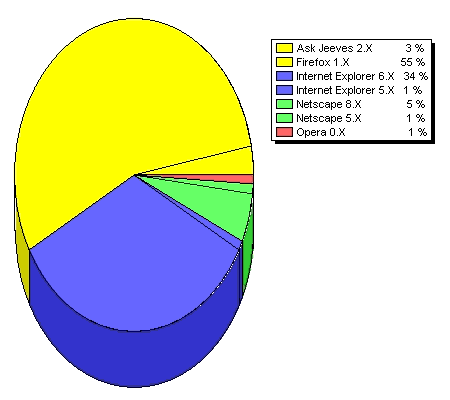
One neat thing about Sitemeter is that it gives charts and graphs about incoming traffic. For example, it reports that 55% of hits are from people who use Firefox.

Now, I use Firefox, so this sample is probably skewed somewhat. But it indicates to me that bloggers (and blog readers) have a strong preference for the upstart browser over the mainstream one.

Tuesday, January 10, 2006

Loose Feathers #15

A collection of news and links on birds, birding, and the environment.
  • During the years of the Bush administration, states have been forced to take the lead on environmental reforms while administration blocks national legislation. One state that is taking up the challenge is Minnesota, where Governor Tim Pawlenty has proposed legislation to clean waterways and a referendum to dedicate a fixed percentage of the state revenue for natural resources.
  • A Christmas Bird Count in Green Bay, Wisconsin, is reporting its second-highest species count in the last thirteen years.
  • A couple in Wisconsin reports that a male ruffed grouse has a strange fascination with their ATV, to the point of following it around.
  • Blog Arundel reports on violations of land-use rules on the Chesapeake waterfront near Annapolis.
  • Birders continue to visit the Conowingo Dam, despite restricted access. (Thanks, Philip.) Dams and reservoirs are, in fact, great places for birdwatching, especially for finding interesting gulls and waterbirds.
  • Congressman Richard Pombo, who wanted to sell Roosevelt Island to developers, can expect opposition in both the Republican primary and the general election. With a good challenger, there is hope that this term will be Pombo's last.
Non-bird stuff
  • Thanks to Modulator I learned about a Firefox extension called Performancing, which is a blogging application. I like the user interface overall, and I like the fact that I can write a long post without Blogger losing it before it's published. The downside is that it appears not to have an easy way to upload images, so I still need to do this through the Blogger editor. It is very useful for writing these linkage posts.

Listing Mania

I have just created two posts on this blog to track my bird sightings for 2006. They are:

I backdated both posts to midnight on January 1 so that they would not gum up the main page. Both are long because they contain more or less the full species list for the District of Columbia in tabular form. Both are linked from the sidebar, in their own box right under the "About Me" box.

By the way, creating and formatting a table in Blogger is a real pain. Unfortunately this blog software does not have a table function, so they must be coded (at least in part) by hand. The other nasty surprise is that there will be a large amount of white space unless you delete every line break in your table code, leaving code that is virtually unreadable. I can see now why some serious bloggers become eager to find better blogging software.

Monday, January 09, 2006

Sightings Wrap-up for 2005

Many birders do not keep track of what they have seen, and some even look down upon listing, especially competitive listing or "twitching." I, however, do keep a life list and lists for various localities. Here are the numbers from 2005.

  • Species seen in DC in 2005: 143
  • Overall DC list: 181
I saw fewer species in DC in 2005 than I did in 2004, when I saw 172. However, I did add six new species to my DC list: snow goose, willow flycatcher, yellow-breasted chat, barred owl, bay-breasted warbler, and northern harrier.

Species seen in states outside DC in 2005
  • New Jersey: 166
  • Maryland: 127
  • Delaware: 112
Top six birding locations for 2005
  • National Arboretum, DC: 106
  • Kenilworth Park and Aquatic Gardens, DC: 89
  • Bombay Hook NWR, DE: 85
  • Sandy Hook, NJ: 78
  • Great Swamp NWR, NJ: 78
  • Rock Creek Park, DC: 67
It is no surprise to see the arboretum at the top of this list, since it is my bread-and-butter birding location. Out-of-state locations move up the list quickly because one or two trips there at the right times can yield high species counts, while the local spots require a bit more diligence and regular visitation.