Tuesday, March 14, 2006

Loose Feathers #31

News and links about birds, birding, and the environment.

  • New Jersey hosted a record 194 wintering bald eagles this year, according to a statewide Midwinter Bald Eagle Survey.
  • Parker River NWR is looking for volunteer plover wardens to look after the refuge's population of endangered piping plovers. To learn more about that kind of work, read the past posts from The Plover Warden Diaries.
  • Three dozen dead snow geese were recently dumped in a playground in Columbia, MD. Investigators from the Department of Natural Resources decided that there was nothing for them to prosecute.
  • The Fatal Light Awareness Program (FLAP) is exhibiting birds killed from flying into skyscrapers during migration. The display is in the Royal Ontario Museum.
  • New Jersey is taking monk parakeets off the state's list of dangerous species.
  • A study of the end of the last Ice Age indicates that, with future global warming, Greenland's ice sheet is likely to disappear while Antarctica's may increase temporarily. A 1-2 foot increase in sea levels is likely within the next century, and 25 feet in the centuries beyond that.
  • You can get the latest news on the Fifth Avenue red-tailed hawks at PaleMale.com.
  • Hurricane Katrina altered or destroyed vital habitat for migrating songbirds along the Gulf Coast. Birders there worry about the effects this will have on birds.
Upcoming Field Trip
  • This Sunday, the DC Audubon Society is running its annual field trip to Hughes Hollow, part of a WMA that mixes impoundments, marsh, and woodlands. See the DCAS webpage for more information and directions.

Monday, March 13, 2006

Birds of the Mid-Atlantic #2: American Woodcock

Many bird species have already begun moving north. It may not be immediately apparent to the casual observer, but if you start to look closely you may see some species declining in numbers and others increasing compared to a few weeks ago. One distinctive species that is on the move right now is the American Woodcock.

The American Woodcock belongs to the order Charadriiformes, commonly known as shorebirds. Woodcocks can be easily separated from most other shorebirds by its long bill, short neck and legs, and plump body. The one other shorebird that has a similar shape is the Wilson's Snipe. Unlike snipe, which have white bellies that contrast sharply with heavily streaked breasts, woodcocks have buffy bellies and breasts without significant striping. Woodcocks walk with a bouncing gait as they probe the ground for earthworms.

Photo by Richard Baetsen / USFWS

Both woodcocks and snipe can be difficult to spot because of their cryptic feather patterns. You can walk right past one, or even run your binoculars right over one, without seeing it. If you are lucky, the bird will flush and give you a glimpse of itself. If you are really lucky, the bird will sit out in the open. My one sighting of a woodcock was highly unusual for such encounters. That particular woodcock did not seem to mind a dozen or so people looking at it intently with binoculars.

The best way to observe woodcocks is during their mating rituals. The show starts at dusk in open fields in spring and summer. Male woodcocks will first give a series of buzzy nasal peent calls and then fly high in the air, tracing a fluttering spiral down to the ground while twittering. The twittering sounds associated with this flight are a combination of chirping calls, given vocally, and fluttering sounds made by certain feathers on its wings.

Certain places are known as display grounds for woodcocks on a yearly basis. Near Washington, DC, the fields around Hughes Hollow and Sycamore Landing Road in Montgomery County, MD; and Huntley Meadows in Fairfax County, VA, have reputations as good places to observe the woodcock mating rituals. To find display grounds in your own area, consult local birding guides or email listserves.

See here for sounds and video of this species. This site (scroll down) also has recordings of a woodcock display.

Crossposted at Blue Ridge Gazette.

Birds on the Mall

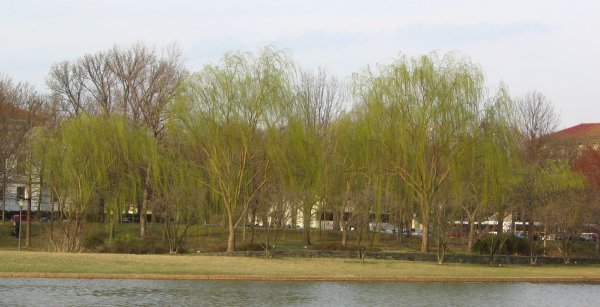
This evening I walked around the west end of the Mall for an hour or two. I started out to see if anything was new at Constitution Gardens. It turned out that only the common birds were there: large flocks of American robins, dark-eyed juncos, common grackles, red-winged blackbirds, and European starlings. The lake has been refilled, so the mallards and ring-billed gulls are back. A northern flicker called repeatedly from high in a tree. The gardens here have a reputation as a migrant trap, so the site bears frequent visitation.

As I walked, I could see small flocks of double-crested cormorants flying high overhead as they followed the course of the Potomac northwest. Later, when I rounded back along the river, there were few birds on it. A small flock of lesser scaup has returned to the Tidal Basin, along with the usual gull species.

This first-year ring-billed gull let out a big yawn as I took its picture. It needs to learn better manners.

DC Environmental Film Festival

The 14th Annual DC Environmental Film Festival is upon us. The festival begins this Thursday, March 16, and runs through Sunday, March 26. It highlights films that show the beauty of the natural world and that push for greater environmental responsibility.

Among its many other offerings, the festival offers two films of local interest:
  • The Anacostia: Restoring the People's River is about the clean-up and revitalization of DC's "other" river, including the improvement of storm drains and habitat restoration. There are two viewings: March 17 at 12 noon at the National Museum of Natural History, and March 25 at 11 am at the Anacostia Museum Center for African American History and Culture.
  • On the Edge: The Potomac River's Dyke Marsh looks at this important preserve located just outside the Beltway and threats to its well-being. One viewing: March 21 at 7 pm at the Kennedy Center.

Sunday, March 12, 2006

Early Migrants at the National Arboretum

When I arrived at the Arboretum this morning and was greeted immediately by the calls and songs of common grackles, red-winged blackbirds, song sparrows, and northern mockingbirds, I knew that it was going to be a good day. A little while later, when I heard and then saw a great skein of tundra swans high overhead - numbering about 250 to 300 - I knew that it was going to be a great day for birding.

It seems that the southerly winds pushed through a load of migrants overnight. Flocks of sparrows were in numbers not seen for quite some time. On Beechwood Road there were several fox sparrows mixed with a flock of song sparrows and white-throated sparrows. In the same area, field sparrows were singing from the shrubs. I flushed a red-tailed hawk in the same area, and it flew away carrying a limp squirrel in its talons.

Pine warblers sang both on Hickey Hill and in the state tree grove. At the latter location, I managed to find the singer and watch it perform. It would cock its head back and sing, and then poke its bill under a flake of bark to pull out a grub of some sort. And then it would repeat the process, sometimes singing several times before probing again. It was fairly active, but not nearly as much as the frenetic ruby-crowned kinglet in the same pine.

Eastern phoebes must have made a major push this weekend as well. I had been seeing one fairly regularly throughout the winter, but today there were at least a dozen, spread all over the arboretum. Many of them were singing, making this the first time I have heard their song this year.

The red-headed woodpecker was near its usual spot, but this time in a tree across the road from the columns parking lot. I suspected it moved around a bit, but this was the first time I saw it anywhere but on the snags. It gave some great looks, too, and called a bit before I was distracted by a pair of red-tailed hawks wheeling about and screaming overhead. With the red-headed, I came within a hairy of a seven-woodpecker day.

A few other birds I saw included a yellow-rumped warbler near the Bonsai building a yellow-bellied sapsucker at the Asian Gardens, hooded mergansers in Beech Spring Pond, wood ducks in flight over the Anacostia, a winter wren calling on the other side of the river, and a brown creeper along the river trail. Red-breasted nuthatches were again on Hickey Hill, as was a hermit thrush. Eastern towhees were warming up their songs after a fall and winter of disuse.

Finally, I heard an eastern screech owl at the Arboretum today. It was just the type of day when one might hear an owl - overcast enough to give a crepuscular feeling even at mid-morning. It was giving its 'pinging' call rather than the 'scream' that gives the species its name. Even though the owl called repeatedly over a short period, I was unable to triangulate the sound well enough to spot it. (Read more about screech owls at Owlpages.)

SPECIES SEEN: 49

Tundra Swan
Canada Goose
Wood Duck
Mallard
Hooded Merganser
Sharp-shinned Hawk
Red-shouldered Hawk
Red-tailed Hawk
Ring-billed Gull
American Herring Gull
Rock Pigeon
Mourning Dove
Eastern Screech-Owl
Red-headed Woodpecker
Red-bellied Woodpecker
Yellow-bellied Sapsucker
Downy Woodpecker
Northern Flicker
Pileated Woodpecker
Eastern Phoebe
Golden-crowned Kinglet
Ruby-crowned Kinglet
Carolina Wren
Winter Wren
Northern Mockingbird
Eastern Bluebird
Hermit Thrush
American Robin
Carolina Chickadee
Tufted Titmouse
Red-breasted Nuthatch
White-breasted Nuthatch
Brown Creeper
Blue Jay
American Crow
Fish Crow
European Starling
American Goldfinch
Yellow-rumped Warbler
Pine Warbler
Eastern Towhee
Field Sparrow
Fox Sparrow
Song Sparrow
White-throated Sparrow
Dark-eyed Junco
Northern Cardinal
Red-winged Blackbird
Common Grackle

BUTTERFLIES: 4

Cabbage White
Clouded Sulphur
Eastern Comma
Mourning Cloak