Monday, July 14, 2008

Fireflies

I conducted my first successful Firefly Watch earlier tonight. By "successful," I mean that my watch was accompanied by fireflies, and not just by mosquitos. There were a lot of fireflies, too. In the 10-second interval, I counted about 20 flashes. An hour makes a big difference.

This is a fairly easy project to carry out, as it requires only ten minutes of observation time per week, plus a minimal amount of time to enter the data. So, give it a try.

Bridge Demolition

Birders planning to visit Sandy Hook should be aware that half of the Route 36 bridge will be nonexistent.

The state Department of Transportation is replacing the 75-year-old 35-foot tall
drawbridge with a 65-foot tall fixed span bridge. The J. H. Reid Construction Company of South Plainfield was awarded the $1.24 million project in December. The company began the three-year project in February.

The demolition of the southbound side of the bridge will take about two weeks, Bruce Hilling, the borough administrator said on Friday.

As of 6 a.m. today, motorist traveling across the Shrewsbury River via the bridge
were diverted to the northbound lanes. For the next 2• years, there will be one lane in each direction on the bridge.
This bridge was "structurally deficient," as the Department of Transportation would put it, and needed replacement. In the meantime, it will become much harder to visit Sandy Hook. I think summer beach traffic would rule out birding visits, at least from the west.

Evolution of the Wood Warblers

Ever since I started birding, I have especially delighted in the birds of the family Parulidae, the North American wood warblers. So it should not be surprising that this blog has one of its genera as its domain namesake, or that I write about them frequently, or that I use one species as my mascot. It is with good reason: these jewels of North American woodlands provide a prime example of avian diversity. The genus Dendroica, in particular, includes (at least) twenty-seven species with a multitude of plumages and specialized adaptations.

This remarkable diversity evolved in a short burst soon after the genus Dendroica split from its ancestral lineage. Most species in the genus emerged within its first million years, and then the rate of diversification slowed down considerably. One explanation for this is that rapid diversification occurs when new ecological opportunities open. As the available niches fill, increased competition from existing species makes it harder for new species to appear.

The authors of the linked paper devised a mathematical model to test that explanation against other possible causes for a decline in speciation rates. An extensive DNA analysis for all continental members of the genus established both the order in which new species appeared and how quickly they did so. (See their new phylogenetic tree below.) The timeline established via DNA analysis supported the idea that the diversification rate for Dendroica warblers spiked quickly and then dropped due to niches being filled.

Phylogenetic tree of Dendroica wood warblersFigure 1: Maximum clade credibility (MCC) tree from Bayesian analysis of all continental North American Dendroica wood warbler species. Nodes marked with asterisks are supported by posterior probabilities of more than 0.95. Tree is based on more than 9kb of mtDNA and nuclear intron sequence. Branch lengths are proportional to absolute time. (Source: Proceedings of the Royal Society B, DOI: 10.1098/rspb.2008.0630)


This paper builds on an earlier finding that the Dendroica lineage arose in the late Miocene or early Pliocene, roughly five million years ago. That transition was accompanied by climate change. As the North American climate became hotter and drier, extensive woodlands fragmented into smaller patches. This change in the landscape may have given wood warblers their opportunity to diversify. Later in the Pliocene, the climate and landscape became more like the present, and those changes may have sparked the secondary burst of speciation.

As an aside, it is interesting that the oldest species in Dendroica – Kirtland's warbler (D. kirtlandii) – is also one of the most endangered species in the genus. (It is probably just a coincidence, since the genus's other endangered species – golden-cheeked warbler (D. chrysoparia) – is among the newest.) Modern humans, by contrast, appeared relatively recently and first entered North America even more recently. Millions of years before humans ever set foot on this continent, these tiny birds were winging their way between their summer and winter territories. That is an amazing thought to keep in mind when fall migration comes again.


Source: Daniel L. Rabosky and Irby J. Lovette, "Density-dependent diversification in North American wood warblers," Proceedings of the Royal Society B, published online (July 8, 2008). doi: 10.1098/rspb.2008.0630

Sunday, July 13, 2008

DC News: Planning a New Downtown

Last week, the National Capital Planning Commission released a plan for improving the downtown areas surrounding the National Mall. It focuses on four sections. They are the Federal Triangle (bounded by Pennsylvania Ave, Constitution Ave, and 15th Street NW), the Northwest Rectangle (the area between the White House and the Kennedy Center), the Southwest Rectangle (south of the Mall, between the Capitol and the Tidal Basin), and East Potomac Park (a good winter birding spot).


All of these areas are crying out for revitalization. Many of the downtown areas can feel cold and desolate outside of business hours, when the massive federal government buildings stand empty. When I first moved there ten years ago, it took a lot of trial and error to learn to avoid certain parts of the Federal Triangle – especially anything in the vicinity of the Reagan Building – because there are frequently long stretches without any public space. Here is how the NCPC characterizes the area (pdf):

The north side of Pennsylvania Avenue now enjoys a lively mix of commercial, retail, residential, and cultural activities, while the south side appears lifeless. The connecting streets between Pennsylvania and Constitution Avenues are typically deserted outside of office hours and are dominated by government buildings that are closed to the public. Attractive interior courtyards are used for parking and loading operations or closed off for security reasons.

On the north side of Pennsylvania Avenue, the FBI’s operation and security requirements have prevented street-level public uses along the entire block. Security installations and the building’s unornamented International Style architecture exacerbate a fortress-like presence. Across the street, revitalization of the Old Post Office (OPO) building and adjacent glass pavilion has not achieved its potential.

Throughout the precinct, poorly landscaped building yards and the absence of a clear way-finding system, create a monotonous public realm. The parks, plazas, and commemorative spaces along Pennsylvania Avenue are showing their age, and the precinct's nationally significant art and architecture are inadequately showcased.
It is good that the planners recognize such problems and are suggesting steps to remedy them. Their solutions emphasize making a more pedestrian-friendly environment by breaking up some barriers to circulation and improving public spaces like the Freedom Plaza. They also suggest adding more museums and sidewalk cafes along Pennsylvania Avenue and 10th Street NW to give more people a reason to go there, even on weekends.

The plan also offers some interesting ideas for East Potomac Park (pdf). Among other things, it suggests cutting a canal through the northern end of the park and building several vehicle and pedestrian bridges across Washington Channel south of the dock area to increase access to the park. It also would add a Metro stop on the Yellow Line near Jefferson Memorial. It is not clear how the proposals for East Potomac Park would affect it as a birding spot. Birds like loons and grebes might be less likely to come up Washington Channel, but other than that I do not think it would make much difference, except that it would be more accessible.

I like where the NCPC seems to be going with their framework plan. How successful it is will depend on implementation. There are a lot of obstacles such as security concerns at federal offices and whether there will be funding to redesign all of the spaces. I hope that at least some of these proposals will be implemented. It would improve the downtown for both residents and visitors.

*****
On a sour note, a country club has formed a "grassroots" campaign to oppose the Purple Line. (For those not familiar with the DC area, the Purple Line is a proposed light rail route that would connect Bethesda with New Carrollton, thus reducing strain on Metro's Red Line and traffic in the Maryland suburbs.) Their main complaint so far seems to be that the line would run through the country club, though they gripe about taxes too.

At least the streetcar plan seems to be trundling along.

Saturday, July 12, 2008

Are Hummingbirds in Decline This Year?

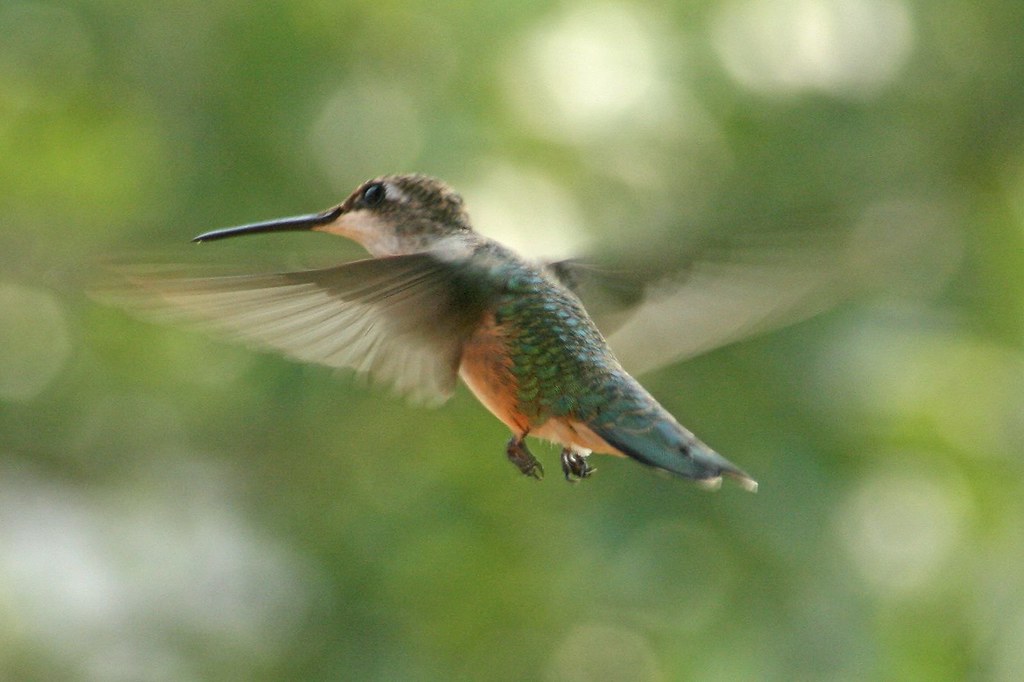
Airborne originally uploaded by c-eight

A couple days ago, Birdchick posted an email she received that asked about the status of ruby-throated hummingbirds. Apparently a lot of people have noticed declines in the number of ruby-throated hummingbirds coming to their feeders. I have received queries about this myself, both last year and this year, and it has been a frequent topic on discussion boards and email lists that deal with hummingbirds. The discussion that I have seen so far, though, has been mostly anecdotal; I would prefer to see it backed up with some data.

One easily-accessible source of distribution information is eBird, which allows users to break down sightings for a species by year. I downloaded the line graph data for ruby-throated hummingbirds during breeding seasons from 2004-2008 and created my own line graphs with Google Docs. The data covers the entire United States. (I would have liked to use a smaller area, but I could either pick the whole country or an individual state.)

The first graph is for frequency, the percentage of checklists from the breeding season (i.e., June-July) on which ruby-throated hummingbirds were reported. Each point on the graph represents a single week. Ignore the flatline near the end of line for 2008; those weeks have not happened yet.

The second graph is for abundance, the average number of birds reported on all checklists from the breeding season, including checklists that do not report the species. Again, ignore the dip at the very end of the line for 2008.

My read of the eBird statistics is that ruby-throated hummingbirds are being reported about as frequently but that birders have been seeing fewer individuals during 2007 and 2008. That might indicate a population decline. Conceivably it could result instead from a range shift or delayed start to the breeding season. In any case, the effect seems to be a small one, and the species does not appear to be undergoing a sudden population crash or catastrophic decline.

With a volunteer source like eBird, there may be some inconsistency in reporting at work in the results. It would be interesting to see whether the same result holds in data sources with more standarized protocols, like the Breeding Bird Survey (BBS) or banding stations. However, as one commenter on Birdchick's post noted, even some of these sources might underreport hummingbirds. BBS picks up mostly singing birds during short point counts, and not all bird banders are trained to band hummingbirds.

Any ideas for a better source on the hummingbird population?


Related posts:
Stokes Birding Blog also has a roundup of recent information on the hummingbird population.